Researchers Investigate Early Solar System
August 14, 2006
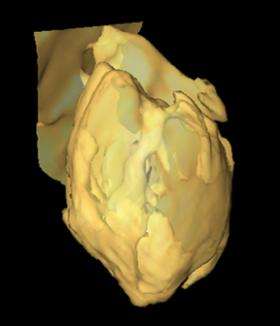
A 3-D tomographic reconstruction of a ~90-nm wide polyhedral serpentine grain from the Mighei CM carbonaceous chondrite meteorite. The surface of the tomogram is made semitransparent to visualize the interior. At the core is an elongated structure that extends the length of the grain. When viewed in axial orientation this structure is hollow from one end to the other, indicating that it is tubular. The tomogram was reconstructed from 120 bright-field images acquired over a tilt range of +/- 60 degrees.
Scientists at the Naval Research Laboratory are part of an international research team that is studying minerals formed during the early history of the solar system.
Their goal is to learn more about the chemical and physical processes that occurred during the formation of the solar system. Their research was published in the May 2006 issue of Meteoritics and Planetary Science where a figure from the paper was selected as the cover image.
The researchers studied serpentine minerals in a group of primitive meteorites called CM carbonaceous chondrites. The CM carbonaceous chondrites formed over 4.5 billion years ago in the solar nebula, the cloud of gas and dust from which our sun and planets formed.
Using a transmission electron microscope (TEM), the researchers imaged the three-dimensional structure of the serpentines and analyzed their compositions. A TEM is capable of imaging the atomic structure of a material, and the research team needed its resolving power to analyze the serpentines, which are small, on the order of 90 nanometers.
Serpentines form by chemical reaction of anhydrous silicates (minerals that do not contain hydrogen) and water. The research team's findings reveal that the formation of these minerals occurred under oxygen-rich conditions, and suggest that the parent asteroids of the meteorites contained active hydrothermal systems that were capable of driving chemical reactions. Such reactions were likely similar to those that occur on Earth, but transpired over 4.5 billion years ago in space.
Thomas Zega, who is the lead author on the paper, and Rhonda Stroud are researchers in NRL's Materials Science and Technology Division. The research team also includes members from Arizona State University, Eötvös L. University in Budapest, Hungary, and Utrecht University in The Netherlands.
Source: Naval Research Laboratory
-
Elements of ExoPlanets
Feb 02, 2012 |
4.9 / 5 (8) |
0
-
Durable NASA rover beginning ninth year of Mars work
Jan 25, 2012 |
4.8 / 5 (4) |
1
-
Quasicrystal is extraterrestrial in origin
Jan 13, 2012 |
4.6 / 5 (37) |
7
-
Research team suggests rock found in Russia an extraterrestrial quasicrystal
Jan 04, 2012 |
4.8 / 5 (15) |
4
-
Space mountain produces terrestrial meteorites
Jan 02, 2012 |
4.2 / 5 (13) |
7
-
Engineers build first sub-10-nm carbon nanotube transistor
Feb 01, 2012 |
4.9 / 5 (31) |
30
-
Something old, something new: Evolution and the structural divergence of duplicate genes
Jan 31, 2012 |
4.6 / 5 (7) |
1
-
The hidden nanoworld of ice crystals: Revealing the dynamic behavior of quasi-liquid layers
Jan 30, 2012 |
5 / 5 (3) |
1
-
Stock market network reveals investor clustering
Jan 27, 2012 |
3.9 / 5 (23) |
8
-
Of microchemistry and molecules: Electronic microfluidic device synthesizes biocompatible probes
Jan 26, 2012 |
5 / 5 (1) |
0
-
Doubts about surface plasmons
Feb 11, 2012
-
excited U-236 decay time in the U235 fission chain
Feb 09, 2012
-
Polar catastrophe?
Feb 09, 2012
-
Large scale field sonication
Feb 09, 2012
-
states and energy of paired electrons in BCS
Feb 08, 2012
-
difference between longitudinal and transverse refractive indices
Feb 08, 2012
- More from Physics Forums - Atomic, Solid State, Comp. Physics
More news stories
Explained: Sigma
It's a question that arises with virtually every major new finding in science or medicine: What makes a result reliable enough to be taken seriously? The answer has to do with statistical significance -- but ...
Feb 09, 2012 |
5 / 5 (19) |
66
Quantum physicist explains $100K offer for proof scaled-up quantum computing is impossible
(PhysOrg.com) -- MIT researcher Scott Aaronson has certainly riled the physics community with his offer this past Friday, of $100,000 to anyone who can prove that scaled-up quantum computing is impossible. ...
Diamond light, brighter than the sun
Its the size of five football pitches and generates light 10 billion times brighter than the sun. As the Diamond Light Source celebrates its tenth anniversary this year, Penny Bailey visits one of the ...
Feb 07, 2012 |
4.3 / 5 (7) |
18
|
Physicists 'record' magnetic breakthrough
An international team of scientists has demonstrated a revolutionary new way of magnetic recording which will allow information to be processed hundreds of times faster than by current hard drive technology.
Feb 07, 2012 |
4.5 / 5 (41) |
14
|
Hints of the Higgs - papers are submitted
Back in December 2011, the ATLAS and CMS experiments at CERN presented some exciting results that provided tantalising hints of the Higgs boson.
Feb 08, 2012 |
4.1 / 5 (7) |
10
Latin America mining boom clashes with conservation
Latin America is experiencing a mining boom as prices rise fuelled by a hike in global demand, but the region is also being hit by a wave of violent protests, strikes and rallies by environmentalists.
Love a click away in Indonesia's Twitter Republic
He was a geeky kid from Yogyakarta, she a glamorous city girl in Jakarta. In a country with one of the world's most vibrant social networking scenes they fell in love on Twitter.
Walney offshore wind farm is world's biggest (for now)
(PhysOrg.com) -- The Walney wind farm on the Irish Sea--characterized by high tides, waves and windy weather--officially opened this week. The farm is treated in the press as a very big deal as the Walney ...
GPS court ruling leaves US phone tracking unclear
A US Supreme Court decision requiring a warrant to place a GPS device on the car of a criminal suspect leaves unresolved the bigger issue of police tracking using mobile phones, legal experts say.
Europeans protest controversial Internet pact
Tens of thousands of people marched in protests in more than a dozen European cities Saturday against a controversial anti-online piracy pact that critics say could curtail Internet freedom.
Europe stakes billion-dollar bet on new rocket
A pencil-slim rocket is scheduled to lift into space from South America on Monday, carrying a billion-dollar bet that Europe can grab a juicy slice of the market to place satellites in low orbit.