Large and small stars in harmonious coexistence
August 15th, 2006 Large and small stars in harmonious coexistence

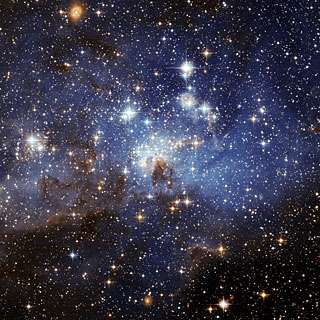
The latest photo from the Hubble Space Telescope, presented at the 2006 General Assembly of the International Astronomical Union in Prague this week, shows a star forming region in the Large Magellanic Cloud (LMC). This sharp image reveals a large number of low-mass infant stars coexisting with young massive stars.

This is a Hubble Space Telescope image of one of the hundreds of star-forming stellar systems, called stellar associations, located 180,000 light-years away in the Large Magellanic Cloud (LMC). The LMC is the second closest known satellite galaxy of our Milky Way, orbiting it roughly every 1.5 billion years. Earlier ground-based observations of such systems had only allowed astronomers to study the bright blue giant stars in these systems, and not the low-mass stars.

This new, most detailed view to date of the star-forming association LH 95 was taken with Hubble's Advanced Camera for Surveys and provides a extraordinarily rich sample of newly formed low-mass stars, allowing a more accurate calculation of their ages and masses. An international team of astronomers, led by Dimitrios Gouliermis of the Max-Planck Institute for Astronomy (MPIA) in Heidelberg, is currently studying the Hubble data. According to Dr. Gouliermis "Hubble's sharp vision has over the years dramatically changed the picture that we had for stellar associations in the Magellanic Clouds". The LMC is a galaxy with relatively small amounts of elements heavier than hydrogen, giving astronomers an insight into star-formation in environments different from our Milky Way.

Once massive stars – those with at least 3 times the mass of the Sun - have formed, they generate strong stellar winds and high levels of ultraviolet radiation that ionize the surrounding interstellar gas. The result is a nebula of glowing hydrogen that will expand out into the molecular cloud that originally collapsed to form these stars. The blue haze seen throughout the image around LH 95 is actually part of this bright nebula, known as DEM L 252.

Some dense parts of this star-forming region have not been completely eroded by the stellar winds and can still be seen as dark dusty filaments in the picture. Such dust lanes absorb parts of the blue light from the stars behind them, making them appear redder. Other parts of the molecular cloud have already contracted to turn into glowing groups of infant stars, the fainter of which have a high tendency to cluster. The new Hubble view of LH 95 shows that there are at least two small compact clusters associated with such groups, one to the right, above the centre of the picture and one to the far left. These stellar nurseries host hundreds of newly discovered infant low-mass stars. Such stars have also been found by Hubble in the main part of LH 95 amongst its massive bright stellar members.

This deep image also reveals a variety of distant galaxies, seen as reddish spirals and elliptical galaxies decorating the background of LH 95.

The Large and Small Magellanic Clouds can be seen by the naked eye in the southern hemisphere.

Source: Hubble Information Centre, Image credit: NASA, ESA and D. A. Gouliermis (MPIA)


print this article email this article download pdf blog this article bookmark this article     Digg this Stumble it share on Facebook share on Reddit add to delicious save to Yahoo! bookmarks
4.5/5 after 11 votes


August 15th, 2006 all stories
Space & Earth / Astronomy

Comments: 0
Rank: 4.5/5 after 11 votes

  • Stumble this up

  • Digg this

  • Share it:
  • share on Facebook
  • share on MySpace
  • share on Slashdot
  • rss-newsfeed
  • share on Google
  • share on Reddit
  • add to delicious
  • save to Yahoo! bookmarks
  • share on Windows Live
  • Add to Mixx!
Rating: 4.5/5 after 11 votes

  • Related Stories

  • Astronomers discover pair of solar systems in the making
    created Jul 01, 2009 | popularity not rated yet | comments 0
  • Red giant star Betelgeuse is mysteriously shrinking
    created Jun 10, 2009 | popularity not rated yet | comments 0
  • Stellar Explosion Displays Massive Carbon Footprint
    created Jun 01, 2009 | popularity not rated yet | comments 0
  • Astronauts to undertake fourth walk to repair Hubble telescope
    created May 17, 2009 | popularity not rated yet | comments 0
  • Far UV detector is part of new instrument to be installed on Hubble
    created May 07, 2009 | popularity not rated yet | comments 0

Tags


  • Physicists Demonstrate Quantum Memory with Matter Qubits
    Physicists Demonstrate Quantum Memory with Matter Qubits
    Physics / General Physics
    created Jul 03, 2009 | popularity 4.4 / 5 (17) | comments 1
  • 'Holey' Nanosheets for Wastewater Dye Removal
    Nanotechnology / Nanomaterials
    created Jul 01, 2009 | popularity 5 / 5 (5) | comments 1
  • Jellyfish Robot Swims Like its Biological Counterpart
    Jellyfish Robot Swims Like its Biological Counterpart
    Electronics / Robotics
    created Jun 26, 2009 | popularity 4.4 / 5 (8) | comments 1
  • Could Maxwell's Demon Exist in Nanoscale Systems?
    Could Maxwell's Demon Exist in Nanoscale Systems?
    Physics / General Physics
    created Jun 24, 2009 | popularity 4.4 / 5 (18) | comments 29
  • Living Safely with Robots, Beyond Asimov's Laws
    Living Safely with Robots, Beyond Asimov's Laws
    Electronics / Robotics
    created Jun 22, 2009 | popularity 4.6 / 5 (54) | comments 40
  • Other News

    Space Station Marathon

    Space Station Marathon

    Space & Earth / Space Exploration

    created 31 minutes ago | popularity not rated yet | comments 0

    The International Space Station (ISS) is about to make a remarkable series of flybys over the United States. Beginning this 4th of July weekend, the station will appear once, twice, and sometimes three times ...


    Proba-2's journey to Russia marks its first step towards space

    Proba-2's journey to Russia marks its first step towards space

    Space & Earth / Space Exploration

    created 41 minutes ago | popularity not rated yet | comments 0

    (PhysOrg.com) -- Proba-2, one of the smallest satellites ESA has ever built for space, is about to leave its Belgian homeland. Its development and testing complete, the satellite is being packed up for the ...


    Researchers test new 'space Internet' system on International Space Station

    Researchers test new 'space Internet' system on International Space Station

    Space & Earth / Space Exploration

    created 1hour ago | popularity not rated yet | comments 0

    The University of Colorado at Boulder is working with NASA to develop a new communications technology now being tested on the International Space Station, which will extend Earth's Internet into outer space ...


    China environmental phenomena monitored from space

    Space & Earth / Earth Sciences

    created 4 hours ago | popularity not rated yet | comments 0

    China is in a very seismically active area and has had many catastrophic earthquakes during its history. A joint European-Chinese team is using satellite radar data to monitor ground deformation across major continental faults ...


    California to require sun-blocking car windows

    Space & Earth / Environment

    created 6 hours ago | popularity 2 / 5 (4) | comments 8

    New cars sold in California must include windshields that block or absorb the sun's rays beginning in 2012, the state's Air Resources Board recently ruled.