Spitzer Reveals New Wonders in the Familiar Orion Nebula
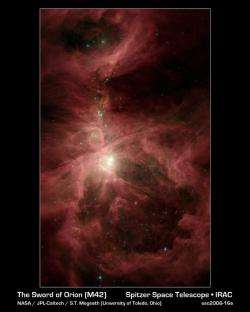
The Orion nebula is one of the most famous and easily viewed deep-sky sights. Located in the sword of Orion the Hunter, this distant cloud of gas and dust holds hundreds of young stars. At its center, a cluster of four bright, massive stars known as the Trapezium bathes the entire 30 light-year-wide nebula with powerful radiation, lighting the surrounding gas. Even a modest telescope reveals billowing ripples of matter gleaming eerily across the vastness of space.
A new image taken by the Infrared Array Camera (IRAC) aboard NASA's Spitzer Space Telescope shows the Orion nebula in a new light. The striking color-coded picture reveals pinkish swirls of dust speckled with stars-some of which are orbited by disks of planet-forming dust.
"When I first got a look at the image, I was immediately struck by the intricate structure in the nebulosity, and in particular, the billowing clouds of the gigantic ring extending from the Orion Nebula," said Tom Megeath of the University of Toledo, Ohio, who spearheaded the research while on the staff of the Harvard-Smithsonian Center for Astrophysics.
Located about 1,450 light-years from Earth, the Orion nebula holds special significance for researchers as the nearest region of massive star formation and the nearest populous cluster of very young stars.
"Most stars form in crowded environments like Orion, so if we want to understand how stars form, we need to understand the Orion nebula star cluster," explained Lori Allen of the Harvard-Smithsonian Center for Astrophysics (CfA). Allen is working with Megeath on a long-term, multiwavelength study of Orion using a variety of ground- and space-based observatories.
Approximately 10,000 IRAC exposures were combined to create the full image of the Orion cloud complex-the collection of interstellar gas clouds that includes the Orion nebula.
Spitzer unearthed nearly 2,300 planet-forming disks in the Orion cloud complex. The disks are too small and distant to be resolved by most visible-light telescopes; however, Spitzer easily detects the infrared glow of their warm dust. Each disk has the potential to form planets and its own solar system.
Source: Harvard-Smithsonian Center for Astrophysics


