Current desires distort children's choices about the future
When it comes to predicting what they want in the future, even a crystal ball probably wouldn't help preschool children figure out what they might want tomorrow. Psychologists looking at the largely unknown world of how children perceive the future have found that the youngsters' choices are warped when they are caught up in a primal desire such as thirst.
The researchers, headed by Cristina Atance, a University of Ottawa assistant professor of psychology, used pretzels to induce thirst in 3-to-5-year-olds. Then they asked one group of these children whether they wanted pretzels or water right now and asked a second group if they would want pretzels or water for tomorrow. Another group of youngsters was not fed pretzels and, when asked to make these same choices for now or for tomorrow, expressed a strong preference for pretzels over water. This was in stark contrast to the first two first groups of children who almost unanimously said they wanted water both for now and for tomorrow. The findings, published in the current issue of the journal Psychological Science, show the extent to which young children's current desires can impact their choices for the future.
"The popular idea is that children are rooted in the here and now," said Atance, "but little research to date has directly explored this claim. On the basis of this study, I think we can conclude that in some instances, at least, this claim is accurate.
Co-author Andrew Meltzoff, co-director of the University of Washington's Institute for Learning and Brain Sciences and the Job and Gertrud Tamaki Chair in psychology, said, "We think of anticipating the future as being one of the most distinctively human traits. We don't only live in the present. It is characteristic of human beings that we engage in mental time-travel. We have present and future selves. Sometimes the needs and desires of the present self conflict with those of the future self."
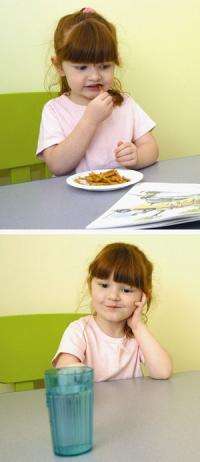
Atance said the study echoes well-known experiments that showed hungry adults bought more food at the grocery store than those who ate before shopping. The new study looked at thirst instead of hunger. For it, 48 children -- 16 three-year-olds, 16 four-year-olds and 16 five-year-olds -- were recruited. Equal numbers of boys and girls participated.
The children were randomly divided into four groups. In two intervention groups, the children were individually seated at a table and given 36 pretzel sticks and encouraged to eat as many as they wanted while an experimenter read to them for 12 minutes. Afterward, they were asked questions that tested their comprehension about "tomorrow." Then the intervention was divided. Twelve of the children were told to pretend that they were going to come back tomorrow and play a game with marbles and were asked what they would like with the game, pretzels or water. In the other intervention, the children were shown the marbles, told they were going to play with them now and asked if they wanted pretzels or water.
Children in the other two groups went through the same procedure except they were not given pretzels to eat during the reading period. Twenty of these 24 youngsters said they wanted pretzels and their choices did not differ when asked about now versus tomorrow. The results were the exact opposite in the intervention group with 20 of the children asking for water, including 11 of 12 who were questioned about what they preferred tomorrow.
There was no improvement in the children's ability to distinguish what they wanted now and tomorrow by age, even though the 4- and 5-year-olds had a better concept of the different times than did the 3-year olds.
Atance said the practical application of the research is that it can help parents and teachers better interpret young children's behavior and understand how difficult it is for children to think about the future.
"For instance, we often see children object when mom asks them to put on their coat in a warm house before going outside into the cold, or when she tells them to bring water to the park when they are not yet hot and thirsty," she said. "Although we may think that the child is simply being disobedient, it may be that they don't understand that they might be cold or thirsty later."
"Knowing about the future is something that is important in adult life," added Meltzoff. "All of education is built on the idea that learning things will be good for you and you will know more in the future. Young children almost have a mental inability to plan accurately for the future when they are in the strong grip of desire. Young children see their future selves through a present veil that is distorted by their current self. As adults we have tricks, experience, friends and spouses to help us focus on the future. Children don't have those capacities or resources."
Atance and Meltzoff plan to continue this line of research with older children and hope to pin-point when children develop the ability to distinguish between present and future desires.
Source: University of Washington


