Mathematicians maximize knowledge of minimal surfaces
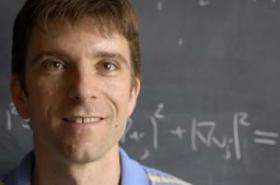
For most people, soap bubbles are little more than ethereal, ephemeral childhood amusements, or a bit of kitsch associated with the Lawrence Welk Show. But for Johns Hopkins University mathematician William Minicozzi, the translucent film that automatically arranges itself into the least possible surface area on the bubble wand is an elegant and captivating illustration of a mathematical concept called "minimal surfaces." A minimal surface is one with the smallest surface area that can span a boundary.
Mathematicians have studied basic minimal surfaces for more than 250 years, and long ago understood their basic building blocks and how those fundamentals fit together to form a figure with the least surface area and high surface tension.
Little to nothing was known, however, about the characteristics of myriad other, more complicated minimal surfaces until Minicozzi and Massachusetts Institute of Technology colleague Tobias H. Colding broke another "minimal surface code," revealing that pieces of planes, catenoids and helicoids are the building blocks of all minimal surfaces, and not merely the less complicated ones.
Their article ("Shapes of embedded minimal surfaces") appeared in the July 25 issue of the Proceedings of the National Academy of Sciences.
"In its simplest form, we just wanted to figure out the possible shapes of minimal surfaces where certain boundaries (surface area and curvature) are not restricted, and this is what we found out," said Minicozzi, the J.J. Sylvester Professor of Mathematics at Johns Hopkins' Krieger School of Arts and Sciences. "What we've concluded is that no matter how complicated minimal surfaces can be – and they can be very complicated, indeed! – they are all built out of pieces that we completely understand."
As an illustration, Minicozzi suggests thinking about children playing with building blocks: give them three blocks, and the figures that they can construct are rather limited. But give them "billions of blocks and, well, all bets are off, because the possibilities are endless. It's sometimes hard to imagine that big, complex structures are built from the same, basic blocks as are the simpler shapes."
Mathematicians' fascination with minimal surfaces dates back more than two centuries, to famous experiments conducted by Belgian physicist Joseph Antoine Ferdinand Plateau. Dipping a wire bent into various shapes into a vat of soapy water, the scientist created a wide variety of minimal surfaces and concluded that every closed boundary curve that neither touches itself nor intersects with itself can be spanned by a minimal surface.
Minicozzi and Colding began by thinking about these original experiments, and quickly moved on to consider many other minimal surfaces, such as those that exist in nature.
"For instance, we wondered why DNA is like a double spiral staircase," Minicozzi said. "'What' and 'Why' are fundamental questions that, when answered, help us to better understand the world we live in. And we knew that the answer to any question about the shape of natural objects was bound to involve mathematics."
Chalk in hand, the researchers spent years thinking, in particular, about helicoids and trying to understand why the double spiral staircase -- DNA, for example -- was an efficient shape. They had a hunch that the answer would provide an important piece of the puzzle for understanding all minimal surfaces. Even so, Minicozzi and Colding were caught off guard when they viewed a computer animation of the minimal surfaces constructed more than a century ago by a mathematician named Riemann.
"They were built out of helicoids!" Minicozzi said. "This confirmed for us the centrality of our work and opened up the way for other, new applications.
"After this," he said, "we knew that we would be able to show that every minimal surface was built from those pieces. This way of describing very complicated minimal surfaces unlocked many of the secrets of these surfaces, leading to breakthroughs by us and by other mathematicians on problems that were previously daunting and unapproachable."
Though it may seem that such work is of interest only to theoretical mathematicians, Minicozzi begs to differ.
"Minimal surfaces come up in a lot of different physical problems, some more or less practical, but scientists have recently realized that they are extremely useful in nanotechnology," he said. "They say that nanotechnology is the next Industrial Revolution and that it has the potential to alter many aspects of our lives, from how we are treated for illness to how we fulfill our energy needs and beyond. That's why increasing numbers of material scientists and mathematicians are discovering minimal surfaces."
Source: Johns Hopkins University


