Building a Ship Outside a Shipyard
August 15, 2006
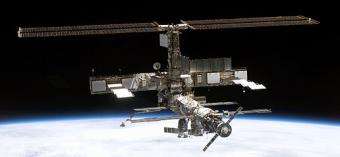
Backdropped by the blackness of space and Earth’s horizon, this full view of the International Space Station was photographed by a crew member onboard the Space Shuttle Discovery in August 2005. Image credit: NASA
It’s not your typical shipbuilder’s site. In fact, it’s not your typical ship. There are no outfitting piers or full-service bulkheads. No sights of yellow hard hats or sounds of beeping trucks with back-up alarms. However, men and women are at work, harder now than ever before.
Construction of the world’s largest ship sailing the skies, rather than the seas, at more than 5 miles per second is under way. The International Space Station began with the launch of the Zarya control module in November 1998. Since then, the massive structure in the sky has grown into an unprecedented construction site.
“It’s like building a ship in the middle of the ocean from the keel up,” said Mike Suffredini, NASA station program manager. “You’ve got to float and you’ve got to sail. All this has to occur while you’re actually building the ship, and that’s what station is like.”
With the remaining shuttle missions, NASA will embark on a series of flights as difficult as any in history to complete the space station.
"The flights ahead will be the most complex and challenging we've ever carried out for construction of the International Space Station in orbit," Suffredini said. "The station literally becomes a new spacecraft with each assembly mission, and that will be true starting this year with dramatic changes in its cooling and power systems, habitable volume, utilization capability as well as its appearance."
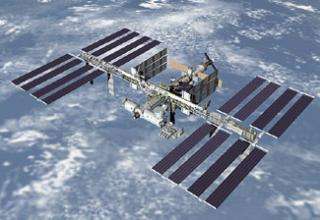
Computer-generated scene showing a high-angle wide view (port-forward) of the International Space Station, after assembly work is completed. Image credit: NASA
The station is nearly halfway through assembly. The next four flights will bring new truss segments, massive structural support beams, to the complex. The new segments will increase the mass of the station by almost 40 tons, the maximum weight of an 18-wheeled semi-truck.Two of the trusses include huge sets of solar array wings, totaling more than 17,000 square feet. With a wingspan area the size of a national standard hockey rink, the panels will carry 130,000 solar cells. The new segments include giant rotary joints to allow the tips of the station "backbone" to move as the massive panels track the sun.
Together, the new arrays will add 50 kilowatts of power for the complex, enough electricity for a small housing community. The increased electrical power will set the stage for the addition of European and Japanese laboratories that will far surpass any previous research capability in space.
The installation of the new truss segments and unfurling of the arrays require unprecedented robotic operations. Those operations will use the shuttle and station's Canadian-built mechanical arms to delicately maneuver school bus-sized station components into place.
The operations will rely heavily on the station's mobile transporter, a sort of space railway that positions the robotic arm along the truss to install the components.
Later this year, the station and shuttle crews face a unique challenge to activate a permanent cooling system and the new power sources.
They must rewire the orbiting laboratory and change its electrical supplies without interrupting the continuous operation of any of its critical systems. Once the power grid is in place, additional shuttle flights will launch a connecting node and the European and Japanese laboratories.
"The assembly of the station on these flights has no parallel in space history," Suffredini said. "We have planned, studied and trained for these missions for years. We know they will be hard, and we may encounter the unexpected. But we are eager to get started, and there is tremendous excitement building in NASA and among our international partners."
The station's assembly and maintenance in orbit, the long-duration spaceflight experience gained aboard the complex, and the research into the effects of long spaceflights contribute to NASA's plans for future missions to return to the moon and travel beyond.
Source: NASA, by Amiko Nevills
-
Europe's ATV space ferry set for launch to Space Station
Feb 09, 2012 |
4 / 5 (2) |
1
-
Russia sets its sights on the moon for 2020
Feb 07, 2012 |
5 / 5 (4) |
5
-
Precision space maneuvers
Feb 01, 2012 |
not rated yet |
0
-
NASA hopes to test new spaceship in 2014
Jan 30, 2012 |
4.4 / 5 (11) |
15
-
Gingrich vows to establish a colony on the moon (Update)
Jan 26, 2012 |
4.4 / 5 (7) |
5
-
Engineers build first sub-10-nm carbon nanotube transistor
Feb 01, 2012 |
4.9 / 5 (31) |
30
-
Something old, something new: Evolution and the structural divergence of duplicate genes
Jan 31, 2012 |
4.6 / 5 (7) |
1
-
The hidden nanoworld of ice crystals: Revealing the dynamic behavior of quasi-liquid layers
Jan 30, 2012 |
5 / 5 (3) |
1
-
Stock market network reveals investor clustering
Jan 27, 2012 |
3.9 / 5 (23) |
8
-
Of microchemistry and molecules: Electronic microfluidic device synthesizes biocompatible probes
Jan 26, 2012 |
5 / 5 (1) |
0
-
Never ending outer space.....
1 hour ago
-
Neutron Star fragments?
3 hours ago
-
stationary or not?
7 hours ago
-
Scale of the Universe
Feb 10, 2012
-
Titan's lack of impact craters
Feb 09, 2012
-
Real pictures of black hole eating a star?
Feb 08, 2012
- More from Physics Forums - General Astronomy
More news stories
Europe stakes billion-dollar bet on new rocket
A pencil-slim rocket is scheduled to lift into space from South America on Monday, carrying a billion-dollar bet that Europe can grab a juicy slice of the market to place satellites in low orbit.
Space & Earth / Space Exploration
13 hours ago |
3.5 / 5 (2) |
0
Political leaders play key role in how worried Americans are by climate change: study
More than extreme weather events and the work of scientists, it is national political leaders who influence how much Americans worry about the threat of climate change, new research finds.
Feb 06, 2012 |
5 / 5 (6) |
72
NASA budget will axe Mars deal with Europe: scientists
US President Barack Obama's budget proposal to be submitted next week for 2013 will cut NASA's budget by 20 percent and eliminate a major partnership with Europe on Mars exploration, scientists said Thursday.
Space & Earth / Space Exploration
Feb 10, 2012 |
5 / 5 (3) |
47
Humans may have helped the decline of African rainforests 3000 years ago
(PhysOrg.com) -- Large areas of rainforests in Central Africa mysteriously disappeared over three thousand years ago, to be replaced by savannas. The prevailing theory has been that the cause was a change ...
Could Venus be shifting gear?
(PhysOrg.com) -- ESAs Venus Express spacecraft has discovered that our cloud-covered neighbour spins a little slower than previously measured. Peering through the dense atmosphere in the infrared, the ...
Space & Earth / Space Exploration
Feb 10, 2012 |
5 / 5 (8) |
10
|
Walney offshore wind farm is world's biggest (for now)
(PhysOrg.com) -- The Walney wind farm on the Irish Sea--characterized by high tides, waves and windy weather--officially opened this week. The farm is treated in the press as a very big deal as the Walney ...
GPS court ruling leaves US phone tracking unclear
A US Supreme Court decision requiring a warrant to place a GPS device on the car of a criminal suspect leaves unresolved the bigger issue of police tracking using mobile phones, legal experts say.
Europeans protest controversial Internet pact
Tens of thousands of people marched in protests in more than a dozen European cities Saturday against a controversial anti-online piracy pact that critics say could curtail Internet freedom.
Study finds that anti-diabetic medication can prevent the long-term effects of maternal obesity
In a study to be presented today at the Society for Maternal-Fetal Medicine's annual meeting, The Pregnancy Meeting, in Dallas, Texas, researchers will report findings that show that short therapy with the anti-diabetic medication ...
Netflix settlement trims 14 pct off 4Q earnings
(AP) -- Netflix pressed the rewind button on its fourth-quarter earnings after settling allegations that the video subscription service violated a consumer-privacy law.
Steroid injections prove effective in treatment of lumbar disc herniations
The use of epidural steroid injections may be a more efficient treatment option for lumbar disc herniations, according to research presented today at the American Orthopaedic Society for Sports Medicine's Specialty Day in ...