A Microscopic Solution to an Enormous Problem
August 15, 2006
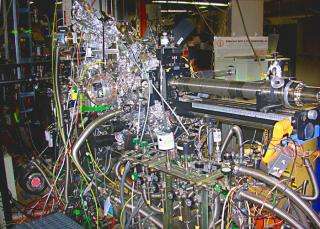
The experimental device at beamline 5-2, where Schiros and colleagues conduct much of their research, contains a suite of instrumentation that scientists use to study chemical processes on the atomic scale.
Hydrogen—the most plentiful element in the Universe—could potentially meet much of the world's demand for energy while reducing or eliminating our dependence on carbon-based fuels. The promise of carbon-free energy has researchers hunting for better ways of isolating this plentiful element, but for all its abundance, hydrogen has proved prohibitively tricky to produce. One answer may lie in sunlight. By directly applying the sun's energy to water within a special solar cell, scientists are inching closer to making usable hydrogen.
"It's a materials issue," said SSRL researcher Theanne Schiros. "Hydrogen doesn't exist freely in nature, but with the right materials we can isolate it from other compounds."
Solar electrolysis converts sunlight into electricity to split water molecules, but until recently solar water splitting devices have proved woefully inefficient. Traditional solar panels, called photovoltaic cells, can be used to generate clean electricity. But this kind of solar cell by itself is impractical for producing hydrogen because an extra step is needed to deliver the electricity generated to the electrolyte.
Direct electrolysis of water is different. Using a photoelectrochemical (PEC) cell, sunlight strikes a special catalyst submerged in the electrolyte itself—in this case, water—eliminating the extra step of transporting the electricity to where it does the work. PEC cells may one day serve as the backbone of a national hydrogen production program. But despite record-breaking achievements in efficiency, the best cells developed so far work for only 240 hours before corroding to a halt. To meet Department of Energy goals for this technology, these cells must work for at least 10,000 hours.
Exactly why these solar cells corrode so quickly is the question researchers at SLAC are now addressing, thanks in part to the efforts of Schiros, a PhD student conducting dissertation research at SSRL. Schiros and colleagues, under the guidance of Stanford Professor Anders Nilsson, are using soft x-rays to look directly into these PEC cells and observe the electrical and chemical reactions occurring at the edge of where water and semiconductor meet. By tracking the corrosion of the semiconductor surfaces on the atomic level, Schiros's work could lead to longer lasting PEC cells.
"We've shown in the lab that we can efficiently produce hydrogen," said Schiros, "but we're a long way from making cells that are stable long enough to meet DOE goals. But by finding the right materials, we will be one step closer to a clean energy infrastructure fueled by a renewable source of hydrogen."
The main obstacle confronting researchers developing PEC cells lies in finding semiconductors that can handle direct exposure to water while converting sunlight to electricity. An unfortunate irony of Nature is that these two properties are largely mutually exclusive—semiconductors stable in water do not efficiently convert sunlight into electricity, and semiconductors that are good solar absorbers corrode easily in water. Scientists have overcome this paradox to some degree by sandwiching various semiconductors with the right properties together. But finding the right combination is tricky.
Despite these obstacles, Schiros and colleagues believe PEC cells hold enormous promise for the efficient production of hydrogen.
"We don't yet know exactly why the reaction dies," said Schiros. "But the photon sciences are well suited to tackle this problem—to understand the fundamental mechanism of photo corrosion."
Source: by Brad Plummer, SLAC Today, Stanford Linear Accelerator Center
-
Elements of ExoPlanets
Feb 02, 2012 |
4.9 / 5 (8) |
0
-
Looks like we’re still looking for earthly life forms on other planets
Feb 02, 2012 |
not rated yet |
1
-
From cancer research to energy storage, Berkeley Lab scientist takes on big challenges
Jan 30, 2012 |
5 / 5 (1) |
0
-
Comparing energy conversion of plants and solar cells
Jan 16, 2012 |
2.3 / 5 (3) |
3
-
Stockholm techies use water to charge mobile phones
Jan 12, 2012 |
4.2 / 5 (21) |
18
-
Engineers build first sub-10-nm carbon nanotube transistor
Feb 01, 2012 |
4.9 / 5 (31) |
30
-
Something old, something new: Evolution and the structural divergence of duplicate genes
Jan 31, 2012 |
4.6 / 5 (7) |
1
-
The hidden nanoworld of ice crystals: Revealing the dynamic behavior of quasi-liquid layers
Jan 30, 2012 |
5 / 5 (3) |
1
-
Stock market network reveals investor clustering
Jan 27, 2012 |
3.9 / 5 (23) |
8
-
Of microchemistry and molecules: Electronic microfluidic device synthesizes biocompatible probes
Jan 26, 2012 |
5 / 5 (1) |
0
-
Kinetic energy of gas
2 hours ago
-
Understanding induced emfs
4 hours ago
-
What is the precise definition of a year?
5 hours ago
-
Universe as a cellular automaton
6 hours ago
-
Question about Newton's laws
7 hours ago
-
Gravity Question (I think) with mass and speed
9 hours ago
- More from Physics Forums - General Physics
More news stories
Explained: Sigma
It's a question that arises with virtually every major new finding in science or medicine: What makes a result reliable enough to be taken seriously? The answer has to do with statistical significance -- but ...
Feb 09, 2012 |
5 / 5 (19) |
66
Quantum physicist explains $100K offer for proof scaled-up quantum computing is impossible
(PhysOrg.com) -- MIT researcher Scott Aaronson has certainly riled the physics community with his offer this past Friday, of $100,000 to anyone who can prove that scaled-up quantum computing is impossible. ...
Diamond light, brighter than the sun
Its the size of five football pitches and generates light 10 billion times brighter than the sun. As the Diamond Light Source celebrates its tenth anniversary this year, Penny Bailey visits one of the ...
Feb 07, 2012 |
4.3 / 5 (7) |
15
|
Physicists 'record' magnetic breakthrough
An international team of scientists has demonstrated a revolutionary new way of magnetic recording which will allow information to be processed hundreds of times faster than by current hard drive technology.
Feb 07, 2012 |
4.5 / 5 (41) |
14
|
Hints of the Higgs - papers are submitted
Back in December 2011, the ATLAS and CMS experiments at CERN presented some exciting results that provided tantalising hints of the Higgs boson.
Feb 08, 2012 |
4.1 / 5 (7) |
10
Walney offshore wind farm is world's biggest (for now)
(PhysOrg.com) -- The Walney wind farm on the Irish Sea--characterized by high tides, waves and windy weather--officially opened this week. The farm is treated in the press as a very big deal as the Walney ...
GPS court ruling leaves US phone tracking unclear
A US Supreme Court decision requiring a warrant to place a GPS device on the car of a criminal suspect leaves unresolved the bigger issue of police tracking using mobile phones, legal experts say.
Europeans protest controversial Internet pact
Tens of thousands of people marched in protests in more than a dozen European cities Saturday against a controversial anti-online piracy pact that critics say could curtail Internet freedom.
Europe stakes billion-dollar bet on new rocket
A pencil-slim rocket is scheduled to lift into space from South America on Monday, carrying a billion-dollar bet that Europe can grab a juicy slice of the market to place satellites in low orbit.
Study finds that anti-diabetic medication can prevent the long-term effects of maternal obesity
In a study to be presented today at the Society for Maternal-Fetal Medicine's annual meeting, The Pregnancy Meeting, in Dallas, Texas, researchers will report findings that show that short therapy with the anti-diabetic medication ...
Netflix settlement trims 14 pct off 4Q earnings
(AP) -- Netflix pressed the rewind button on its fourth-quarter earnings after settling allegations that the video subscription service violated a consumer-privacy law.