Completed genome set to transform the cow
The ability of scientists to improve health and disease management of cattle and enhance the nutritional value of beef and dairy products has received a major boost with the release this week of the most complete sequence of the cow genome ever assembled.
Developed by an international consortium of research organisations, including CSIRO and AgResearch New Zealand, the new bovine sequence contains 2.9 billion DNA base pairs and incorporates one-third more data than earlier versions.
Differences in just one of these base pairs (known as single nucleotide polymorphisms or SNPs) can affect the functioning of a gene and mean the difference between a highly productive and a poorly performing animal. Over two million of these SNPs, which are genetic signposts or markers, were identified as part of the project.
“We can use this data to identify those genes that are involved in important functions like lactation, reproduction, muscling, growth rate and disease resistance”Australia’s representative on the US $53 million Bovine Genome Sequencing Project, CSIRO’s Dr Ross Tellam, says the new map marks the end of the sequencing phase of the project, with the focus now on analysing the available data.
“This is very valuable information,” Dr Tellam says. “We could potentially achieve as much improvement in cattle breeding and production in 50 years as we have over the last 8000 years of traditional farming.”
Cattle geneticists will use the bovine genome as a template to highlight genetic variation within and between cattle breeds, and between cattle and other mammal species.
The head of bioinformatics research at CSIRO Livestock Industries, Dr Brian Dalrymple, says the new data is very valuable because it provides researchers with a more complete picture of the genes in a cow and how variations in the DNA code influence desirable production traits.
“We can use this data to identify those genes that are involved in important functions like lactation, reproduction, muscling, growth rate and disease resistance,” Dr Dalrymple says.
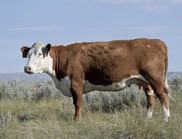
The Hereford breed was selected for the bulk of the sequencing project, which began in December 2003. Holstein, Angus, Jersey, Limousin, Norwegian Red and Brahman animals were also sequenced to detect specific genetic differences between breeds.
“This is just the beginning of a revolution in the way we produce our animals and food,” Dr Dalrymple says. “Once we have a complete set of genes that influence tenderness, for example, we will be able to predict that animals of a certain type, fed a particular type of pasture or grain, will consistently produce meat of a particular standard of tenderness and marbling.”
He says, despite the centuries of inbreeding involved in developing different cattle breeds, most maintain a “surprisingly large” degree of genetic diversity.
Contributors to the US$53 million international effort to sequence the genome of the cow (Bos taurus) include: the National Human Genome Research Institute (NHGRI), which is part of the National Institutes of Health (NIH); the U.S. Department of Agriculture's Agricultural Research Service and Cooperative State Research, Education, and Extension Service; the state of Texas; Genome Canada via Genome British Columbia, The Commonwealth Scientific and Industrial Research Organization of Australia; Agritech Investments Ltd., Dairy InSight, Inc, AgResearch Ltd; the Kleberg Foundation; and the National, Texas and South Dakota Beef Check-off Funds.
The data can be accessed via a number of public databases including: the Baylor College of Medicine Human Genome Sequencing Center (www.hgsc.bcm.tmc.edu); GenBank (www.ncbi.nih.gov/Genbank) at NIH's National Center for Biotechnology Information; EMBL Bank (www.ebi.ac.uk/embl/index.html) at the European Molecular Biology Laboratory's Nucleotide Sequence Database; and, the DNA Data Bank of Japan (www.ddbj.nig.ac.jp).
Source: CSIRO


