Radical 'Ballistic Computing' Chip Bounces Electrons Around Like Billiards
Computer designers at the University of Rochester are going ballistic. "Everyone has been trying to make better transistors by modifying current designs, but what we really need is the next paradigm," says Quentin Diduck, a graduate student at the University who thought up the radical new design. "We've gone from the relay, to the tube, to semiconductor physics. Now we're taking the next step on the evolutionary track."
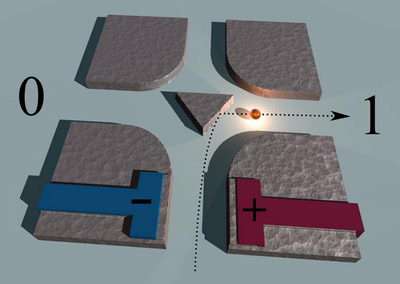
That next step goes by the imposing name of "Ballistic Deflection Transistor," and it's as far from traditional transistors as tubes. Instead of running electrons through a transistor as if they were a current of water, the ballistic design bounces individual electrons off deflectors as if playing a game of atomic billiards.
Though today's transistor design has many years of viability left, the amount of heat these transistors generate and the electrical "leaks" in their ultra-thin barriers have already begun to limit their speed. Research groups around the world are investigating strange new designs to generate ways of computing at speeds unthinkable with today's chips. Some of these groups are working on similar single-electron transistors, but these designs still compute by starting and stopping the flow of electrons just like conventional designs. But the Ballistic Deflection Transistor adds a new twist by bouncing the electrons into their chosen trajectories—using inertia to redirect for "free," instead of wrestling the electrons into place with brute energy.
Such a chip would use very little power, create very little heat, be highly resistant to "noise" inherent in electronic systems, and should be easy to manufacture with current technologies. All that would make it incredibly fast. The National Science Foundation is so impressed with the idea that it just granted the University of Rochester team $1.1 million to develop a prototype.
"We've assembled a unique team to take on this chip," says Marc Feldman, professor of computer engineering at the University. "In addition to myself and Quentin, we have a theoretical physicist, a circuit designer, and an expert in computer architecture. We're not just designing a new transistor, but a new archetype as well, and as far as I know, this is the first time an architect has been involved in the actual design of the transistor on which the entire architecture is built."
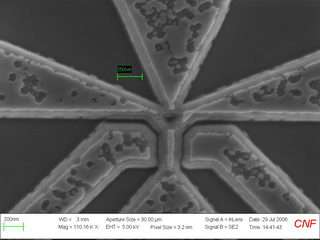
The team has already had some luck in fabricating a prototype. The ballistic transistor is a nano-scale structure, and so all but impossible to engineer just a few years ago. Its very design means that this "large" prototype is already nearly as small as the best conventional transistor designs coming out of Silicon Valley today. Feldman and Diduck are confident that the design will readily scale to much smaller dimensions.
There's one hurdle the team isn't quite as confident about: "We're talking about a chip speed measured in terahertz, a thousand times faster than today's desktop transistors" Diduck says. "We have to figure out how to test it because there's no such thing as a terahertz oscilloscope!"
The Science Behind the Ballistics
The Ballistic Deflection Transistor (BDT) should produce far less heat and run far faster than standard transistors because it does not start and stop the flow of its electrons the way conventional designs do. It resembles a roadway intersection, except in the middle of the intersection sits a triangular block. From the "south" an electron is fired, as it approaches the crossroads, it passes through an electrical field that pushes the electron slightly east or west. When the electron reaches the middle of the intersection, it bounces off one side of the triangle block and is deflected straight along either the east or west roads. In this way, if the electron current travels along the east road, it may be counted as a zero, and as a one if it travels down the west road.
A traditional transistor registers a "one" as a collection of electrons on a capacitor, and a "zero" when those electrons are removed. Moving electrons on and off the capacitor is akin to filling and emptying a bucket of water. The drawback to this method is that it takes time to fill and empty that bucket. That refill time limits the speed of the transistor—the transistors in today's laptops run at perhaps two gigahertz, meaning two billion refills every second. A second drawback is that these transistors produce immense amounts of heat when that energy is emptied.
The BDT design should also be able to resist much of the electrical noise present in all electronic devices because the noise would only be present in the electrical "steering" field, and calculations show the variations of the noise would cancel themselves out as the electron passes through.
The BDT is "ballistic" because it is made from a sheet of semiconductor material called a "2D electron gas," which allows the electrons to travel without hitting impurities, which would impede the transistor's performance.
Source: University of Rochester


