Voyager 1 Hits New Milestone
August 16, 2006 Voyager 1 Hits New Milestone

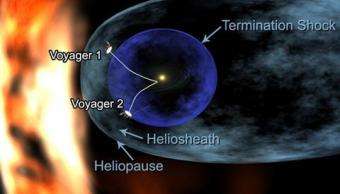
Artist concept of the two Voyager spacecraft as they approach interstellar space. Image credit: NASA/JPL

Voyager 1, already the most distant human-made object in the cosmos, reaches 100 astronomical units from the sun on Tuesday, August 15 at 5:13 p.m. Eastern time (2:13 p.m. Pacific time). That means the spacecraft, which launched nearly three decades ago, will be 100 times more distant from the sun than Earth is.

In more common terms, Voyager 1 will be about 15 billion kilometers (9.3 billion miles) from the sun. Dr. Ed Stone, Voyager project scientist and the former director of NASA's Jet Propulsion Laboratory in Pasadena, Calif., says the Voyager team always predicted that the spacecraft would have enough power to last this long.

"But what you can't predict is that the spacecraft isn't going to wear out or break. Voyager 1 and 2 run 24 hours a day, seven days a week, but they were built to last," Stone said. The spacecraft have really been put to the test during their nearly 30 years of space travel, flying by the outer planets, and enduring such challenges as the harsh radiation environment around Jupiter.

The spacecraft are traveling at a distance where the sun is but a bright point of light and solar energy is not an option for electrical power. The Voyagers owe their longevity to their nuclear power sources, called radioisotope thermoelectric generators, provided by the Department of Energy.

Voyager 1 is now at the outer edge of our solar system, in an area called the heliosheath, the zone where the sun's influence wanes. This region is the outer layer of the 'bubble' surrounding the sun, and no one knows how big this bubble actually is. Voyager 1 is literally venturing into the great unknown and is approaching interstellar space. Traveling at a speed of about one million miles per day, Voyager 1 could cross into interstellar space within the next 10 years.

"Interstellar space is filled with material ejected by explosions of nearby stars," Stone said. "Voyager 1 will be the first human-made object to cross into it."

Voyager Project Manager Ed Massey of JPL says the survival of the two spacecraft is a credit to the robust design of the spacecraft, and to the flight team, which is now down to only 10 people. "But it’s these 10 people who are keeping these spacecraft alive. They're very dedicated. This is sort of a testament to them, that we could get all this done."

Between them, the two Voyagers have explored Jupiter, Uranus, Saturn and Neptune, along with dozens of their moons. In addition, they have been studying the solar wind, the stream of charged particles spewing from the sun at nearly a million miles per hour.

Source: by Jane Platt, JPL NASA


print this article email this article download pdf blog this article bookmark this article     Stumble it Digg this share on Facebook retweet share on Reddit add to delicious
Rate this story - 4.8 /5 (76 votes)


August 16, 2006 all stories

Comments: 0

4.8 /5 (76 votes)
  • Stumble this up

  • Digg this

  • share this

  • hide
  • Related Stories

  • Cassini's Big Sky: The View from the Center of Our Solar System
    created Nov 20, 2009 | popularity not rated yet | comments 0
  • The Stars My Destination
    created Nov 10, 2009 | popularity not rated yet | comments 0
  • Fantastic Voyage
    created Nov 02, 2009 | popularity not rated yet | comments 0
  • Scientists explain mystery of observed turbulent density fluctuations in interplanetary space
    created Oct 28, 2009 | popularity not rated yet | comments 0
  • A long night falls over Saturn's rings
    created Oct 24, 2009 | popularity not rated yet | comments 0


  • hide
  • Relevant PhysicsForums posts

  • dark energy can escape black holes.
    created 3 hours ago
  • Are there green, purple and pink stars?
    created 15 hours ago
  • Sideral question
    created Nov 21, 2009
  • Doppler shifted blackbody spectrum
    created Nov 21, 2009
  • More from Physics Forums - General Astronomy

Other News

Is global warming unstoppable?

Space & Earth / Environment

created 5 hours ago | popularity 3.4 / 5 (10) | comments 9

In a provocative new study, a University of Utah scientist argues that rising carbon dioxide emissions - the major cause of global warming - cannot be stabilized unless the world's economy collapses or society builds the ...


The shore of Deception Island in Antarctica, in 2008

Antarctic ice loss vaster, faster than thought: study

Space & Earth / Earth Sciences

created 20 hours ago | popularity 2.9 / 5 (17) | comments 26

The East Antarctic icesheet, once seen as largely unaffected by global warming, has lost billions of tonnes of ice since 2006 and could boost sea levels in the future, according to a new study.


Astronaut suit problem delays spacewalk No. 3 (AP)

Astronaut suit problem delays spacewalk No. 3

Space & Earth / Space Exploration

created 6 hours ago | popularity not rated yet | comments 0

(AP) -- The third and final spacewalk of space shuttle Atlantis' mission is being held up by a suit problem.


How green is your house? Recycling favorite activity among Brits says new survey

Space & Earth / Environment

created 4 hours ago | popularity not rated yet | comments 3

Seventy percent of households always separate their rubbish for recycling, but only 2 percent buy their energy on a green tariff, according to the early findings of a major new annual household survey, called "Understanding ...


Denmark: 65 world leaders for UN climate summit (AP)

Denmark: 65 world leaders for UN climate summit

Space & Earth / Environment

created 20 hours ago | popularity 2.3 / 5 (3) | comments 2

(AP) -- Sixty-five world leaders have said they will attend the Copenhagen climate summit in December, and several more have responded positively to invitations, Danish officials said Sunday.