Scientists discover secret behind human red blood cell's amazing flexibility
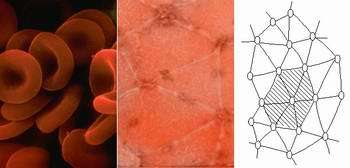
A human red blood cell is a dimpled ballerina, ceaselessly spinning, tumbling, bending, and squeezing through openings narrower than its width to dispense life-giving oxygen to every corner of the body. In a paper published in the October issue of Annals of Biomedical Engineering, which was made available online on Oct. 21, a team of UCSD researchers describe a mathematical model that explains how a mesh-like protein skeleton gives a healthy human red blood cell both its rubbery ability to stretch without breaking, and a potential mechanism to facilitate diffusion of oxygen across its membrane.
Image: The human red blood cell membrane skeleton is a network of roughly 33,000 protein hexagons that looks like a microscopic geodesic dome.
“Red cells are one of the few kinds of cells in the body with no nucleus and only a thin layer of protein skeleton under their membrane: they are living bags of hemoglobin,” said Amy Sung, a professor of bioengineering at UCSD’s Jacobs School of Engineering and coauthor of the study. “Very little is known about how the elements of the membrane skeleton behave when red blood cells deform, and we were amazed at what our simulation revealed.” Scientists have been mystified for years by the human red blood cell membrane skeleton, a network of roughly 33,000 protein hexagons that looks like a microscopic geodesic dome. Unfortunately, neither the architecture of the dome nor the structures of individual proteins that make up the hexagons reveal the details of how the remarkably regular organization actually works.
Sung and her collaborators at the Jacobs School of Engineering focused on what they view is a key component at the center of each hexagon, a rod-shaped protein complex called the proto-filament. The proto-filament is 37 nanometers in length and made of a protein called actin. Elsewhere in the human body, bundles of actin form contractile muscles, and matrices of actin are responsible for the gel-like properties of various cells’ cytoplasm. However, the foreshortened actin fibers in the proto-filaments act as rigid rods held in suspension by six precisely positioned fibers made of the actin-binding protein spectrin.
Robert Skelton, a professor of mechanical and aerospace engineering at the Jacobs School of Engineering and a co-author of the study, employed the unorthodox approach of modeling the proto-filaments as if they were part of a tensegrity structure. Artists have been more familiar with rod-and-cable tensegrity structures than scientists. The most celebrated tensegrity structures may be the rod-and-cable sculptures of R. Buckminster Fuller, the futurist and inventor of the geodesic dome. Sung asked Skelton to collaborate on her red blood cell project because Skelton and his students have pioneered the development of rigorous scientific tools to analyze the movement and balance of forces in many types of tensegrity systems.
“Although we made several assumptions, our model is an important step toward our goal of understanding the molecular basis of cell membrane mechanics,” said Sung.
Sung, Skelton, and post-doctoral fellows Carlos Vera and Frederic Bossens combined mathematical modeling of a proto-filament as a tensegrity structure with a visualization technique that revealed how a single proto-filament moves in response to the pulling force of six spectrin fibers attached to it. Their paper in Annals of Biomedical Engineering uses aeronautical terms commonly used to describe the changing position of an airplane to explain how the six attached spectrin fibers make a proto-filament swivel and flip.
Microscopy studies by other researchers have documented that the yaw of a proto-filament, its left or right position, is near random, whereas the pitch, or upward tilt from the plane of the membrane, is more parallel to the membrane than perpendicular to it. Sung’s team was pleasantly surprised that its model also generated near-random yaw angles for the proto-filament during deformation of the red blood cell and no more than 18 degrees of pitch relative to the membrane in most cases. “Our model is the first to come close to duplicating the 3-D behavior that is observed in nature,” said Skelton.
The modeling suggests that the more a red blood cell is mechanically deformed, the more likely its individual proto-filaments will rotate left and right like a baseball bat swung over home plate. “These back-and-forth sweeping motions would speed up the movement of oxygen from one side of the membrane to the other,” said Sung. “We think this model may explain why the deformations of red blood cells squeezing through narrow capillary openings are so important: the movement of proto-filaments may effectively enhance the diffusion of oxygen from red blood cells deep in tissues and organs where the exchange is most needed.”
The team is planning to broaden its analysis to include the effects of trans-membrane proteins that physically anchor the underlying protein network to the red blood cell membrane. The team also plans to enlarge its simulation to visualize more than one proto-filament at a time, and eventually model the simultaneously movement of all 33,000 proto-filaments in a cell.
“We were amazed that we can actually predict and simulate the behavior of components of the red cell skeleton at the nano-scale and estimate tension forces at the pico-Newton level,” said Sung. “We may also be able to apply our approach to understand what’s happening in the rupture-prone red blood cells of people with hemolytic anemias.”
Source: UCSD


