Artificial muscles may enable more lifelike color displays
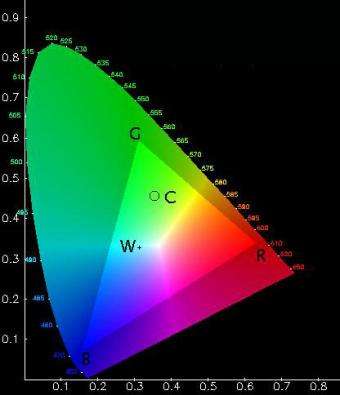
Scientists have unveiled a new technology that could lead to video displays that faithfully reproduce a fuller range of colors than current models, giving such a life-like viewing experience that it could be hard to go back to your old TV. The invention, based on fine-tuning light using microscopic artificial muscles, could turn into competitively priced consumer products in eight years, the scientists say.
The research appears online in Optics Letters, a journal of the Optical Society of America, and will also be published in the September 1 print issue of the journal.
In ordinary displays such as TV tubes, flat-screen LCDs, or plasma screens, each pixel is composed of three light-emitting elements, one for each of the fundamental colors red, green, and blue. For example, shades of orange and yellow are displayed by mixing different amounts of red and green. Unless you look closely, the color elements in a pixel are indistinguishable: the eye sees a single, composite color.
The fundamental colors in each pixel are fixed, and only their amounts can change -- by adjusting the brightness of the color elements -- to create different composite colors. That way, existing displays can reproduce most visible colors -- but not all. For example, current displays do not faithfully reproduce the hues of blue one can see in the sky or in the sea.
"State-of-the-art displays such as LCD displays can only reproduce a limited range of colors because the three mixing colors red, green and blue are determined during the time of production," said Manuel Aschwanden, a nanotechnology expert at the Swiss Federal Institute of Technology (Eidgenössische Technische Hochschule, or ETH) in Zurich, Switzerland. Aschwanden and his colleague Andreas Stemmer figured that one can overcome such limitations by changing the fundamental colors themselves, not just their brightness. To obtain different colors, they used an optical trick called diffraction.
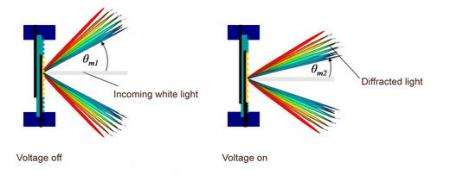
In their setup, white light hits a so-called diffraction grating, a pattern of equally spaced grooves on a surface. Their grating is a rubbery, one-tenth of a millimeter wide membrane, with one side molded into a shape that resembles microscopic pleated window shades. The membrane consists of an "artificial muscle," a polymer that contracts when voltage is applied.
White light contains the full spectrum of colors of the rainbow, which correspond to all wavelengths of light. But when white light hits a diffraction grating, different wavelengths fan out at different angles.
"It's like when you hold a CD in direct sunlight, and you rotate it," Aschwanden said. Like the microscopic tracks on a CD surface, the grooves on the artificial muscle split white light into a rainbow of colors. But instead of rotating the surface to obtain different colors, the ETH team adjusts the light's angle by applying different voltages to the artificial muscle. As the membrane stretches or relaxes, the incoming light "sees" the grooves spaced closer or tighter. All the angles of reflection change, so the entire fan of wavelengths turns as a whole. The desired color can then be isolated by passing the light through a hole: As the hole stays fixed, different parts of the spectrum will hit it and go through it.
To obtain composite colors, every pixel would use two or more diffraction gratings. By this method, a display could produce the full range of colors that the human eye can perceive, Aschwanden said.
Tunable diffraction gratings are routinely used in applications such as fiberoptic telecommunications and video projectors, but existing technologies are based on hard materials rather than artificial muscles, limiting their stretchability to less than a percentage point. By contrast, artificial muscles can change their length by large amounts. Correspondingly, the fan of reflected light will move enough for the part of the beam going through a hole to change from one end of the spectrum to the other.
Getting a full range of colors requires a source of "true" white light to begin with -- rather than a mere combination of red, green and blue that looks like white light to the human eye. For that purpose, the technology could exploit a new generation of white LED lights that have recently been developed, Aschwanden said.
Though Aschwanden and Stemmer have so far just a proof of concept, it demonstrates the feasibility of the technology, Aschwanden said. With enough investment, it could turn into consumer products, perhaps in less than eight years, he said. "Once you have one pixel, it doesn't take too long to develop a new product."
The team is now improving the technology to bring it closer to industrial application. In particular, the artificial muscles described in the Optics Letters paper operated at several thousand volts, while in a consumer product that would have to come closer to the 120 volts of household AC. Since the paper was accepted, the team has already reduced the voltage to 300 volts, and new materials currently being developed could allow voltage to drop further, Aschwanden said.
Paper: "Polymeric, electrically tunable diffraction grating based on artificial muscles," Manuel Aschwanden and Andreas Stemmer, Optics Letters, Vol. 31, Issue 17, pp. 2610-2612. Abstract at ol.osa.org/abstract.cfm?id=96931
Source: Optical Society of America


