Mystery of Quintuplet stars in Milky Way solved
August 17, 2006 Mystery of Quintuplet stars in Milky Way solved

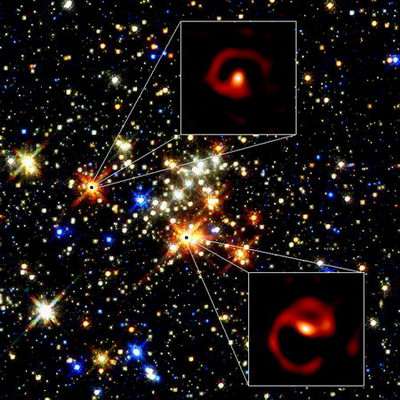
A Yin and Yang in the Galactic Center. High-resolution infrared images of the dusty pinwheel nebulae are shown inset overlaid on a Hubble Space Telescope image of the Quintuplet cluster. Each of the five bright red stars is now thought to be a pinwheel nebula. Credit: Peter Tuthill (Sydney U.), Keck Observatory, Donald Figer (RIT).

For the first time, scientists have identified the cluster of Quintuplet stars in the Milky Way's galactic center, next to the super massive black hole, as massive binary stars nearing the end of their life cycle, solving a mystery that had dogged astronomers for more than 15 years.

The nature of the stars was not entirely clear until now. In a paper published in the Aug. 18 issue of Science, co-authors Peter Tuthill of the University of Sydney and Donald Figer of Rochester Institute of Technology show that the Quintuplet cluster consists of young massive binary stars that produce large amounts of dust. Their data reveal that five bright red stars are nearing the end of their "short" lives of approximately 5 million years. These quickly evolving stars burn fast and bright, but die younger than fainter stars, which live for billions of years. The study captures the Quintuplet stars just before disintegrating in supernovae explosions.

Using advanced imaging techniques on the world's biggest telescope at the W.M. Keck Observatory in Hawaii, the scientists captured the stars at the highest attainable resolution for the instrument, far exceeding the capability of the Hubble Space Telescope, which imaged the cluster a decade ago. The extra-resolution gives scientists a new glimpse of the dust plumes surrounding the stars and the swirling spirals Tuthill likened to pinwheels when he identified the first one in 1999 elsewhere in the galaxy.

"Only a few pinwheels are known in the galaxy," Figer says. "The point is, we've found five all next to each other in the same cluster. No one has seen anything like this before."

According to Figer, the swirling dust in pinwheel stars is key to the presence of the most evolved massive stars and points to the presence of pairs of stars. The geometry of the plume allows scientists to measure the properties of the binary stars, including the orbital period and distance.

"The only way that pinwheels can form is if they have two stars, swirling around each other. The stars are so close that their winds collide, forming dust in a spiral shape, just like water sprayed from a garden hose of a twirling sprinkler," Figer says. "A single star wouldn't be able to produce the dust and wouldn't have the spiral outflow."

An earlier study by Figer in 1996 claimed the Quintuplet cluster consists of evolved massive stars that produce dust. Figer's research could not be confirmed until now with the use of the Keck telescope.

"If you want to understand star formation, you have to understand if they are forming alone or if they have partners," Figer says. "The answer gives us a clue as to whether stars form alone or with companions."

Source: Rochester Institute of Technology


print this article email this article download pdf blog this article bookmark this article     Stumble it Digg this share on Facebook retweet share on Reddit add to delicious
Rate this story - 4.3 /5 (21 votes)


August 17, 2006 all stories

Comments: 0

4.3 /5 (21 votes)
  • Stumble this up

  • Digg this

  • share this

  • hide
  • Related Stories


  • hide
  • Relevant PhysicsForums posts

  • Gravity on Mars
    created 10 hours ago
  • Question about the orbit between Mars and Earth
    created 18 hours ago
  • SIMBAD/NED help
    created 21 hours ago
  • Black hole confusion
    created Nov 14, 2009
  • More from Physics Forums - General Astronomy

Other News

Close-up movie shows hidden details in the birth of super-suns

Close-up movie shows hidden details in the birth of super-suns (w/ Video)

Space & Earth / Astronomy

created 8 hours ago | popularity 4.8 / 5 (4) | comments 0

(PhysOrg.com) -- The constellation of Orion is a hotbed of massive star formation, most prominently in the Great Nebula that sits in Orion's sword. The glowing gas of the Nebula is powered by a group of young ...


NASA 'Drops' Next Generation Robotic Lander During Autonomous Tests

NASA 'Drops' Next Generation Robotic Lander During Autonomous Tests

Space & Earth / Space Exploration

created 5 hours ago | popularity 4.7 / 5 (3) | comments 1

(PhysOrg.com) -- NASA has successfully completed a series of autonomous "drop" tests of a robotic lander test article - in a record 10 months - to demonstrate the ability to perform a controlled landing on ...


Ghostly 'Spokes' Puff Out From Saturn's Ring's

Ghostly 'Spokes' Puff Out From Saturn's Ring's (w/ Video)

Space & Earth / Space Exploration

created 5 hours ago | popularity 5 / 5 (1) | comments 0

(PhysOrg.com) -- Massive, bright clouds of tiny ice particles hover above the darkened rings of Saturn in an image captured by the Cassini spacecraft on Sept. 22, 2009, around the time of Saturn's equinox. ...


Space shuttle Atlantis lifts off on supply mission (AP)

Space shuttle Atlantis lifts off on supply mission

Space & Earth / Space Exploration

created 5 hours ago | popularity 3.5 / 5 (2) | comments 0

(AP) -- With 100 Internet-savvy NASA fans cheering on the shuttle and churning out constant Twitter updates, Atlantis sailed smoothly into orbit Monday with six astronauts and a full load of spare parts for ...


Volatile gas could turn Rwandan lake into a freshwater time bomb

Space & Earth / Earth Sciences

created 7 hours ago | popularity 5 / 5 (2) | comments 3

A dangerous level of carbon dioxide and methane gas haunts Lake Kivu, the freshwater lake system bordering Rwanda and the Republic of Congo.