Molecules spontaneously form honeycomb network featuring pores of unprecedented size
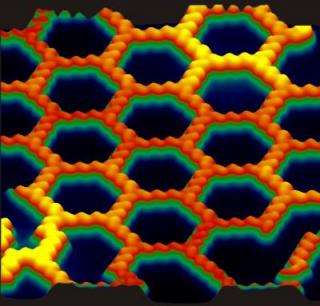
UC Riverside researchers have discovered a new way in which nature creates complex patterns: the assembly of molecules with no guidance from an outside source. Potential applications of the finding are paints, lubricants, medical implants, and processes where surface-patterning at the scale of molecules is desired.
Spreading anthraquinone, a common and inexpensive chemical, on to a flat copper surface, Greg Pawin, a chemistry graduate student working in the laboratory of Ludwig Bartels, associate professor of chemistry, observed the spontaneous formation of a two-dimensional honeycomb network comprised of anthraquinone molecules. (Click here to view animation.)
The finding, reported in the Aug. 18 issue of Science, describes a new mechanism by which complex patterns are generated at the nanoscale – 0.1 to 100 nanometers in size, a nanometer being a billionth of a meter – without any need for expensive processes such as lithography.
"We know that some of the most striking phenomena in nature, like the colors on a butterfly wing, come about by the regular arrangement of atoms and molecules," said Pawin, the first author of the paper. "But what physical and chemical processes guide their arrangement? Anthraquinone showed us how such patterns can form easily and spontaneously."
Over a span of several years, Bartels's research group tested a multitude of molecules for pattern formation at the nanoscale. The group found that, generally, these molecules tended to become lumps, forming uninteresting islands of molecules lying side by side.
Anthraquinone molecules, however, form chains that weave themselves into a sheet of hexagons on the copper surface, forming a network similar to chicken wire. The precise shape of the network is governed by a delicate balance between forces of attraction and repulsion operating on the molecules.
"The honeycomb pattern that the anthraquinone molecules produce is open, meaning it has big pores, or cavities, enclosed by the hexagonal rings," Pawin said. "Such patterns have never been observed before. Rather, the common belief was that they cannot be generated. But anthraquinone shows that we can use chemistry to engineer molecules that self-assemble into structures with pores that are many times larger than the individual molecules themselves. With judicious engineering of the relation between the strength of the attraction and repulsion, we could tailor film patterns and pore sizes almost at will."
Patterning of surfaces is important for many applications. The friction that water or air experience when flowing over a surface crucially depends on the microscopic structure of the surface. Biological cells and tissue grow easily on surfaces of some patterns while rejecting other patterns and completely flat surfaces.
In their research the UCR chemists first cleaned the copper surface, creating an extremely slippery surface. Then they deposited anthraquinone molecules onto it. Next, the surface with the molecules was annealed to spread the molecules. During cool-down to the temperature of liquid nitrogen, the hexagonal pattern emerged.
Pawin also developed a computer model to understand not only why the anthraquinone molecules lined up in rows that ultimately arranged themselves into a honeycomb network, but also how anthraquinone molecules are prevented from taking up space inside the pores.
"The precise pattern anthraquinone forms depends on a delicate balance between the attraction between the anthraquinone molecules and the substrate-mediated forces that ultimately disperse these molecules," said Bartels, a member of UCR's Center for Nanoscale Science and Engineering. "By fine-tuning this balance, it should be possible to produce a wide variety of patterns of different sizes."
In the future, Pawin and Bartels plan on investigating how chemical modifications of anthraquinone can produce novel patterns. "In addition, we would like to form the hexagonal network at higher temperatures and be able to control the size of the hexagons," Pawin said. "We also want to extend our research to include surfaces other than copper and determine if there are molecules similar to anthraquinone that assemble spontaneously into sheets on them."
Besides Pawin and Bartels, Kin L. Wong and Ki-Young Kwon of Bartels's research group participated in the study, which was supported by a grant from the National Science Foundation. Pawin first started working in Bartels's laboratory in 2000 as an undergraduate. This fall, he will be a second-year graduate student at UCR.
Details of the study
Anthraquinone molecules consist of three fused benzene rings with one oxygen atom on each side. An organic compound, anthraquinone is widely used in the pulp industry for turning cellulose from wood into paper. It is also the parent substance of a large class of dyes and pigments. Its chemical formula is C14H8O2.
The pore diameter of the honeycomb network of anthraquinone molecules is about 50 Е. The attractive interaction between the molecules stems from hydrogen bridge bonding, a phenomenon common in nature and fundamental to all life (e.g., by holding DNA helixes together) but which occurs here in a slightly unconventional and novel form. The substrate-meditated repulsive interactions are: (a) expansion of the copper surface because the anthraquinone molecules 'dig' their oxygen 'heels' into it; (b) electrostatic repulsion due to slightly negative charging of the anthraquinone molecules; or (c) a combination thereof.
The UCR study used a scanning tunneling microscope in Bartels's laboratory which can image individual molecules at great precision. An individual anthraquinone molecule appears as an almost rectangular feature with slightly rounded edges. The sides of each hexagon consist of three parallel anthraquinone molecules. The vertices consist of three anthraquinone molecules that form a triangle. Each hexagon encloses more than 200 atoms of the copper substrate.
Source: University of California - Riverside


