Snapdragons take the evolutionary high-road
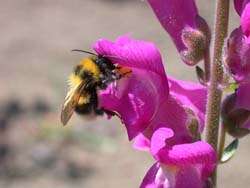
Roses are red, violets are blue, but why aren't snapdragons orange? Norwich scientists from the John Innes Centre (JIC) and the University of East Anglia (UEA) in collaboration with the Université Paul Sabatier (Toulouse, France) have developed a pioneering computer modelling technique that traces the evolutionary paths underlying flower colour variation in the model plant snapdragon (Antirrhinum).
Their research, funded by the BBSRC and published today in the journal Science, shows how flower colour diversity has evolved in natural populations of these plants in the Pyrenees.
In the wild, only the plants with the most attractive flower colours are able to reproduce and thrive because the insects that pollinate them prefer certain colours. The bees that pollinate snapdragon find magenta and yellow flowers the most attractive; they do not find colours such as orange attractive and so flowers of this colour would not flourish in the wild due to lack of pollination. Scientists already know that natural colour variation is controlled by three genes: ROSEA and ELUTA affect the intensity and pattern of the magenta pigment anthocyanin and thirdly SULFUREA affects the distribution of the yellow aurone pigment. The researchers in this study wanted to understand how plants producing magenta or yellow flowers could evolve from a common ancestor without producing in-between non-attractive flower colours such as orange.
"This is a totally different way of looking at evolution and could lead to a better understanding of the rules that govern biodiversity" explains Coen, "If we can comprehend how Antirrhinum genes interact in their natural habitat, it may help us in the future to better preserve genetic diversity".
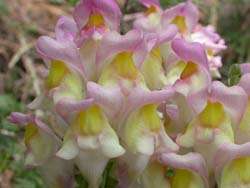
The team led by Enrico Coen (JIC) and Andrew Bangham (UEA) combined molecular, genetic and computational approaches to analyse flower colour variation in natural populations of snapdragon. Using a traditional model, a plot of evolutionary fitness for this study appears to have two peaks: one at the magenta end of the colour spectrum and a second peak at the yellow end, with a trough in the middle representing non-attractive intermediate colours such as orange. As a result, for a plant to evolve from producing magenta flowers to yellow ones it would first have to pass through the trough and produce non-attractive orange flowers before developing yellow ones. However, as Bangham points out, “There are computational methods for understanding and visualising high-dimensional problems that provide new insights”. With these, a more realistic model was created and the researchers discovered that different attributes (phenotypes) that previously appeared as separate peaks in the adaptive landscape, were in fact connected by paths in higher dimensions, forming a U-shaped cloud, with one arm representing magenta connected to the second arm representing yellow. Using this new model, the scientists could trace the evolutionary path that linked these two apparently distinct colour attributes.
"We now understand how these plants can evolve to produce different colours whilst staying attractive to pollinating insects – we've found that colour is variable but constrained to a defined path" states Enrico Coen. But if pollinators prefer certain coloured flowers, why aren't all flowers the same colour? "We still do not know precisely why flower colours should vary in the first place," says Coen, "it could be due to drifting of colours from one to another by accumulation of genetic errors, or alternatively there could be a selective advantage for certain colours in different environments".
The researchers are now applying this new way of modelling evolution to other phenotypes, allowing them to identify how apparently distinct attributes are linked through evolution.
Source: John Innes Centre


