Satellites Will Improve Understanding of the Sun
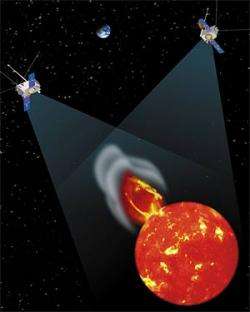
NASA's Solar Terrestrial Relations Observatory mission will dramatically improve understanding of the powerful solar eruptions that can send more than a billion tons of the sun's outer atmosphere hurtling into space.
The STEREO mission comprises two nearly identical spacecraft the size of golf carts, which are scheduled to launch on Aug. 31 aboard a Delta II rocket from Cape Canaveral Air Force Station, Fla. Their observations will enable scientists to construct the first-ever three-dimensional views of the sun. These images will show the sun's stormy environment and its effect on the inner solar system. The data are vital for understanding how the sun creates space weather.
During the two-year mission, the two spacecraft will explore the origin, evolution and interplanetary consequences of coronal mass ejections, some of the most violent explosions in our solar system. When directed at Earth, these billion-ton eruptions can produce spectacular aurora and disrupt satellites, radio communications and power systems. Energetic particles associated with these solar eruptions permeate the entire solar system and may be hazardous to spacecraft and astronauts.
"In terms of space-weather forecasting, we're where weather forecasters were in the 1950s," said Michael Kaiser, STEREO project scientist at NASA's Goddard Space Flight Center in Greenbelt, Md. "They didn't see hurricanes until the rain clouds were right above them. In our case, we can see storms leaving the sun, but we have to make guesses and use models to figure out if and when they will impact Earth."
To obtain their unique stereo view of the sun, the two observatories must be placed in different orbits, where they are offset from each other and Earth. Spacecraft "A" will be in an orbit moving ahead of Earth, and "B" will lag behind, as the planet orbits the sun.
Just as the slight offset between eyes provides depth perception, this placement will allow the STEREO observatories to obtain 3-D images of the sun. The arrangement also allows the spacecraft to take local particle and magnetic field measurements of the solar wind as it flows by the spacecraft.
STEREO is the first NASA mission to use separate lunar swingbys to place two observatories into vastly different orbits around the sun. The observatories will fly in an orbit from a point close to Earth to one that extends just beyond the moon.
Approximately two months after launch, mission operations personnel at the Johns Hopkins University Applied Physics Laboratory, Laurel, Md., will use a close flyby of the moon to modify the orbits. The moon's gravity will be used to direct one observatory to its position trailing Earth. Approximately one month later, the second observatory will be redirected after another lunar swingby to its position ahead of Earth. These maneuvers will enable the spacecraft to take permanent orbits around the sun.
Each STEREO observatory has 16 instruments. The observatories have imaging telescopes and equipment to measure solar wind particles and to perform radio astronomy.
"STEREO is charting new territory for science research and the building of spacecraft. The simultaneous assembly, integration and launch of nearly identical observatories have been an extraordinary challenge," said Nick Chrissotimos, STEREO project manager at Goddard.
The STEREO mission is managed by Goddard. The Applied Physics Laboratory designed and built the spacecraft. The laboratory will maintain command and control of the observatories throughout the mission, while NASA tracks and receives the data, determines the orbit of the satellites, and coordinates the science results.
For more information about STEREO, visit: www.nasa.gov/stereo
Source: NASA


