Turbulent fibers

August 17, 2006 Turbulent fibers

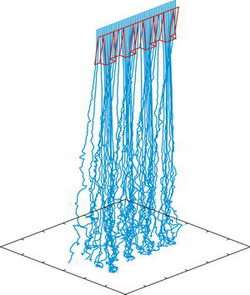
Simulation of the dynamics of a fiber curtain being laid to form a non-woven tissue. © Fraunhofer ITWM

From car interiors to diapers – non-woven tissues are used every-where. Manufacturers are aiming to produce increasingly hard-wearing non-woven tissues from as little plastic as possible. A simulation model has been designed to help optimize the process.

Non-woven tissues are among the everyday items that everyone needs but hardly anyone takes notice of. They hold diapers together, insulate walls and pad out car door linings. The demands they are expected to meet can be very different, depending on where they are used: As an insulation material, the non-woven fabric has to be evenly thick all over, whilst in diapers it needs to be tear-resistant. The manufacturers hope to meet these demands with as little material as possible. Diaper materials are indeed considerably thinner and also tougher today than they were ten years ago. However, optimizing the production of non-woven tissues is harder than it might seem – they are made from delicate plastic fibers created by thousands of tiny nozzles.

These “filaments” are pulled out to their full length by an air flow, then finally – filament by filament – laid down on a kind of conveyer belt. The delicate non-woven sheet is created entirely without weaving or knitting. But there is a problem: The threads flapping in the turbulent air flow are difficult to control.

A team led by Dr. Dietmar Hietel at the Fraunhofer Institute for Industrial Mathematics ITWM in Kaiserslautern is investigating and calculating the turbulent formation of the fiber mats and simulating them on the computer. In addition to developing mathematical models, the Fraunhofer team devised a simulation tool called FIDYST. This makes it possible to simulate fiber movement and density distribution – though only in bright colors. “These colored images are not much use to non-woven tissue specialists. What they need is a realistic depiction of the soft structure of the tissue”, says André Stork of the Fraunhofer Institute for Computer Graphics Research IGD in Darmstadt. He has now developed the simulation software IFX, which further processes the density images and finally portrays the chaotic structure of the tissue in a deceptively real way.

The researchers have thus achieved their ambitious goal of adapting the simulation to create the ideal non-woven material. And the simulation program makes it genuinely possible to control real machinery. In future, the researchers will be collaborating with the machine manufacturer Neumag of Neumünster to optimize non-woven tissue production facilities.

Source: Fraunhofer-Gesellschaft


print this article email this article download pdf blog this article bookmark this article     Stumble it Digg this share on Facebook retweet share on Reddit add to delicious
Rate this story - 4.7 /5 (3 votes)


August 17, 2006 all stories

Comments: 0

4.7 /5 (3 votes)
  • Stumble this up

  • Digg this

  • share this

  • hide
  • Related Stories


  • hide
  • Relevant PhysicsForums posts

  • General Questions About "sizing" Structural Beams.
    created Dec 22, 2009
  • Question about COMSOL and boundary conditions
    created Dec 21, 2009
  • Vacuum Systems
    created Dec 20, 2009
  • non linear curve fitting
    created Dec 20, 2009
  • More from Physics Forums - General Engineering

Other News

Immersive Game System Allows Physical Interaction Between Players

Immersive Game System Allows Physical Interaction Between Players

Technology / Computer Sciences

created 17 hours ago | popularity 4.4 / 5 (12) | comments 3

(PhysOrg.com) -- With a new immersive multiplayer game system, researchers are further blurring the line between gaming and the real world. Using a mouse and keyboard sounds kind of quaint compared to the ...


Glitter-sized solar photovoltaics produce competitive results

Glitter-sized solar photovoltaics produce competitive results

Technology / Energy

created 13 hours ago | popularity 4.5 / 5 (25) | comments 0

Sandia National Laboratories scientists have developed tiny glitter-sized photovoltaic cells that could revolutionize the way solar energy is collected and used.


Microsoft Word

Court bans sale of Word; Microsoft promises fix

Technology / Software

created 12 hours ago | popularity 4.3 / 5 (4) | comments 5

(AP) -- A federal appeals court ordered Microsoft Corp. to stop selling its Word program in January and pay a Canadian software company $290 million for violating a patent, upholding the judgment of a lower ...


Motorized knee can make you run faster

Motorized knee can make you run faster

Technology / Engineering

created 18 hours ago | popularity 4.1 / 5 (8) | comments 3

(PhysOrg.com) -- Scientists at the Tsukuba University in Japan have come up with a motorized knee you can attach to your leg to make you run faster and use less muscle power.


Hardware-accelerated global illumination by image space photon mapping

Technology / Computer Sciences

created 15 hours ago | popularity 5 / 5 (4) | comments 0

Research presented in a paper by Morgan McGuire, assistant professor of computer science at Williams College, and co-author Dr. David Luebke of NVIDIA, introduces a new algorithm to improve computer graphics for video games.