Researchers find gland that tells fruit flies when to stop growing
Many baffled parents have wondered whether their teenagers would ever stop growing. The answer is obvious, but researchers have never really quite understood just how an organism determines when it has reached its optimal size and growth should cease.
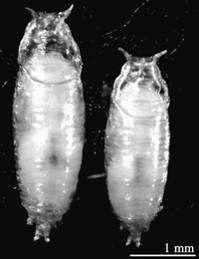
A normal fruit fly in the pupa stage of development (left) lies next to one in which growth has been inhibited by an artificially enlarged prothoracic gland. Photo credit: Christen Mirth
Now University of Washington biologists studying the physiology of Drosophila melanogaster, the common fruit fly, have discovered an organ that assesses the size of the juvenile and signals when it has reached a critical weight to begin metamorphosis into an adult.
The team, led by postdoctoral researcher Christen Mirth, found that the prothoracic gland, a major endocrine organ situated just in front of the brain, assesses the fly's size as it grows during the larval stage. The gland then sends hormonal signals when it senses the fly has reached a size appropriate to enter adulthood.
The scientists found they could use the pathway that sends insulin to a fly's cells to genetically manipulate the size of the prothoracic gland, part of a more complex structure called the ring gland, and send false signals about a fly's weight. Enlarging the gland by increasing insulin signaling triggered metamorphosis at smaller sizes than usual. Suppressing the gland's growth by decreasing insulin signaling allowed larvae to grow larger than usual before entering the pupal stage that precedes adulthood.
Mirth and her colleagues, UW biology professors Lynn Riddiford and James Truman, surmised that size assessment had to be accomplished through a major endocrine organ, so they screened all fruit fly endocrine glands, enlarging or reducing them and studying the effect on body size.
"The only thing that gave us the size shifts that we had hypothesized was changing the size of the prothoracic gland. Enlarging the organ made the animals small, and vice versa," Mirth said. "It seems to be a nutrition-related phenomenon. You sort of trick the fruit fly into thinking it is bigger than it really is."
Enlarging the prothoracic gland produces much smaller-than-normal adult fruit flies, Riddiford said. "In humans, it would be as if you reached puberty when you were 6 years old."
In the research, Mirth determined the critical weight for fruit flies to begin metamorphosis, and examined when larvae with enlarged prothoracic glands reached that weight compared with normal larvae. This was done by starving larvae of known weight and age, then determining what proportion of them reached metamorphosis.
She found that larvae with enlarged prothoracic glands reached critical weight earlier and at a much smaller size than normal larvae. But she also found that flies with enlarged glands reached that critical weight and initiated metamorphosis before they had reached a size that would allow them to survive metamorphosis. Suppressing prothoracic gland growth by reducing insulin signaling caused flies to spend longer in each stage of development, allowing them to be larger than normal when they emerged into adulthood.
"Normal larvae would never initiate metamorphosis before they were of a sufficient size to survive the process," Mirth said.
This marks the first time a tissue such as the prothoracic gland has been found to be a factor in size assessment, she said, and it provides a more complete picture of how an organism's growth is controlled.
Mirth is lead author of the work, which is published in the Oct. 25 edition of the journal Current Biology and was funded by the UW Royalty Research Fund.
"What is particularly exciting about these findings is that now that we know how size is assessed in Drosophila larvae, we can begin examining other species for analogous structures," she said.
The primary goal of the research, conducted in Riddiford's and Truman's laboratories, is to get a fuller understanding of an organism's growth process. Scientists have had a fairly good understanding of how growth is regulated by environmental factors such as nutrition, but the new research clarifies the second part of the picture – how an organism knows that growth should stop.
"There has to be a way for an animal to assess its size, and I don't think it does it by looking in the mirror," Riddiford said.
Source: University of Washington


