Bacteria-based nanoclusters
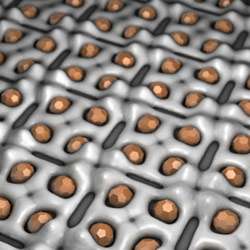
Scientists from the research center Forschungszentrum Rossendorf (Germany) use the survival mechanism of special bacteria to produce solid nanoclusters out of palladium. The tiny bullets, only a few billions of millimeters in size, show new properties, i.e. enhanced catalytic activity. Thus, bacteria-based nanoclusters seem to be ideally suited for building new nano-catalysts.
Experts regard nanotechnology as the key technology of the 21 century. The tiny particles – one nanometer is a billion of a millimeter large – are used already in industrial applications such as optics or electronics or i.e. in the car industry. Nature has invented its own mechanisms on the nanometer scale. Basic knowledge about these natural processes can contribute to the development of new nano-materials.
To produce nanoparticles out of the noble metal palladium a team of biologists from the Forschungszentrum Rossendorf (FZR) in Dresden use the surface protein layer (S-layer) of one bacterium. Through this layer the bacterium „Bacillus sphaericus JG-A12“ is able to survive in the extreme environment of a uranium mining waste pile. The biologists discovered this bacterium in 1997 and have since been able to cultivate it in the laboratory of the FZR. Its S-layer is very regularly structured with pores of identical size on the nanometer scale. On this grid-like matrix the biologists applied a metallic salt of palladium ions to investigate the metal-protein interactions and their impact on the secondary structure.
Within the pores of the S-layer the metallic salt is transformed into the noble metal palladium by the use of hydrogen. The result are nanoclusters of metallic palladium, each comprising of 50 to 80 atoms, which are regularly arranged on the surface layer. This combined metal-protein layer shows new physical and chemical effects. Because the metal stabilizes the protein and vice versus the S-layer stays stable to higher temperatures or even in an acidic environment. In relation to their size the nanoclusters possess many atoms on the surface where other substances can bind. Today, the noble metal palladium is often used as a catalyst, i.e. in the chemical industry or in cars. Nano-catalysts made from palladium promise to accelerate chemical reactions even at low temperatures. A few laboratories are already producing and testing this new technology.
Scientists of the FZR, however, have taken a step further. They are aiming at producing innovative nano-catalysts out of a noble metal like gold or to model the size of the metallic nanoclusters. This could lead to more efficient nano-catalysts or to completely new fields of application. For the first time they exactly characterized the bonding between the metal and the S-layer protein of „Bacillus sphaericus JG-A12“. Hereby, the prerequisite is given to manipulate this protein by means of genetic engineering enabling the scientists to construct materials with new optic, magnetic, catalytic, and other novel physical properties.
The team consists of the biologists Dr. Katrin Pollmann, Dr. Mohamed Merroun, Dr. Johannes Raff, Dr. Sonja Selenska-Pobell and the biophysicist Dr. habil. Karim Fahmy. Through various methodological approaches they decoded the mechanism, where and how the bacteria bonds noble metals on its protective surface layer. Karim Fahmy used infrared spectroscopy to characterize the nature of the chemical groups responsible for the stable metal-protein interaction. Given this as a basis, and after already having deciphered the structure of the S-layer, Johannes Raff was able to determine the building blocks of the S-layer protein which take part in the bonding of the metal. Mohamed Merroun and Dr. Christoph Hennig, another team member, helped to clear the atomic environment of the palladium within the biological matrix by means of X-rays of the Rossendorf Beamline at the European Synchrotron (ESRF) in Grenoble/France.
The scientific results were published in the latest issue of the Biophysical Journal (www.biophysj.org/) by Karim Fahmy, Mohamed Merroun, Katrin Pollmann, Johannes Raff, Olesya Savchuk, Christoph Hennig, Sonja Selenska-Pobell: "Secondary structure and Pd(II) coordination in S-layer proteins from Bacillus sphaericus studied by infrared and X-ray absorption spectroscopy".
Source: Forschungszentrum Rossendorf


