Student Creates Electric Tweezers
August 18th, 2006 Student Creates Electric Tweezers

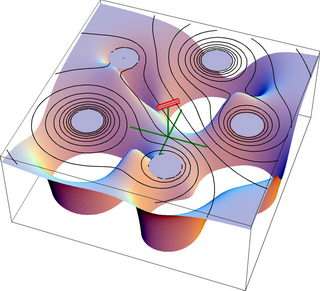
A small rod surfs the crests of the magnetic field generated by the five electrodes (dark circles).

The ability to sort cells or manipulate microscopic particles could soon be in the hands of small laboratories, high schools and amateur scientists, thanks to researchers at the University of Pennsylvania School of Engineering and Applied Science. They have created a device, called "electric tweezers," which can manipulate and move almost any object seen on a simple microscope slide.

The research was led by graduate student Brian Edwards, with the help of his advisor Nader Engheta, professor, and Stephane Evoy, adjunct assistant professor, both of Penn's Electrical and Systems Engineering Department. While devices with similar functionality using lasers exist, they often cost upwards of a quarter-million dollars. Edwards' device performs some of the same tasks as laser tweezers, yet at a price anticipated to be in the same range as a high-end desktop computer.

"The tweezers create an electric field that you can use to manipulate almost any object on a microscopic scale. It has the potential of being a powerful tool for research," said Edwards, a doctoral candidate in Penn's Electrical and Systems Engineering Department. "I would prefer not to put a limit on the type of tasks that can be done with it, but I hope it will find uses in anything from picking an individual cell out of a culture to fabricating circuits."

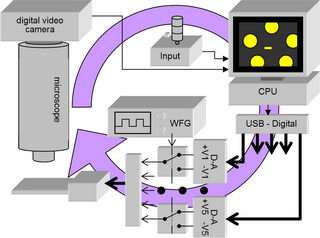
All it would take to use electric tweezers is a computer and a microscope. The tweezers' action occurs on a common glass microscope slide embedded with five electrodes. These electrodes create an electric field that can be used to push, pull, move and spin a selected object in any direction without actual physical contact. Using software Edwards developed, an operator can select an individual object from a microscope image on a computer screen.
Student Creates Electric Tweezers

A schematic of the electronic tweezer setup.

"Different types of particles respond differently to different frequencies in the electric field," Edwards said. "Once you lock onto the object of interest you can move it however you like."

The electric tweezers take advantage of the phenomenon known as dielectrophoresis, where electric fields impart a force upon a neutral particle. In essence, the object that is selected surfs atop the hills and valleys created by subtly changing the electric field. The principle works best on the microscopic scale, which makes it ideal for this application.

"Moving objects with the tweezers is a lot like playing one of those wooden labyrinth games, but, instead of twisting knobs to move a ball in the maze, we're adjusting an electric field to move a small object," Edwards said. "The tweezers move the object by fiddling with the electric field. All the math is done on the computer, so all the user needs to do is move a joystick."

According to Edwards, the electrical field can be attuned to almost anything visible through a microscope. He believes the device will be a boon to smaller laboratories that cannot afford similar devices, as well as to high schools and science hobbyists. Its size, utility and potentially low price could put it into the hands of almost anyone interested in experimenting with the technology.

"We hope that the electric tweezers could mean to science what the PC meant to computing; it's a scientific tool for the rest of us," said Hugo FitzGerald nanotechnology and licensing manager at Penn's Center for Technology Transfer.

The Center is assisting Edwards in patenting and, along with the Bressler Group, bringing electric tweezers to the marketplace.

Source: University of Pennsylvania


print this article email this article download pdf blog this article bookmark this article     Digg this Stumble it share on Facebook share on Reddit add to delicious save to Yahoo! bookmarks
4.7/5 after 21 votes


August 18th, 2006 all stories
Physics / General Physics

Comments: 0
Rank: 4.7/5 after 21 votes

  • Stumble this up

  • Digg this

  • Share it:
  • share on Facebook
  • share on MySpace
  • share on Slashdot
  • rss-newsfeed
  • share on Google
  • share on Reddit
  • add to delicious
  • save to Yahoo! bookmarks
  • share on Windows Live
  • Add to Mixx!
Rating: 4.7/5 after 21 votes

  • Related Stories

  • Electric-Field-Induced Phase-Separation of Liquid Mixtures
    created Aug 09, 2004 | popularity not rated yet | comments 0
  • New method to detect quantum mechanical effects in ordinary objects
    created Jun 22, 2009 | popularity not rated yet | comments 0
  • Researchers create freestanding nanoparticle films without fillers
    created Jun 09, 2009 | popularity not rated yet | comments 0
  • A (virtual) smart home controlled by your thoughts
    created May 11, 2009 | popularity not rated yet | comments 0
  • Dutch chemists make new chiral palladium metal
    created Apr 23, 2009 | popularity not rated yet | comments 0

Tags


  • Physicists Demonstrate Quantum Memory with Matter Qubits
    Physicists Demonstrate Quantum Memory with Matter Qubits
    Physics / General Physics
    created Jul 03, 2009 | popularity 4.4 / 5 (17) | comments 1
  • 'Holey' Nanosheets for Wastewater Dye Removal
    Nanotechnology / Nanomaterials
    created Jul 01, 2009 | popularity 5 / 5 (5) | comments 1
  • Jellyfish Robot Swims Like its Biological Counterpart
    Jellyfish Robot Swims Like its Biological Counterpart
    Electronics / Robotics
    created Jun 26, 2009 | popularity 4.4 / 5 (8) | comments 1
  • Could Maxwell's Demon Exist in Nanoscale Systems?
    Could Maxwell's Demon Exist in Nanoscale Systems?
    Physics / General Physics
    created Jun 24, 2009 | popularity 4.4 / 5 (18) | comments 29
  • Living Safely with Robots, Beyond Asimov's Laws
    Living Safely with Robots, Beyond Asimov's Laws
    Electronics / Robotics
    created Jun 22, 2009 | popularity 4.6 / 5 (53) | comments 40
  • Other News

    Physical reality of string theory demonstrated

    Physics / General Physics

    created 1hour ago | popularity 4.7 / 5 (11) | comments 4

    String theory has come under fire in recent years. Promises have been made that have not been lived up to. Leiden (The Netherlands) theoretical physicists have now for the first time used string theory to describe a physical ...


    UQ researchers break the law -- of physics

    Physics / General Physics

    created 7 hours ago | popularity 4.6 / 5 (12) | comments 4

    (PhysOrg.com) -- Two UQ Science researchers have proved two famous physical laws that have been widely used for the past 25 years do not always work.


    Scientists create first electronic quantum processor

    Scientists create first electronic quantum processor

    Physics / General Physics

    created Jun 28, 2009 | popularity 4.8 / 5 (54) | comments 44

    A team led by Yale University researchers has created the first rudimentary solid-state quantum processor, taking another step toward the ultimate dream of building a quantum computer.


    Science journals

    How to Spot an Influential Paper Based on its Citations

    Physics / General Physics

    created Jul 04, 2009 | popularity 3.9 / 5 (10) | comments 6

    (PhysOrg.com) -- At first it may seem that the number of citations received by a published scientific paper is directly related to that paper's quality of content. The higher the quality, the more people read ...


    Fermilab's CDF observes Omega-sub-b baryon

    Fermilab's CDF observes Omega-sub-b baryon

    Physics / General Physics

    created Jun 29, 2009 | popularity 4.7 / 5 (18) | comments 7

    (PhysOrg.com) -- At a recent physics seminar at the Department of Energy’s Fermi National Accelerator Laboratory, Fermilab physicist Pat Lukens of the CDF experiment announced the observation of a new particle, ...