A Matter of Fact: NASA Finds Direct Proof of Dark Matter
August 21, 2006
NASA Finds Direct Proof of Dark Matter

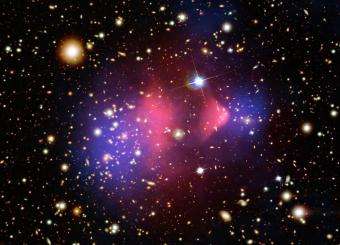
A purple haze shows dark matter flanking the "Bullet Cluster." Image Credit: X-ray: NASA/CXC/M.Markevitch et al. Optical: NASA/STScI; Magellan/U.Arizona/D.Clowe et al. Lensing Map: NASA/STScI; ESO WFI; Magellan/U.Arizona/D.Clowe et al.

Dark matter and normal matter have been wrenched apart by the tremendous collision of two large clusters of galaxies. The discovery, using NASA's Chandra X-ray Observatory and other telescopes, gives direct evidence for the existence of dark matter.

"This is the most energetic cosmic event, besides the Big Bang, which we know about," said team member Maxim Markevitch of the Harvard-Smithsonian Center for Astrophysics in Cambridge, Mass.

These observations provide the strongest evidence yet that most of the matter in the universe is dark. Despite considerable evidence for dark matter, some scientists have proposed alternative theories for gravity where it is stronger on intergalactic scales than predicted by Newton and Einstein, removing the need for dark matter. However, such theories cannot explain the observed effects of this collision.

"A universe that's dominated by dark stuff seems preposterous, so we wanted to test whether there were any basic flaws in our thinking," said Doug Clowe of the University of Arizona at Tucson, and leader of the study. "These results are direct proof that dark matter exists."
NASA Finds Direct Proof of Dark Matter

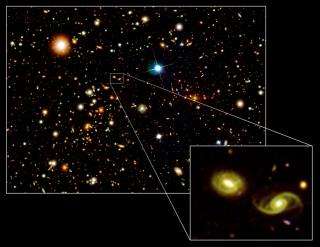
The Bullet Cluster is made of two colliding groups of galaxies. Image Credit: NASA/STScI

In galaxy clusters, the normal matter, like the atoms that make up the stars, planets, and everything on Earth, is primarily in the form of hot gas and stars. The mass of the hot gas between the galaxies is far greater than the mass of the stars in all of the galaxies. This normal matter is bound in the cluster by the gravity of an even greater mass of dark matter. Without dark matter, which is invisible and can only be detected through its gravity, the fast-moving galaxies and the hot gas would quickly fly apart.

The team was granted more than 100 hours on the Chandra telescope to observe the galaxy cluster 1E0657-56. The cluster is also known as the bullet cluster, because it contains a spectacular bullet-shaped cloud of hundred-million-degree gas. The X-ray image shows the bullet shape is due to a wind produced by the high-speed collision of a smaller cluster with a larger one.

In addition to the Chandra observation, the Hubble Space Telescope, the European Southern Observatory's Very Large Telescope and the Magellan optical telescopes were used to determine the location of the mass in the clusters. This was done by measuring the effect of gravitational lensing, where gravity from the clusters distorts light from background galaxies as predicted by Einstein's theory of general relativity.

The hot gas in this collision was slowed by a drag force, similar to air resistance. In contrast, the dark matter was not slowed by the impact, because it does not interact directly with itself or the gas except through gravity. This produced the separation of the dark and normal matter seen in the data. If hot gas was the most massive component in the clusters, as proposed by alternative gravity theories, such a separation would not have been seen. Instead, dark matter is required.

"This is the type of result that future theories will have to take into account," said Sean Carroll, a cosmologist at the University of Chicago, who was not involved with the study. "As we move forward to understand the true nature of dark matter, this new result will be impossible to ignore."

This result also gives scientists more confidence that the Newtonian gravity familiar on Earth and in the solar system also works on the huge scales of galaxy clusters.

"We've closed this loophole about gravity, and we've come closer than ever to seeing this invisible matter," Clowe said.

These results are being published in an upcoming issue of The Astrophysical Journal Letters.

Source: NASA

4.6 /5 (128 votes)  

Rank 4.6 /5 (128 votes)
Tags

Relevant PhysicsForums posts
  • Upward speed of an object in water
    created1 hour ago
  • flipping quarks
    created2 hours ago
  • partial derivation question
    created2 hours ago
  • How to magnetize water using super magnet?
    created3 hours ago
  • Anti-Gravity Q
    created3 hours ago
  • Help my dad and I settle a argument
    created4 hours ago
  • More from Physics Forums - General Physics

More news stories

Transparent iron? For the first time, an experiment shows that atomic nuclei can become transparent

At the high-brilliance synchrotron light source PETRA III, a team of DESY scientists headed by Dr. Ralf Röhlsberger has succeeded in making atomic nuclei transparent with the help of X-ray light. At the ...

Physics / General Physics

created 9 hours ago | popularity 5 / 5 (5) | comments 1 | with audio podcast

Physicists build highly efficient 'no-waste' laser

A team of University of California, San Diego researchers has built the smallest room-temperature nanolaser to date, as well as an even more startling device: a highly efficient, "thresholdless" laser that ...

Physics / General Physics

created 9 hours ago | popularity 5 / 5 (14) | comments 2 | with audio podcast

Quantum physicist explains $100K offer for proof scaled-up quantum computing is impossible

(PhysOrg.com) -- MIT researcher Scott Aaronson has certainly riled the physics community with his offer this past Friday, of $100,000 to anyone who can prove that scaled-up quantum computing is impossible. ...

Physics / Quantum Physics

created 14 hours ago | popularity 4.5 / 5 (8) | comments 27 | with audio podcast weblog

Unusual 'collapsing' iron superconductor sets record for its class

(PhysOrg.com) -- A team from the National Institute of Standards and Technology and the University of Maryland has found an iron-based superconductor that operates at the highest known temperature for a material ...

Physics / Superconductivity

created 14 hours ago | popularity 4.3 / 5 (3) | comments 2 | with audio podcast

Flipping a light switch in the cell: Quantum dots used for targeted neural activation

By harnessing quantum dots—tiny light-emitting semiconductor particles a few billionths of a meter across—researchers at the University of Washington (UW) have developed a new and vastly more targeted ...

Physics / Optics & Photonics

created 11 hours ago | popularity 5 / 5 (3) | comments 0 | with audio podcast


Astronomy team discovers nearby dwarf galaxy

(PhysOrg.com) -- A team led by UCLA research astronomer Michael Rich has used a unique telescope to discover a previously unknown companion to the nearby galaxy NGC 4449, which is some 12.5 million light years ...

Amasia: As next supercontinent forms, Arctic Ocean, Caribbean will vanish first

(PhysOrg.com) -- Geologists at Yale University have proposed a new theory to describe the formation of supercontinents, the epic process by which Earth’s major continental blocks combine into a single ...

Why are there so few fish in the Earth's oceans?

(PhysOrg.com) -- A Stony Brook University researcher has found that, contrary to popular belief, there are not plenty of fish in the sea.

Scientists strengthen memory by stimulating key site in brain

Ever gone to the movies and forgotten where you parked the car? New UCLA research may one day help you improve your memory.

Study shows how DNA finds its match

It's been more than 50 years since James Watson and Francis Crick showed that DNA is a double helix of two strands that complement each other. But how does a short piece of DNA find its match, out of the millions ...

Most stretchable spider silk reported

The egg sac silk of the cocoon stalk of the cave spider Meta menardi is the most stretchable egg sac silk yet tested, according to a study published Feb. 8 in the open access journal PLoS ONE.