Researchers test carbon fiber to make tiny, cheap video displays
August 22, 2006
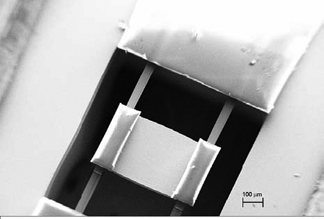
Carbon fiber rods supporting this tiny mirror can be made to bend up to 90 degrees millions of times without showing fatigue. The technology could be used to create a video projector on a chip. Credit: Thompson Lab/Cornell University
Engineers who develop microelectromechanical systems (MEMS) like to make their tiny machines out of silicon because it is cheap, plentiful and can be worked on with the tools already developed for making microelectronic circuits. There is just one problem: Silicon breaks too easily.
For decades, researchers have been trying to make video displays using tiny mirrors mounted on silicon oscillators. But silicon won't oscillate fast enough and bend far enough.
"You need something incredibly stiff to oscillate at a resonant frequency of 60,000 times a second (the line-scanning rate of most video displays), but it also needs to bend a lot for adequate image size," explained Shahyaan Desai, a Cornell graduate student who has been working for more than three years to create a practical MEMS video display device.
So Desai and his Cornell colleagues have turned to carbon fiber, the same material used to reinforce auto and aircraft body parts, bicycle frames and fishing rods.
"Carbon fiber is twice as stiff as silicon but 10 times more flexible," said Desai.
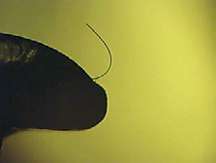
Microscopic flash photography shows a carbon fiber 5 microns in diameter bending nearly 90 degrees while driven to oscillate at 33.4 kHz. The combined flexibility and durability of carbon fibers suggest many uses in microelectromechanical (MEMS) devices, including use as springs and as supports for vibrating objects. Credit: Thompson Lab/Cornell University
He is first author of a paper with Michael Thompson, Cornell associate professor of materials science and engineering, and Anil Netravali, Cornell professor of fiber science, on using carbon fibers in MEMS, published in the July issue of the Journal of Micromechanics and Microengineering.Carbon fibers are made of thin, narrow sheets of graphite that roll up and clump together to form fibers. For industrial uses the fibers are embedded in plastic to form composite materials that are stronger than steel, yet lighter. Desai's MEMS are made with the raw fibers.
Desai first showed that micrometer-scale carbon fibers can bend like tiny fishing rods by more than 90 degrees and can be made to vibrate billions of times without breaking down. "This is, to our knowledge, the first material to even approach such large deformation at high frequencies without observable fatigue," the researchers wrote in their paper.
"Carbon is normally a brittle material," Desai said, "but in the fiber form it resists breakage. We have some data implying that if it lasts three and a half days it's going to last forever."
Desai then built an optical scanner consisting of a tiny rectangular mirror measuring 400 by 500 microns, supported by two carbon-fiber hinges about 55 microns across. Made to oscillate at 2.5 kHz, the tiny mirror caused a laser beam to scan across a range of up to 180 degrees, corresponding to a 90-degree bend by the carbon fibers.
An oscillating mirror could be used to scan a laser beam across a screen, and an array of mirrors, one for each horizontal line, could produce an image in the same way that a moving electron beam creates an image on a television screen.
"It would be an incredibly cheap display," Desai said. And the entire device would be small enough to build into a cell phone to project an image on a wall.
Besides serving as oscillators, the researchers said, carbon fibers could be made into clock springs that either unwind slowly to power a micromachine over a period of time or unwind rapidly to provide a sudden burst of power, or used as micro-sized pendulums that could harvest energy from motion like a mechanical self-winding watch to make cell phones, PDAs and even watches that are powered by the user's movement.
Source: Cornell University
-
A bronze matryoshka doll: The metal in the metal in the metal
Feb 07, 2012 |
5 / 5 (7) |
1
-
As strong as an insect's shell
Feb 03, 2012 |
4.8 / 5 (8) |
0
-
Mass hysteria rare, but usually seen in girls
Feb 02, 2012 |
not rated yet |
0
-
Graphene quantum dots: The next big small thing
Jan 12, 2012 |
5 / 5 (6) |
0
-
How do green algae react to carbon nanotubes?
Nov 04, 2011 |
4 / 5 (1) |
3
-
Engineers build first sub-10-nm carbon nanotube transistor
Feb 01, 2012 |
4.9 / 5 (31) |
30
-
Something old, something new: Evolution and the structural divergence of duplicate genes
Jan 31, 2012 |
4.6 / 5 (7) |
1
-
The hidden nanoworld of ice crystals: Revealing the dynamic behavior of quasi-liquid layers
Jan 30, 2012 |
5 / 5 (3) |
1
-
Stock market network reveals investor clustering
Jan 27, 2012 |
3.9 / 5 (23) |
8
-
Of microchemistry and molecules: Electronic microfluidic device synthesizes biocompatible probes
Jan 26, 2012 |
5 / 5 (1) |
0
-
Doubts about surface plasmons
14 hours ago
-
excited U-236 decay time in the U235 fission chain
Feb 09, 2012
-
Polar catastrophe?
Feb 09, 2012
-
Large scale field sonication
Feb 09, 2012
-
states and energy of paired electrons in BCS
Feb 08, 2012
-
difference between longitudinal and transverse refractive indices
Feb 08, 2012
- More from Physics Forums - Atomic, Solid State, Comp. Physics
More news stories
Explained: Sigma
It's a question that arises with virtually every major new finding in science or medicine: What makes a result reliable enough to be taken seriously? The answer has to do with statistical significance -- but ...
Feb 09, 2012 |
5 / 5 (18) |
65
Quantum physicist explains $100K offer for proof scaled-up quantum computing is impossible
(PhysOrg.com) -- MIT researcher Scott Aaronson has certainly riled the physics community with his offer this past Friday, of $100,000 to anyone who can prove that scaled-up quantum computing is impossible. ...
Diamond light, brighter than the sun
Its the size of five football pitches and generates light 10 billion times brighter than the sun. As the Diamond Light Source celebrates its tenth anniversary this year, Penny Bailey visits one of the ...
Feb 07, 2012 |
4.3 / 5 (7) |
15
|
Physicists 'record' magnetic breakthrough
An international team of scientists has demonstrated a revolutionary new way of magnetic recording which will allow information to be processed hundreds of times faster than by current hard drive technology.
Feb 07, 2012 |
4.5 / 5 (41) |
14
|
Hints of the Higgs - papers are submitted
Back in December 2011, the ATLAS and CMS experiments at CERN presented some exciting results that provided tantalising hints of the Higgs boson.
Feb 08, 2012 |
4.1 / 5 (7) |
10
Walney offshore wind farm is world's biggest (for now)
(PhysOrg.com) -- The Walney wind farm on the Irish Sea--characterized by high tides, waves and windy weather--officially opened this week. The farm is treated in the press as a very big deal as the Walney ...
Europeans protest controversial Internet pact
Tens of thousands of people marched in protests in more than a dozen European cities Saturday against a controversial anti-online piracy pact that critics say could curtail Internet freedom.
GPS court ruling leaves US phone tracking unclear
A US Supreme Court decision requiring a warrant to place a GPS device on the car of a criminal suspect leaves unresolved the bigger issue of police tracking using mobile phones, legal experts say.
Europe stakes billion-dollar bet on new rocket
A pencil-slim rocket is scheduled to lift into space from South America on Monday, carrying a billion-dollar bet that Europe can grab a juicy slice of the market to place satellites in low orbit.
Study finds that anti-diabetic medication can prevent the long-term effects of maternal obesity
In a study to be presented today at the Society for Maternal-Fetal Medicine's annual meeting, The Pregnancy Meeting, in Dallas, Texas, researchers will report findings that show that short therapy with the anti-diabetic medication ...
Netflix settlement trims 14 pct off 4Q earnings
(AP) -- Netflix pressed the rewind button on its fourth-quarter earnings after settling allegations that the video subscription service violated a consumer-privacy law.