Ant jaws break speed record, propel insects into air
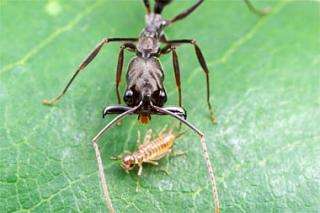
A species of ant native to Central and South America is entering the annals of extreme animal movement, boasting jaws arguably more impressive than such noteworthy contenders as the great white shark and the spotted hyena.
Biologists clocked the speed at which the trap-jaw ant, Odontomachus bauri, closes its mandibles at 35 to 64 meters per second, or 78 to 145 miles per hour - an action they say is the fastest self-powered predatory strike in the animal kingdom. The average duration of a strike was a mere 0.13 milliseconds, or 2,300 times faster than the blink of an eye.
A research team led by Sheila Patek, assistant professor of integrative biology at the University of California, Berkeley, calculated the kinematics of the trap-jaw ant's mandible strikes with the help of advances in high-speed videography. The researchers published their results in the Aug. 21 issue of the Proceedings of the National Academy of Sciences.
They found that the jaws, used to capture prey and to defend the ant from harm, accelerate at 100,000 times the force of gravity, with each jaw generating forces exceeding 300 times the insect's body weight. The ants in this study had body masses ranging from 12.1 to 14.9 milligrams.
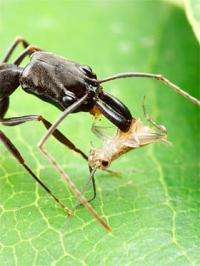
"You'd think the relevant number is the mandible closing speed, but it's actually the acceleration that is most impressive," said Patek. "The acceleration is huge relative to the tiny mass of the mandibles. The mandibles are operating in the outer known limits in biology in terms of speed and acceleration."
Patek acknowledged that falcons can dive as fast as 300 miles per hour, but that the raptors must start from very high altitudes and get a boost from the force of gravity to reach those speeds. In comparison, animals such as trap-jaw ants and mantis shrimp (which formerly held the record for swiftest strike in the animal world) utilize energy stored within their own bodies. The mandibles of the trap-jaw ant, for instance, are held cocked by a pair of huge, contracting muscles in the head. The muscles are sprung when their corresponding latches, each on a shield-like plate called the clypeus, are triggered.
"Having a latch system is critical in obtaining the explosive speeds," said Patek. "In general, muscles aren't good at generating fast movements. If a person were to throw an arrow, it wouldn't get very far. But by using a crossbow, elastic energy is stored in the bow, and a latch releases the stored energy almost instantaneously. As a result, the arrow shoots out very fast and goes much farther. That's exactly what really fast organisms are doing."
It's no wonder, then, that O. bauri ants can launch themselves into the air with a mere snap of their jaws, achieving heights up to 8.3 centimeters and horizontal distances up to 39.6 centimeters. That roughly translates, for a 5-foot-6-inch tall human, into a height of 44 feet and a horizontal distance of 132 feet, an aerial trajectory likely to be the envy of circus acrobats and Olympic athletes.
The jump's trajectory depends on the purpose of the mandible's strike. When the ant, either alone or in a group, approaches and strikes a large intruder with its jaws, it is simultaneously catapulted away from the trespasser, perhaps leaving behind a crippled victim in the process. In these so-called "bouncer defense" maneuvers, the trap-jaw ants clear, on average, 22.3 centimeters horizontally, but only 0.8 to 5.7 centimeters vertically.
In comparison, when the ant needs to escape quickly from an intruder, it strikes its jaws against the ground to fling itself into the air. In these "escape jumps," the ant is jettisoned to heights of 6.1 to 8.3 centimeters, but just 3.1 centimeters horizontally.
Escape jumps also yield a faster initial spin rate, 63 revolutions per second, compared to the relatively slow spin rate of 36 revolutions per second for bouncer defense jumps.
Study co-author Andrew Suarez, assistant professor of entomology at the University of Illinois at Urbana-Champaign, noted that when the ants jump to escape from harm, they are airborne from 0.22 to 0.27 seconds, often long enough to keep them away from a lizard's tongue, which takes 0.11 to 0.28 seconds to strike.
The researchers suggest that the "popcorn effect" of multiple ants jumping at once may also serve to help them escape by confusing potential predators. Suarez, along with study co-author Brian Fisher, associate curator and chair of entomology at the California Academy of Sciences, witnessed this jumping frenzy first-hand when they were in Costa Rica collecting the worker ants for this study.
The researchers said the difference in aerial trajectories may be more a function of the angle at which an ant's mandibles hit their target rather than an intentional maneuver, although that is something they intend to investigate further.
Perhaps less impressive is the ants' apparent inability to control the direction of their jumps, or even their orientation when landing. Yet, the researchers note that even when an ant lands on its back or head, the insect is so light that it can still walk away no worse for wear.
That the ants use their jaws for both capturing prey and for defense is a notable example of multi-functionality. The trap-jaw ant, like other ants, initially used its mandibles only to catch its dinner, but along the way in its evolutionary history, whole body locomotion was added to the jaws' repertoire.
"O. bauri appears to be rather unusual among trap-jaw ants in that it definitely uses its jaws for functions other than prey capture, namely defense," said Suarez. "It remains to be seen if other trap-jaw ants have co-opted their high speed mandibles for other purposes."
While many examples of multi-functionality exist among other animals — bird feathers are used for both heat regulation and flight, for example — the researchers note that the spring-latch system for the jaws has evolved a remarkable four times in ants, at least, and perhaps twice in evolutionary history has the system been used for propulsion. These multiple independent origins of such structures — a rare occurrence in evolution — offer insights into how novel behaviors may evolve in biology.
The researchers used a high-speed video camera filming at 50,000 frames per second to visualize the mandible movements. The jumps were detailed at a relatively slower 3,000 frames per second. Motion pictures, by comparison, are typically shot at 24 frames per second.
"The debate about whether these ants were intentionally using their jaws to jump or not date back to the late 1800s, but no one was able to prove it until now," said Patek.
Joseph Baio, research staff member at UC Berkeley's Department of Integrative Biology, also co-authored the study.
Source: UC Berkeley


