Researcher hits bulls-eye for antibiotic target
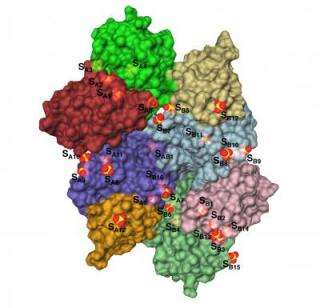
A Purdue University researcher has opened the door for possible antibiotic treatments for a variety of diseases by determining the structure of a protein that controls the starvation response of E. coli.
This research is applicable to the treatment of many diseases because that same protein is found in numerous harmful bacteria, including those that cause ulcers, leprosy, food poisoning, whooping cough, meningitis, sexually transmitted diseases, respiratory infections and stomach cancer, said David Sanders, an associate professor of biology. Sanders, who is part of the Markey Center for Structural Biology at Purdue, detailed his research in a paper published in the Aug. 16 issue of the journal Structure.
"This is an important discovery for the field of antibiotics, which was greatly in need of something new," Sanders said. "The antibiotics available today face a challenge of increasing resistance and failure. This research suggests a whole new approach to combat bacterial infections. In addition, this protein is an excellent antibiotic target because it only exists in bacteria and some plants, which means the treatment will only affect the targeted bacterial cells and will be harmless to human cells."
Sanders and his collaborator, Miriam Hasson, studied the structure of exopolyphosphatase, a protein in E. coli bacteria that functions as an enzyme and catalyzes chemical reactions within the bacteria. This enzyme provides the signal for bacteria to enter starvation mode and limit reproduction.
"With the ability to control the use of this signal, we can fool bacteria into thinking they are starving all the time, even when they are not; or we could never allow them to realize that they're starving, and that would kill them as well."
Researchers could design drugs to bind to the protein and keep it from being used by the bacteria, rendering the bacteria unable to react to and survive a lack of nutrient supply; the other possibility would be to design a drug to mimic the protein, causing the bacteria to react as if it were starving even when in the presence of a plentiful nutrient supply, Sanders said.
Such a signal exists in almost all living things because most organisms struggle to find food or nutrients and have had to develop a way to avoid starvation, he said.
"Bacteria typically are in an environment lacking nutrients and respond by limiting their reproduction," he said. "And that's a good thing because if they were growing at their maximum rate all the time, within two weeks we would be 20 feet deep in bacteria."
The protein also is of particular interest because it is highly processive, meaning it is efficient in the chemical reaction it initiates. It is able to latch onto its substrate, the substance it uses to fuel its chemical reaction, and to stay tenaciously in place until it has consumed all of the substrate, Sanders said.
Using X-ray crystallography, Sanders was able to show the structure of the E. coli exopolyphosphatase and found the protein had a unique way of achieving its high processivity.
"There is a hole in the protein," he said. "This is extremely rare and provides a physical explanation of why it is so processive. The hole physically encompasses the substrate, keeping it in place, in addition to the usual chemical bonding that keeps it attached. Once the protein attaches to the substrate, it doesn't come off. The protein chews away until it reaches the end of the substrate chain."
Sanders worked with a team to create the first-of-its-kind animated movie showing this process from the point of view of the substrate. The audience follows along as it is pulled through the protein from one side to the next.
"This is the first time this sort of thing has ever been seen, and this is the first movie of its kind," he said. "It elegantly illustrates the physical process of this reaction."
Sanders also determined the structure of the protein and demonstrated that it belongs to the ASKHA (Acetate and Sugar Kinases, Hsp70, Actin) superfamily. Knowing the family to which a protein belongs allows researchers to use existing information about other members of the family to better understand the protein being studied. It also allows information gained from the study to be used for other members of the family, Sanders said.
"Fundamental basic research is the engine that drives the development of technology such as antibiotics," he said. "The next step in this research will be working to develop inhibitors for this protein and studying the applications to other bacteria."
Source: Purdue University


