Nanowire-Paper Offers Strength, Flexibility
August 22nd, 2006 Nanowire-Paper Offers Strength, Flexibility

University of Arkansas researchers have created assemblies of nanowires that show potential in applications such as armor, flame-retardant fabric, bacteria filters, oil cracking, controlled drug release, decomposition of pollutants and chemical warfare agents.

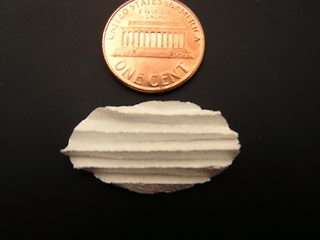
This two-dimensional “paper” can be shaped into three-dimensional devices. It can be folded, bent and cut, or used as a filter, yet it is chemically inert, remains robust and can be heated up to 700 degrees Celsius.

“Humans have used paper made from natural fibers for thousands of years,” said Z. Ryan Tian, assistant professor of chemistry and biochemistry in the J. William Fulbright College of Arts and Sciences. “With this technology, we are entering a new era.” The researchers published their findings in the Journal of Physical Chemistry B.

Tian and his team used a hydrothermal heating process to create long nanowires out of titanium dioxide and from there created free-standing membranes. The resulting material is white in color and resembles regular paper.
Nanowire-Paper Offers Strength, Flexibility
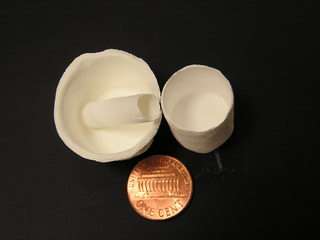
Further, the material can be cast into different three-dimensional shapes, with different functions. The researchers have created tubes, bowls and cups using this process. These three-dimensional hollow objects can be manipulated by hand and trimmed with scissors, the researchers report.

The university has applied for patent protection on the process used to create the free-standing membranes for filtration and catalysis, and is looking for industrial partners to license and commercialize various applications of the nanopaper technology.

Source: University of Arkansas, Fayetteville


print this article email this article download pdf blog this article bookmark this article     Digg this Stumble it share on Facebook share on Reddit add to delicious save to Yahoo! bookmarks
4.3/5 after 26 votes


August 22nd, 2006 all stories
Nanotechnology / Nanomaterials

Comments: 0
Rank: 4.3/5 after 26 votes

  • Stumble this up

  • Digg this

  • Share it:
  • share on Facebook
  • share on MySpace
  • share on Slashdot
  • rss-newsfeed
  • share on Google
  • share on Reddit
  • add to delicious
  • save to Yahoo! bookmarks
  • share on Windows Live
  • Add to Mixx!
Rating: 4.3/5 after 26 votes

  • Related Stories

  • World's Largest Ocean Observatory Nears Completion
    created 8 minutes ago | popularity not rated yet | comments 0
  • Study: delirium presentation predicts mortality
    created 15 minutes ago | popularity not rated yet | comments 0
  • Brain's immune system may cause chronic seizures
    created 21 minutes ago | popularity not rated yet | comments 0
  • A New Way of Treating the Flu
    created 24 minutes ago | popularity not rated yet | comments 0
  • Scientists are learning more about big birds from feathers
    created 27 minutes ago | popularity not rated yet | comments 0

Tags


  • Physicists Demonstrate Quantum Memory with Matter Qubits
    Physicists Demonstrate Quantum Memory with Matter Qubits
    Physics / General Physics
    created Jul 03, 2009 | popularity 4.4 / 5 (17) | comments 1
  • 'Holey' Nanosheets for Wastewater Dye Removal
    Nanotechnology / Nanomaterials
    created Jul 01, 2009 | popularity 5 / 5 (5) | comments 1
  • Jellyfish Robot Swims Like its Biological Counterpart
    Jellyfish Robot Swims Like its Biological Counterpart
    Electronics / Robotics
    created Jun 26, 2009 | popularity 4.4 / 5 (8) | comments 1
  • Could Maxwell's Demon Exist in Nanoscale Systems?
    Could Maxwell's Demon Exist in Nanoscale Systems?
    Physics / General Physics
    created Jun 24, 2009 | popularity 4.4 / 5 (18) | comments 29
  • Living Safely with Robots, Beyond Asimov's Laws
    Living Safely with Robots, Beyond Asimov's Laws
    Electronics / Robotics
    created Jun 22, 2009 | popularity 4.6 / 5 (54) | comments 40
  • Other News

    Physics research with atomic force microscope could lead to better health care

    Atomic force microscope research could lead to better health care

    Nanotechnology / Nanophysics

    created 2 hours ago | popularity 5 / 5 (1) | comments 0

    Where biology, chemistry and physics intersect, a Kansas State University professor expects to find applications to improve human health.


    Canadian researchers set to study impact of nanomaterials on aquatic ecosystems

    Nanotechnology / Bio & Medicine

    created 4 hours ago | popularity 5 / 5 (1) | comments 0

    A team of Canadian scientists and engineers, led by the University of Alberta and the National Research Council of Canada, will collaborate on a $3.39 million, three-year study to assess the potential effects of nanoparticles ...


    Nano Measurement in the 3rd Dimension

    Nano Measurement in the 3rd Dimension

    Nanotechnology / Nanophysics

    created 6 hours ago | popularity 3 / 5 (1) | comments 0

    From the motion sensor to the computer chip - in many products of daily life components are used whose functioning is based on smallest structures of the size of thousandths - or even millionths - of millimetres. ...


    A 'quantum of sol' -- how nanotechnology could hold the key to a solar-powered future

    A 'quantum of sol' -- how nanotechnology could hold the key to a solar-powered future

    Nanotechnology / Nanomaterials

    created Jun 30, 2009 | popularity 3.9 / 5 (16) | comments 17

    (PhysOrg.com) -- A new generation of 'nano-structured' millimetre-sized solar cells that could convert the sun's energy to electricity more than twice as efficiently as current technology, is the subject of ...


    Australian researchers are set to begin human trials of a tiny nano-cell that acts as a "Trojan horse" against cancer

    Hi-tech 'Trojan horse' can kill cancer cells: researchers

    Nanotechnology / Bio & Medicine

    created Jun 29, 2009 | popularity 4.7 / 5 (12) | comments 7

    Australian researchers are set to begin human trials of a tiny nano-cell that acts as a "Trojan horse" against cancer cells, a breakthrough they say may curb the need for debilitating chemotherapy.