Terence Tao, 'Mozart of Math,' Is UCLA's First Mathematician Awarded the 'Nobel Prize in Mathematics'
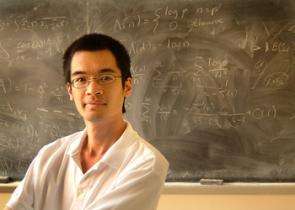
Terence Tao became the first mathematics professor in UCLA history to be awarded the prestigious Fields Medal, often described as the "Nobel Prize in mathematics," during the opening ceremony of the International Congress of Mathematicians in Madrid on Aug. 22. In the 70 years the prize has been awarded by the International Mathematical Union, only 48 researchers ever have won it.
"Terry is like Mozart; mathematics just flows out of him," said John Garnett, professor and former chair of mathematics at UCLA, "except without Mozart's personality problems; everyone likes him. Mathematicians with Terry's talent appear only once in a generation. He's an incredible talent, and probably the best mathematician in the world right now. Terry can unravel an enormously complicated mathematical problem and reduce it to something very simple."
"I'm not surprised," said Tony Chan, dean of the Division of Physical Sciences and professor of mathematics. "Someone like Terry comes along once every few decades. People all over the world say, 'UCLA's so lucky to have Terry Tao.' He has solved important problems in several areas of mathematics that have stumped others for a long time. The way he crosses areas would be like the best heart surgeon also being exceptional in brain surgery. What is also amazing is that Terry is still so young.
"The best students in the world in number theory all want to study with Terry," Chan added. "He's a magnet attracting the best students the same way John Wooden attracted outstanding basketball players." Chan said he is known as "the dean of the university where Terry Tao works." He described the International Congress of Mathematicians as "the World Cup or Olympics of mathematics."
Christoph Thiele, UCLA professor and chair of the mathematics department, said outstanding graduate students from as far as Romania and China, as well as throughout the United States, have come to UCLA for the chance to study with Tao.
Tao was awarded the Fields Medal "for his contributions to partial differential equations, combinatorics, harmonic analysis and additive number theory." In honoring Tao, the organization said, "Terence Tao is a supreme problem-solver whose spectacular work has had an impact across several mathematical areas. He combines sheer technical power, an other-worldly ingenuity for hitting upon new ideas, and a startlingly natural point of view that leaves other mathematicians wondering, 'Why didn't anyone see that before?' "
Like the summer Olympics and the World Cup, the Fields Medal is awarded every fourth year. Along with Tao, the Fields Medal also was presented to Andrei Okounkov, professor of mathematics at Princeton University; Grigori Perelman, formerly a Miller Fellow at University of California, Berkeley; and Wendelin Werner, professor of mathematics at the University of Paris-Sud in Orsay.
Tao's genius at mathematics began early in life. He started to learn calculus when he was 7, at which age he began high school; by 9 he was already very good at university-level calculus. By 11, he was thriving in international mathematics competitions. Tao, now 31, was 20 when he earned his Ph.D. from Princeton University, and he joined UCLA's faculty that year. UCLA promoted him to full professor at age 24.
One of the branches of mathematics on which Tao focuses is theoretical field called harmonic analysis, an advanced form of calculus that uses equations from physics. Some of this work involves, in Garnett's words, "geometrical constructions that almost no one understands." Tao also works in a related field, nonlinear partial differential equations, and in the entirely distinct fields of algebraic geometry, number theory and combinatorics — which involves counting. His research has been supported by the David and Lucille Packard Foundation and the Clay Mathematics Institute.
"Terry wrote 56 papers in two years, and they're all high-quality," Garnett said. "In a good year, I write three papers."
Discover magazine praised Tao's research on prime numbers, conducted with Ben Green, a professor of mathematics at the University of Bristol in England, as one of the 100 most important discoveries in all of science for 2004. A number is prime if it is larger than one and divisible by only itself and one. The primes begin with 2, 3, 5, 7, 11, 13 and 17.
Euclid proved that the number of primes is infinite. Tao and Green proved that the set of prime numbers contains infinitely many progressions of all finite lengths. An example of an equally spaced progression of primes, of length three and space four, is 3, 7, 11; the largest known progression of prime numbers is length 24, with each of the numbers containing more than two dozen digits. Green and Tao's discovery reveals that somewhere in the prime numbers, there is a progression of length 100, one of length 1,000, and one of every other finite length, and that there are an infinite number of such progressions in the primes.
To prove this, Tao and Green spent two years analyzing all four proofs of a theorem named for Hungarian mathematician Endre Szemerédi. Very few mathematicians understand all four proofs, and Szemerédi's theorem does not apply to prime numbers.
"We took Szemerédi's theorem and goosed it so that it handles primes," Tao said. "To do that, we borrowed from each of the four proofs to build an extended version of Szemerédi's theorem. Every time Ben and I got stuck, there was always an idea from one of the four proofs that we could somehow shoehorn into our argument."
Tao is also well-known for his work on the "Kakeya conjecture," a perplexing set of five problems in harmonic analysis. One of Tao's proofs extends more than 50 pages, in which he and two colleagues obtained the most precise known estimate of the size of a particular geometric dimension in Euclidean space. The issue involves the most space-efficient way to fully rotate an object in three dimensions, a question of interest to theoretical mathematicians.
"Terry is the world's expert on this set of five problems, and has been since he finished graduate school," Garnett said. "When Terry made a new estimate of how big the dimension must be, he also produced the solutions, or partial solutions, to many other problems."
Tao and colleagues Allen Knutson at UC Berkeley and Chris Woodward at Rutgers solved an old problem (proving a conjecture proposed by former UCLA professor Alfred Horn) for which they developed a method that also solved longstanding problems in algebraic geometry and representation theory.
Speaking of this work, Tao said, "Other mathematicians gave the impression that the puzzle required so much effort that it was not worth making the attempt, that first you have to understand this 100-page paper and that 100-page paper before even starting. We used a different approach to solve a key missing gap."
Tao found a surprising result to an applied mathematics problem involving image processing with California Institute of Technology mathematician Emmanuel Candès; their collaboration was forged while they were taking their children to UCLA's Fernald Child Care Center. Chan said that Tao and Candès work is providing important insights into how to compress images, which has applications for medical imaging.
"A lot of our work came in the preschool while we were dropping off our kids," Tao said.
"Outstanding mathematicians love working with Terry," Garnett said. "You could build the best mathematics department in the world by hiring his co-authors."
What are Tao's secrets for success?
Tao, who was raised in Australia, offered some insight. "I don't have any magical ability," he said. "I look at a problem, and it looks something like one I've done before; I think maybe the idea that worked before will work here. Nothing's working out; then you think of a small trick that makes it a little better but still is not quite right. I play with the problem, and after a while, I figure out what's going on.
"Most people, faced with a math problem, will try to solve the problem directly," he said. "Even if they get it, they might not understand exactly what they did. Before I work out any details, I work on the strategy. Once you have a strategy, a very complicated problem can split up into a lot of mini-problems. I've never really been satisfied with just solving the problem. I want to see what happens if I make some changes; will it still work? If you experiment enough, you get a deeper understanding. After a while, when something similar comes along, you get an idea of what works and what doesn't work.
"It's not about being smart or even fast," Tao added. "It's like climbing a cliff: If you're very strong and quick and have a lot of rope, it helps, but you need to devise a good route to get up there. Doing calculations quickly and knowing a lot of facts are like a rock climber with strength, quickness and good tools. You still need a plan — that's the hard part — and you have to see the bigger picture."
His views about mathematics have changed over the years.
"When I was a kid, I had a romanticized notion of mathematics, that hard problems were solved in 'Eureka' moments of inspiration," he said. "With me, it's always, 'Let's try this. That gets me part of the way, or that doesn't work. Now let's try this. Oh, there's a little shortcut here.' You work on it long enough and you happen to make progress towards a hard problem by a back door at some point. At the end, it's usually, 'Oh, I've solved the problem.'"
Tao concentrates on one math problem at a time, but keeps a couple dozen others in the back of his mind, "hoping one day I'll figure out a way to solve them."
"If there's a problem that looks like I should be able to solve it but I can't," he said, "that gnaws at me."
Most of Tao's work is pure theoretical mathematics. Of what use is that to society?
"Mathematicians often work on pure problems that do not have any applications for 20 years, and then a physicist or computer scientist or engineer has a real-life problem that requires the solution of a mathematical problem and finds that someone already solved it 20 years ago," Tao said. "When Einstein developed his theory of relativity, he needed a theory of curved space. Einstein found that a mathematician devised exactly the theory he needed more than 30 years earlier."
Will Tao become an even better mathematician in another decade or so?
"Experience helps a lot," he said. "I may get a little slower, but I'll have access to a larger database of tricks. I'll know better what will work and what won't. I'll get déjà vu more often, seeing a problem that reminds me of something."
What does Tao think of his success?
"I'm very happy," he said. "Maybe when I'm in my 60s, I'll look back at what I've done, but now I would rather work on the problems."
Source: UCLA


