Microcapsules open in tumor cells
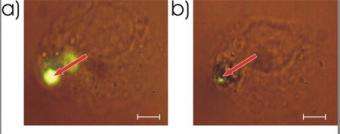
Medicines are most helpful when they directly affect the diseased organs or cells - for example, tumour cells. Scientists at the Max Planck Institute of Colloids and Interfaces in Potsdam, Germany, and Ludwig-Maximilian-University in Munich, have come one step closer to that goal: they have intentionally released a substance in a tumour cell.
The scientists placed the substance in a tiny capsule which gets channelled into cancer cells, and is then "unpacked" with a laser impulse. The laser light cracks its polymer shell by heating it up and the capsule'TMs contents are released. (Angewandte Chemie, July 2006).
Treating malignant tumours is difficult. Doctors have to destroy the tumour, but healthy tissue needs to be preserved. Chemotherapy tends to kill diseased cells, at the same time causing great damage to the body in general. So scientists are looking for ways to destroy only the rampant tumour cells. One way to achieve this is to transport substances inside of microcapsules into the tumour cells and release them there. Researchers led by Andre Skirtach and Gleb Sukhorukov at the Max Planck Institute of Colloids and Interfaces in Potsdam, Germany, along with Wolfgang Parak at Ludwig-Maximilian-University in Munich, have now used a laser as a means of opening microcapsules inserted into a tumour cell. The capsules subsequently release their contents, a fluorescent test substance, into the cell. The scientists used a light microscope to monitor how the luminous materials distribute themselves within the cell.
The vehicle that the researchers used was a polymer capsule only a few micrometres in diameter. The walls of the capsules were built from a number of layers of charged polymers, alternating positive and negative. In the laboratory, at least, this is an established way of producing transport containers for medicines, cosmetics, or nutrients, which can also pass through cell membranes. Andre Skirtach and his colleagues equipped the capsules with a kind of "open sesame". But it didn't require any magic - just nanoparticles made of gold or silver atoms. The scientists mixed together charged metal nanoparticles along with the polymers composing the walls of the vesicle. The tumour cells absorbed the microcapsules and then the scientists aimed an infrared laser at them. Metal nanoparticles are particularly good at absorbing the laser light and transmitting the heat further into their surroundings, heating up the walls. They became so hot that the bonds broke between the polymers and the shell and the capsules eventually opened.
For the time being, the scientists have only been trying out their methods on isolated tumour cells. "In principle, however, active substances could be released into the body this way," says Helmuth Mohwald, director of the Max Planck Institute of Colloids and Interfaces, and one of the participating scientists. This has to (do) with the fact that infrared laser light can penetrate at least one centimetre deep into the tissue. The cells of the body heat up negligibly because laser light at this wavelength is insignificantly absorbed in the tissue. It is the metal particles in the walls of the microcapsules only that absorb the light - even when the microcapsules are in a cell, because the laser affects only them.
Besides using a "thermal opener", the scientists have found another way of making the capsules more stable. They simply heat up the newly created microcapsules very slightly, so that the diameter of the hollow capsules becomes smaller. At the same time, the molecules in their shell are located closer to each other, thickening the capsule walls and better protecting their contents.
There is still, however, a major problem to solve before scientists can use this technology to create medicines which squeeze microcapsules into tumour cells. There is still no way to "steer" the microcapsules. Helmuth Mohwald says, "we have to add some kind of feature to the capsules so that they only recognise the target cells." Only these cells would then allow microcapsules through their membrane.
Citation: Andre G. Skirtach, et al., Laser-Induced Release of Encapsulated Materials inside Living Cells, Angewandte Chemie (July 5, 2006)
Source: Max-Planck-Gesellschaft


