Tiny ion pump sets new standard in cooling hot computer microchips
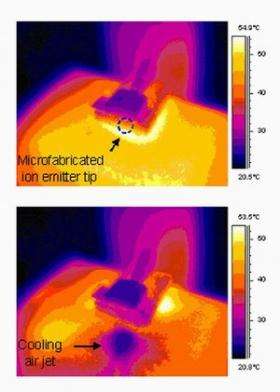
University of Washington researchers have succeeded in building a cooling device tiny enough to fit on a computer chip that could work reliably and efficiently with the smallest microelectronic components.
The device, which uses an electrical charge to create a cooling air jet right at the surface of the chip, could be critical to advancing computer technology because future chips will be smaller, more tightly packed and are likely to run hotter than today's chips. As a result, tomorrow's computers will need cooling systems far more efficient than the fans and heat sinks that are used today.
"With this pump, we are able to integrate the entire cooling system right onto a chip," said Alexander Mamishev, associate professor of electrical engineering and principal investigator on the project. "That allows for cooling in applications and spaces where it just wasn't realistic to do before."
The micro-pump also represents the first time that anyone has built a working device at this scale that uses this method, Mamishev added.
"The idea has been around for several years," he said. "But until now it hasn't been physically demonstrated in terms of a working prototype."
Mamishev and doctoral students Nels Jewell-Larsen and Chi-Peng Hsu presented a paper on the device at the American Institute of Aeronautics and Astronautics/American Society of Mechanical Engineers Joint Thermophysics and Heat Transfer Conference earlier this summer and are scheduled to give an additional presentation this fall. In addition, the UW researchers and collaborators with Kronos Advanced Technologies and Intel Corp. have been awarded a $100,000 grant from the Seattle-based Washington Technology Center for the second phase of the project.
The device utilizes an electrical field to accelerate air to speeds previously possible only with the use of traditional blowers. Trial runs showed that the prototype device significantly cooled an actively heated surface on just 0.6 watts of power.
The prototype cooling chip contains two basic components: an emitter and a collector. The emitter has a tip radius of about 1 micron -- so small that up to 300 tips could fit across a human hair. The tip creates air ions, electrically charged particles that are propelled in an electric field to the collector surface. As the ions travel from tip to collector, they create an air jet that blows across the chip, taking heat with it. The volume of the airflow can be controlled by varying the voltage between the emitter and collector.
The findings are significant for future computing applications, which will incorporate denser circuitry to boost computing power. More circuitry equals more heat and a greater need for innovative cooling technologies that go beyond bulky, noisy and relatively inefficient fans and heat sinks -- metal plates with fins to increase surface area and help dissipate heat. Circulating liquids among the chips to draw away heat is one possibility, but computer chips and liquids don't mix well; the cost of a cooling system breakdown could be steep.
"Our goal is to develop advanced cooling systems that can be built right onto next-generation microchips," Jewell-Larsen said. "Such systems could handle both the increased heat generation of future chips and the fact that they would be distributed throughout a computer or electronic device."
Added Mamishev: "It promises a new dimension in thermal management strategy and design."
A few challenges remain, he added. One involves developing the mathematical models to control vast systems of chips with built-in coolers.
"These pumps end up being very complicated, dynamic systems," Mamishev said. "You have flow on a microscale, electrohydrodynamic forces, electrical fields and moving charges."
A second challenge is identifying the best materials to use in building devices that are high-performing and durable.
"There is evidence that nanotubes and other nano-structures could give significant performance gains," Jewell-Larsen said. "Those are avenues we are currently pursuing."
Source: University of Washington


