Researchers aim to close 'green gap' in LED technology
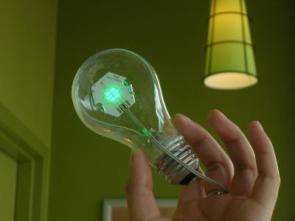
A team of researchers from Rensselaer Polytechnic Institute has received $1.8 million in federal funding to improve the energy efficiency of green light-emitting diodes (LEDs). As part of the U.S. Department of Energy's (DOE) Solid-State Lighting Program, the team aims to close the "green gap" in LED technology by doubling or tripling the power output of green LEDs in three years, an advance that ultimately could lead to the replacement of incandescent and fluorescent lamps in general illumination applications.
"Making lighting more efficient is one of the biggest challenges we face," says Christian Wetzel, the Wellfleet Career Development Constellation Professor, Future Chips, and associate professor of physics at Rensselaer.
"Substantial reductions in the nation's dependence on primary energy imports will be possible once highly efficient solid-state light sources replace wasteful incandescent and fluorescent lighting."
Wetzel will be leading a team of scientists and engineers attempting to help meet the aggressive performance targets laid out in DOE's solid-state lighting accelerated roadmap, which calls for the development by 2025 of advanced solid-state lighting technologies that are much more energy efficient, longer lasting, and cost competitive than conventional lighting technologies.
The prime contender to meet this goal, according to Wetzel, is a white-light unit made from a combination of high-performance red, blue, and green LEDs. Researchers have made major strides in advancing the design of red and blue LEDs, but the technology behind green LEDs has lagged behind substantially, he says.
Wetzel notes that green light is an essential piece of the puzzle because it addresses the peak of the human eye's sensitivity, providing balance to the colors of red and blue light.
Researchers originally discovered that green LEDs could be made by simply adding indium (In) to the gallium nitride (GaN) materials that composed blue LEDs, but the materials produced to date have been inefficient, resulting in green LEDs that are too dim to be used for lighting homes and offices.
"The indium segregates under certain conditions, clustering in areas where there are already defects in the material," Wetzel says. A correlation between the indium clustering and the limited device performance has been proposed, but Wetzel suggests that this may just be a coincidence.
He plans to focus instead on aspects of the "piezoelectric effect" - a property of some materials that causes them to produce an electrical field when pressure is applied. By controlling this effect, he and his colleagues hope to develop a process to make higher-intensity green LEDs that convert electricity into light more efficiently.
Wetzel will be collaborating with co-principal investigator E. Fred Schubert, the Wellfleet Senior Constellation Professor of the Future Chips Constellation at Rensselaer, as well as Theeradetch Detchprohm, a research associate in Wetzel's lab, and four Rensselaer graduate students: Yong Xia, Wei Zhao, Yufeng Li, and Mingwei Zhu.
The team will be partnering with Kyma Technologies Inc., a developer of gallium nitride (GaN) substrates and related products and services to the nitride semiconductor device market; and Crystal IS Inc., maker of single-crystal aluminum nitride (AlN) substrates for the production of optoelectronic devices such as blue and ultraviolet lasers.
The research was one of 16 projects selected for funding through DOE's Solid-State Lighting Core Technologies Funding Opportunity Announcement, which seeks to support multiple enabling or fundamental solid-state lighting technology areas for general illumination applications. The selections are expected to fill key technology gaps, provide enabling knowledge or data, and represent a significant advancement in the solid-state lighting technology base, according to DOE.
Source: Rensselaer Polytechnic Institute


