Huge Black Holes Stifle Star Formation
August 23, 2006
Huge Black Holes Stifle Star Formation

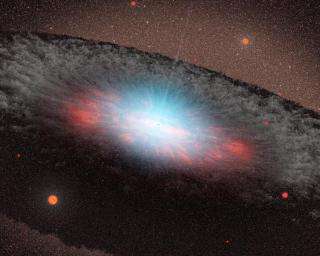
This artist's concept depicts a supermassive black hole at the center of a galaxy. The blue color here represents radiation pouring out from material very close to the black hole. The grayish structure surrounding the black hole, called a torus, is made up of gas and dust. Image credit: NASA/JPL-Caltech

Supermassive black holes in some giant galaxies create such a hostile environment, they shut down the formation of new stars, according to NASA Galaxy Evolution Explorer findings published in the August 24 issue of Nature.

The orbiting observatory surveyed more than 800 nearby elliptical galaxies of various sizes. An intriguing pattern emerged: the more massive, or bigger, the galaxy, the less likely it was to have young stars. Because bigger galaxies are known to have bigger black holes, astronomers believe the black holes are responsible for the lack of youthful stars.

"Supermassive black holes in these giant galaxies create unfriendly places for stars to form," said Dr. Sukyoung K. Yi of Yonsei University in Seoul, Korea, who led the research team. "If you want to find lots of young stars, look to the smaller galaxies."

Previously, scientists had predicted that black holes might have dire consequences for star birth, but they didn't have the tools necessary to test the theory. The Galaxy Evolution Explorer, launched in 2003, is well-suited for this research. It is extremely sensitive to the ultraviolet radiation emitted by even low numbers of young stars.
Huge Black Holes Stifle Star Formation

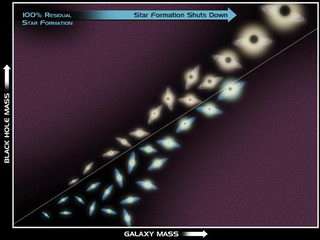
This diagram illustrates the trend observed by the Galaxy Evolution Explorer: the biggest galaxies and black holes (shown in upper right corner) are less likely to have any observable star formation (red) than the smaller galaxies with smaller black holes. This is evidence that black holes can create environments unsuitable for stellar birth. Image credit: NASA/JPL-Caltech/Yonsei University

Black holes are monstrous heaps of dense matter at the centers of galaxies. Over time, a black hole and its host galaxy will grow in size, but not always at the same rate.

Yi and his collaborators found evidence that the black holes in elliptical galaxies bulk up to a critical mass before putting a stop to star formation. In other words, once a black hole reaches a certain size relative to its host galaxy, its harsh effects become too great for new stars to form. According to this "feedback" theory, the growth of a black hole slows the development of not only stars but of its entire galaxy.

How does a black hole do this? There are two possibilities. First, jets being blasted out of black holes could blow potential star-making fuel, or gas, out of the galaxy center, where stars tend to arise.

The second theory relates to the fact that black holes drag surrounding gas onto them, which heats the gas. The gas becomes so hot that it can no longer clump together and collapse into stars.

Source: Jet Propulsion Laboratory/NASA

4.4 /5 (43 votes)  

Rank 4.4 /5 (43 votes)
Tags

Related Stories
Relevant PhysicsForums posts
  • Never ending outer space.....
    created7 hours ago
  • Neutron Star fragments?
    created9 hours ago
  • stationary or not?
    created13 hours ago
  • Scale of the Universe
    createdFeb 10, 2012
  • Titan's lack of impact craters
    createdFeb 09, 2012
  • Real pictures of black hole eating a star?
    createdFeb 08, 2012
  • More from Physics Forums - General Astronomy

More news stories

Latin America mining boom clashes with conservation

Latin America is experiencing a mining boom as prices rise fuelled by a hike in global demand, but the region is also being hit by a wave of violent protests, strikes and rallies by environmentalists.

Space & Earth / Environment

created 5 minutes ago | popularity not rated yet | comments 0

Europe stakes billion-dollar bet on new rocket

A pencil-slim rocket is scheduled to lift into space from South America on Monday, carrying a billion-dollar bet that Europe can grab a juicy slice of the market to place satellites in low orbit.

Space & Earth / Space Exploration

created 19 hours ago | popularity 3.5 / 5 (2) | comments 0

Political leaders play key role in how worried Americans are by climate change: study

More than extreme weather events and the work of scientists, it is national political leaders who influence how much Americans worry about the threat of climate change, new research finds.

Space & Earth / Environment

created Feb 06, 2012 | popularity 5 / 5 (6) | comments 72

NASA budget will axe Mars deal with Europe: scientists

US President Barack Obama's budget proposal to be submitted next week for 2013 will cut NASA's budget by 20 percent and eliminate a major partnership with Europe on Mars exploration, scientists said Thursday.

Space & Earth / Space Exploration

created Feb 10, 2012 | popularity 5 / 5 (3) | comments 48

Humans may have helped the decline of African rainforests 3000 years ago

(PhysOrg.com) -- Large areas of rainforests in Central Africa mysteriously disappeared over three thousand years ago, to be replaced by savannas. The prevailing theory has been that the cause was a change ...

Space & Earth / Environment

created Feb 10, 2012 | popularity 4.1 / 5 (14) | comments 20 | with audio podcast report


Love a click away in Indonesia's Twitter Republic

He was a geeky kid from Yogyakarta, she a glamorous city girl in Jakarta. In a country with one of the world's most vibrant social networking scenes they fell in love on Twitter.

Walney offshore wind farm is world's biggest (for now)

(PhysOrg.com) -- The Walney wind farm on the Irish Sea--characterized by high tides, waves and windy weather--officially opened this week. The farm is treated in the press as a very big deal as the Walney ...

GPS court ruling leaves US phone tracking unclear

A US Supreme Court decision requiring a warrant to place a GPS device on the car of a criminal suspect leaves unresolved the bigger issue of police tracking using mobile phones, legal experts say.

Europeans protest controversial Internet pact

Tens of thousands of people marched in protests in more than a dozen European cities Saturday against a controversial anti-online piracy pact that critics say could curtail Internet freedom.

Study finds that anti-diabetic medication can prevent the long-term effects of maternal obesity

In a study to be presented today at the Society for Maternal-Fetal Medicine's annual meeting, The Pregnancy Meeting, in Dallas, Texas, researchers will report findings that show that short therapy with the anti-diabetic medication ...

Netflix settlement trims 14 pct off 4Q earnings

(AP) -- Netflix pressed the rewind button on its fourth-quarter earnings after settling allegations that the video subscription service violated a consumer-privacy law.