The Final IAU Resolution on the definition of 'planet' ready for voting
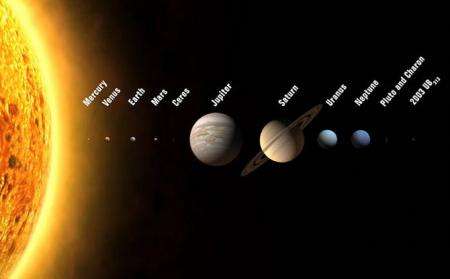
At the second session of the 2006 International Astronomical Union (IAU) General Assembly, which will be held 14:00 CEST (08:00 EDT) Thursday 24 August, members of the IAU will vote on the Resolutions presented below. There will be separate sequential votes on Resolution 5A and Resolution 5B. Similarly, there will be separate votes on Resolutions 6A and 6B.
Following active discussion among IAU scientists at the IAU 2006 General Assembly in Prague, draft Resolution 6b (issued 16 August 2006) has been updated and amended.
IAU President Ron Ekers says: "IAU's rules for proposing resolutions are based on an open democratic process and it is a great pleasure for the IAU Executive Committee to see the level of engagement of so many astronomers here. We want to engage as broad a part of the IAU community as possible in the decision-making process to give this Resolution the best chance to be passed."
Below are the full texts of "IAU Resolution 5a for GA-XXVI", "IAU Resolution 5b for GA-XXVI" and "IAU Resolution 6a for GA-XXVI" and "IAU Resolution 6b for GA-XXVI". The voting will take place in four steps.
The voting on these Resolutions is expected to end today (Thursday 24 August) between 15:30 and 16:00 CEST.
According to the revised Statutes approved at the First Session of the General Assembly last week, scientific issues such as Resolutions are decided by majority of those IAU members present and voting at the business meeting. Thus the scientific resolutions, including those on the definition of solar system bodies, will be presented and decided by voting of the individual members. Yellow ballots will be handed out to all IAU members at the entrance. Members will vote by raising these ballots in the air; the number of raised ballots will be counted. The result of the vote should be known shortly thereafter and will be communicated in a public statement.
RESOLUTIONS
Resolution 5A is the principal definition for the IAU usage of "planet" and related terms. Resolution 5B adds the word "classical" to the collective name of the eight planets Mercury through Neptune.
Resolution 6A creates for IAU usage a new class of objects, for which Pluto is the prototype. Resolution 6B introduces the name "plutonian objects" for this class. The Merriam-Webster dictionary defines "plutonian" as:
Main Entry: plu • to • ni • an
Pronunciation: plü-'tO-nE-&n
Function: adjective
Usage: often capitalized
: of, relating to, or characteristic of Pluto or the lower world
After having received inputs from many sides -- especially the geological community -- the term "Pluton" is no longer being considered.
IAU Resolution: Definition of a Planet in the Solar System
Contemporary observations are changing our understanding of planetary systems, and it is important that our nomenclature for objects reflect our current understanding. This applies, in particular, to the designation 'planets'. The word 'planet' originally described 'wanderers' that were known only as moving lights in the sky. Recent discoveries lead us to create a new definition, which we can make using currently available scientific information.
RESOLUTION 5A
The IAU therefore resolves that planets and other bodies in our Solar System be defined into three distinct categories in the following way:
(1) A planet1 is a celestial body that (a) is in orbit around the Sun, (b) has sufficient mass for its self-gravity to overcome rigid body forces so that it assumes a hydrostatic equilibrium (nearly round) shape, and (c) has cleared the neighbourhood around its orbit.
(2) A dwarf planet is a celestial body that (a) is in orbit around the Sun, (b) has sufficient mass for its self-gravity to overcome rigid body forces so that it assumes a hydrostatic equilibrium (nearly round) shape2, (c) has not cleared the neighbourhood around its orbit, and (d) is not a satellite.
(3) All other objects3 orbiting the Sun shall be referred to collectively as "Small Solar System Bodies".
--------------------------------------------------------------------------------
1The eight planets are: Mercury, Venus, Earth, Mars, Jupiter, Saturn, Uranus, and Neptune.
2An IAU process will be established to assign borderline objects into either dwarf planet and other categories.
3These currently include most of the Solar System asteroids, most Trans-Neptunian Objects (TNOs), comets, and other small bodies.
--------------------------------------------------------------------------------
RESOLUTION 5B
Insert the word "classical" before the word "planet" in Resolution 5A, Section (1), and footnote 1. Thus reading:
(1) A classical planet1 is a celestial body . . .
and
--------------------------------------------------------------------------------
1The eight classical planets are: Mercury, Venus, Earth, Mars, Jupiter, Saturn, Uranus, and Neptune.
--------------------------------------------------------------------------------
IAU Resolution: Pluto
RESOLUTION 6A
The IAU further resolves:
Pluto is a dwarf planet by the above definition and is recognized as the prototype of a new category of trans-Neptunian objects.
RESOLUTION 6B
The following sentence is added to Resolution 6A:
This category is to be called "plutonian objects."
Source: IAU


