Insect predation sheds light on food web recovery after the dinosaur extinction
The recovery of biodiversity after the end-Cretaceous mass extinction was much more chaotic than previously thought, according to paleontologists. New fossil evidence shows that at certain times and places, plant and insect diversity were severely out of balance, not linked as they are today.
The extinction took place 65.5 million years ago. Labeled the K-T extinction, it marks the beginning of the Cenozoic Era and the Paleocene Epoch.
"The K-T caused major extinction among North American plants and insects. The Western Interior U.S. was a dead zone for plants and plant-insect food webs," said Dr. Peter Wilf, assistant professor of geosciences and the David and Lucile Packard Fellow. "We know that right after the extinction, for 800,000 years, there was very low insect predation and plant diversity. We know that 9 million years afterwards, there was renewed diversity in both plants and insects. What happened in the 8 million years in between?
"In modern forests, insect diversity tracks plant populations. If there are few plants, there are few insects, and that is what we expected to see and mostly found throughout the 10-million-year Paleocene. However, we looked extremely hard to test this conventional wisdom and found some shocking exceptions that have given us new ideas about how food webs recover from mass extinction," he added.
The researchers include Wilf; Conrad C. Labandeira, curator, fossil arthropods, the Smithsonian Institution; and Kirk R. Johnson, vice president for research and collections, and Beth Ellis, paleobotany researcher, Department of Earth Sciences, Denver Museum of Nature and Science. They reported their findings in today's (Aug. 25) issue of Science.
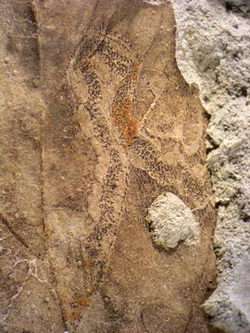
The researchers analyzed insect-feeding damage on 14,999 fossil leaves from flowering plants found at 14 sites, 4 from latest Cretaceous, 9 from early and late Paleocene and 1 from early Eocene rocks in Wyoming, Colorado, Montana and North Dakota. Insects eat leaves in many different ways, including chewing, mining, galling, and piercing and sucking; their diverse feeding marks preserve well in the rock record, often when insect body fossils are absent, and give researchers a proxy for both plant and insect diversity from the same fossils.
The majority of the samples followed expectations: the Cretaceous sites were rich in plants and insect-feeding diversity, and the latest Paleocene and Eocene sites showed signs of recovery. Through most of the intervening Paleocene, most floras have low richness of plants and insect damage. Typical numbers of species of plants in the Paleocene range between 15 and 20 at the sites, with many of the same species found throughout the Paleocene. Insect predation was low as well.
In sharp contrast, the team also found two unusual early Paleocene sites. The first, a previously identified site in the Denver basin, in the town of Castle Rock, showed great plant diversity, especially when compared with the other Paleocene floras.
The researchers found nearly 200 different species with thick leaves and drip tips, indicating a tropical rainforest completely unlike the other Paleocene floras. This site was on the eastern slope of the Paleocene Front Range, and Johnson and Ellis' work, as well as recent paleoclimate modeling simulations, has suggested that the local geography allowed high rainfall. While this site shows many different plant species 1.7 million years after the K-T extinction, predation by insects, as seen in preserved mines and galls on the fossil leaves unexpectedly was as low as in other Paleocene sites.
The second site, known as Mexican Hat, in southeastern Montana was even more intriguing.
"We looked at more than 2,000 specimens at Mexican Hat and found the usual 16 species of plants,” said Wilf. "But the insect mines were unlike anywhere else in North America."
The researchers found heavy and diverse insect damage; all abundant species were mined, and the four major species each showed more than one kind of mining.
"The mines show great abundance and taxonomic breadth," said Wilf. "There are fly, wasp and moth mines on the sycamores. We have not seen this kind of saturation of a flora with insect feeding anywhere else in North America, even in the Cretaceous before the extinction."
What made this happen at Mexican Hat? The researchers do not know because to date, it is the only example of high insect-feeding diversity on a Paleocene flora. The heavy insect population did not apparently spread from Mexican Hat and perpetuate through time because the same plants at younger sites do not have the feeding associations seen at Mexican Hat.
Wilf suggests that the K-T extinction destroyed the ecological links in the food web. Plants and insects were killed outright, and herbivorous insects took a further hit when the plants they were specialized to eat disappeared. Surviving insects faced the choice of shifting their food resource or dying. Many died, but in most places a few survived, and from these, some evolved to feed on new host plants.
As the ecosystem rebuilt new links from its shattered state, the empty ecological space was open to opportunism, and in a few places the food chain became unbalanced and unstable. At Castle Rock, plants flourished in the warm wet climate and without insect predatory pressure -- possibly because their rainforest-type leaves were already thick, tough, and hard to eat -- plant species proliferated and thrived for a short time. At Mexican Hat, 16 species of mostly thin-leaved, poorly defended, typical Paleocene plants temporarily became the hosts to diverse swarms of insects that then disappeared.
This decoupling of producer and consumer diversity after mass extinction is a new pattern for the fossil record that researchers can now test for its generality.
"Temporally and geographically isolated occurrences of severely unbalanced food webs may be a widespread feature of ecological recovery from mass extinction, resulting from instability, incumbency and opportunism in drastically simplified ecological landscapes," say the authors.
Source: Penn State


