U-M physics researchers chosen to study space mission
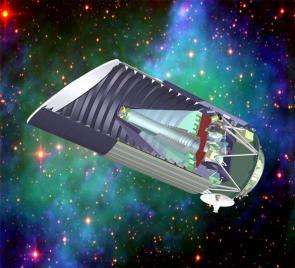
Researchers from the University of Michigan Physics Department are part of an international team that has been chosen by NASA to study a proposed Joint Dark Energy Mission.
The U-M physicists' role in the research is to develop the infrared light detectors that will be mounted on a satellite to be launched into space to study dark energy.
U-M has been involved with the team, called SNAP (SuperNova/Acceleration Probe), which is funded by the Department of Energy for about five years, said Gregory Tarlé, a professor of physics who is leading the Michigan group. It is the hope that this SNAP program will ultimately be chosen as the team to study the dark energy when the satellite is launched.
SNAP is an experiment designed to learn the nature of dark energy by precisely measuring the expansion history of the universe by looking at exploding stars called supernovae.
Discovered in 1998, dark energy is now believed to make up 75 percent of the universe. Unlike matter, which slows the expansion of the universe, dark energy causes the expansion to accelerate.
"By observing thousands of type Ia supernovae, we will track the expansion history of the universe and determine the nature of dark energy," Tarlé said.
The Dark Energy Task Force commissioned by NASA, DOE, and the National Science Foundation has called dark energy among the most compelling of all outstanding problems in physical science.
U-M scientists Myron Campbell, David Gerdes, Wolfgang Lorenzon, Tim McKay, Michael Schubnell and Shawn McKee, along with several undergraduate students and research engineer Bruce Bigelow and graduate student Matthew Brown, are working with Tarlé, the SNAP infrared coordinator, to develop the near-infrared system for the SNAP telescope.
SNAP Web site: snap.lbl.gov/
Source: University of Michigan


