Philips showcases production-ready Lumalive textile garments
August 24, 2006
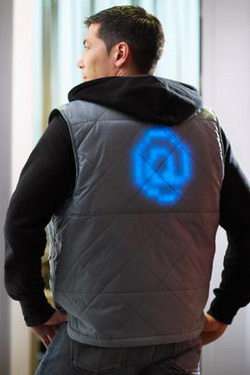
On jackets containing the Philips Lumalive fabrics dynamic advertisements, graphics and constantly changing color surfaces can be displayed. Photo: Philips
Philips Research intends to impress the visitors at this year’s IFA (Internationale Funkausstellung) with a world-first demonstration of promotional jackets and furniture featuring its innovative Lumalive technology. Lumalive textiles make it possible to create fabrics that carry dynamic advertisements, graphics and constantly changing color surfaces.
Although the technology has been developed only recently —early prototypes were exhibited at IFA 2005— Philips Research has made immense progress in fully integrating Lumalive fabrics into garments demonstrated by the jackets worn by Philips’ hostesses at the show. These first-generation jackets are ready for commercialization by companies partnering with Philips Research, particularly those in the promotional industry looking for a new, high-impact medium.
Lumalive fabrics feature flexible arrays of colored light-emitting diodes (LEDs) fully integrated into the fabric - without compromising the softness or flexibility of the cloth. These light emitting textiles make it possible to create materials that can carry dynamic messages, graphics or multicolored surfaces. Fabrics like drapes, cushions or sofa coverings become active when they illuminate in order to enhance the observer’s mood and positively influence his/her behavior.
The jackets are comfortable to wear, and the Lumalive fabrics only become obvious when they light up to display vivid colored patterns, logos, short text messages or even full color animations. The electronics, batteries and LED arrays are fully integrated and invisible to the observer and wearer. The jackets feature panels of up to 200 by 200 mm², although the active sections can be scaled up to cover much larger areas such as a sofa.
“Taking the Lumalive fabrics from prototypes to integrated products has been a major challenge,” said Bas Zeper, Managing Director of Photonic Textiles, Philips Research. “The light emitting textiles have to be flexible, durable and operated by reasonably compact batteries. Fitting all that into a comfortable, lightweight garment is a considerable engineering success.”
“What Philips Research showed last year were research prototypes; this year the jackets and furniture represent versions that are ready to go into commercial production, and include integrated power sources and control electronics,” said Zeper.
The products include features that make them practical for daily use. For example, when integrating the Lumalive fabrics into the garment Philips Research has made the parts that can’t be easily washed — such as the batteries and control electronics—simple to disconnect and reconnect after the garment has been cleaned. Even the light-emitting layer can be easily removed and refitted to the jacket.
Source: Philips
-
India army offers 'glacier toilet' in hi-tech sell-off
Jan 03, 2012 |
4.3 / 5 (3) |
0
-
Childhood hypersensitivity linked to OCD
Dec 27, 2011 |
4.5 / 5 (2) |
0
-
Cotton fabric cleans itself when exposed to ordinary sunlight
Dec 14, 2011 |
4.3 / 5 (21) |
12
-
Google donating $11.5M to fight modern slavery
Dec 14, 2011 |
not rated yet |
0
-
A natural dye obtained from lichens may combat Alzheimer's disease
Dec 02, 2011 |
5 / 5 (3) |
0
-
Engineers build first sub-10-nm carbon nanotube transistor
Feb 01, 2012 |
4.9 / 5 (28) |
26
-
Something old, something new: Evolution and the structural divergence of duplicate genes
Jan 31, 2012 |
4.6 / 5 (7) |
1
-
The hidden nanoworld of ice crystals: Revealing the dynamic behavior of quasi-liquid layers
Jan 30, 2012 |
5 / 5 (3) |
1
-
Stock market network reveals investor clustering
Jan 27, 2012 |
4 / 5 (22) |
8
-
Of microchemistry and molecules: Electronic microfluidic device synthesizes biocompatible probes
Jan 26, 2012 |
5 / 5 (1) |
0
-
Flow around a reducing bend - effect on pumping work
7 hours ago
-
Formula for deflection of 6061 T6 hollow tube, please help.
12 hours ago
-
Help to make a Unit Hydrograph of Reservoir Level - Storage Curve for a Dam
22 hours ago
-
Heating frozen water pipes by induction?
Feb 05, 2012
-
Bending around sheave or pulley
Feb 05, 2012
-
Electric company meter reading
Feb 05, 2012
- More from Physics Forums - General Engineering
More news stories
Airborne robot swarms are making complex moves (w/ video)
(PhysOrg.com) -- The GRASP Lab at the University of Pennsylvania this week released a video that shows their new look in GRASP Lab robotic flying devices. They are now showing flying devices with more complex ...
New Nokia phone no standout, but worth a look
The first of Nokia's new generation of smartphones isn't flashy and certainly isn't an iPhone killer. But it's a nice device, and at $40 with a two-year contract, a bargain.
Electronics / Consumer & Gadgets
Feb 03, 2012 |
1 / 5 (2) |
3
Some HTC Android phones found vulnerable to WiFi password leak
(PhysOrg.com) -- The United States Computer Emergency Readiness Team (U-CERT) has issued a warning to users of some HTC Android phones regarding a security vulnerability that has been found. The warning pert ...
New Vizio HD-TV breaks wide-screen barrier for movies, apps
The shape of TVs to come might be even wider than wide-screen. Today's high-definition sets evolved to a rectangular 16-by-9 shape from the more square analog TVs. But a wider 21-by-9 display standard is in ...
Electronics / Consumer & Gadgets
Jan 30, 2012 |
3.8 / 5 (4) |
1
Studying butterfly flight to help build bug-size flying robots
To improve the next generation of insect-size flying machines, Johns Hopkins engineers have been aiming high-speed video cameras at some of the prettiest bugs on the planet. By figuring out how butterflies ...
Feb 02, 2012 |
5 / 5 (2) |
1
|
Our Amorphophallus is smaller: New plant species from Madagascar smells like roadkill
The famed "corpse flower" plant known for its giant size, rotten-meat odor and phallic shape has a new, smaller relative: A University of Utah botanist discovered a new species of Amorphophallus that i ...
Invasive alien predator causes rapid declines of European ladybirds
A new study provides compelling evidence that the arrival of the invasive non-native harlequin ladybird to mainland Europe and subsequent spread has led to a rapid decline in historically-widespread species ...
New findings highlight the benefit of exercise ECGs just as they are being scrapped
In the UK, the exercise electrocardiogram (ECG) is the most common initial test for the evaluation of stable chest pain and has been used widely for almost half a century. However, recent NICE guidelines recommend that it ...
Long-term study shows epilepsy surgery improves seizure control and quality of life
While epilepsy surgery is a safe and effective intervention for seizure control, medical therapy remains the more prominent treatment option for those with epilepsy. However, a new 26-year study reveals that following epilepsy ...
New DVT guidelines: No evidence to support 'economy class syndrome'
New evidence-based guidelines from the American College of Chest Physicians (ACCP) address the many risk factors for developing a deep vein thrombosis (DVT), or blood clot, as the result of long-distance travel. These risk ...
Obama to seek more Alzheimer's research money
(AP) -- The Obama administration wants to spend just over half a billion dollars on Alzheimer's research next year, hoping to battle back against what could become the defining disease of the aging baby-boom generation.