Nanoscience May Produce 'Perfect' Materials
August 25, 2006 Nanoscience May Produce 'Perfect' Materials

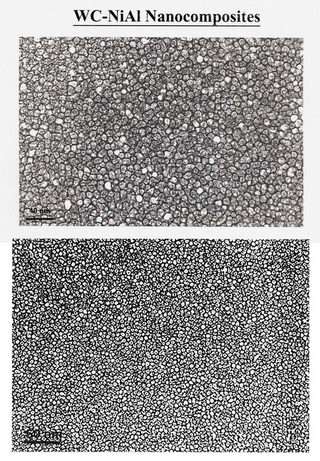
Figure 1: Transmission electron microscope images of WC-NiAl, with (top) an average grain size of 11 nm and (bottom) an average grain size of 6 nm.

Nanoscience may provide a way to engineer materials that are virtually defect-free – perfect, that is.

A scientist at North Carolina State University has discovered that the tiny grains comprising many bulk materials can potentially contain nearly zero structural imperfections when the grains are smaller than a certain critical size, typically a few to several nanometers.

Therefore, materials created with grains of the right size could be structurally flawless. Not only would these materials possess exceptional strength and durablity, but their optical, electrical, and magnetic properties could be vastly improved as well. The number of potential applications, such as smart sensors and ultra-efficient “solid-state” lighting, as well as entire industries impacted, such as automobiles and defense, is staggering.
Nanoscience May Produce 'Perfect' Materials

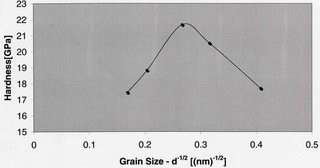
Figure 2: A plot of hardness as a function of grain size for WC-NiAl, with increasing numbers on the x-axis representing decreasing grain size. As grain size gets smaller, the hardness increases, peaking at a critical grain size.

“Nanostructured materials offer a unique opportunity to realize perfect materials with greatly improved properties,” said NCSU materials scientist Jagdish (Jay) Narayan, the study's sole researcher, to PhysOrg.com. “Copper, for example, can be made as strong as steel by reducing the grain/feature size so that defects cease to exist.”

In his paper describing the work, published in the August 7 online edition of the Journal of Applied Physics, Narayan discusses the many types of defects that can be present in a material and shows, via theoretical arguments and a couple of specific examples, how controlling grain size may be able to prevent them.

For example, one type of defect is a dislocation, an irregularity in the repetitive pattern of a crystalline material that compromises strength. It is nearly impossible to eliminate dislocations, Narayan says, but reducing the grain size can theoretically restrict the movement of a dislocation so that it can't propagate through the rest of the material. For copper, he calculates that this will occur at the critical grain size of about 7.5 nanometers (nm).

He provides a specific example of how grain size affects a material's properties, using a nanocomposite material made of two compounds, tungsten carbide (WC) and nickel aluminide (NiAl). The NiAl component acts as a hardening agent, bonding with atoms at the surface of WC nanoparticles. Because WC-NiAl grains are all about the same size, it is a good material for testing how grain size affects hardness. The results show the hardness of WC-NiAl increases as its grain size decreases, but only down to a critical grain size. Below that, the material begins to get softer.

But there are some challenges to overcome before a “perfect” material could truly be achieved. The problems lie at the interfaces between grains, where the surfaces of two grains meet. There, some defects may persist because it is difficult for scientists to control certain properties and grain-to-grain interactions, such as atomic structure, chemistry, and atomic bonding.

Just how difficult is determined by the ratio of surface atoms to inner-grain atoms. As grain size gets smaller, this ratio gets larger – there are more and more surface atoms relative to non-surface atoms. Through additional research, scientists may be able to make adjacent grains come together harmoniously and prevent defects between them.

Citation: Journal of Applied Physics, Volume 100, 0034039 (2006)

By Laura Mgrdichian, Copyright 2006 PhysOrg.com


print this article email this article download pdf blog this article bookmark this article     Stumble it Digg this share on Facebook retweet share on Reddit add to delicious
Rate this story - 4.4 /5 (55 votes)


August 25, 2006 all stories

Comments: 0

4.4 /5 (55 votes)
  • Stumble this up

  • Digg this

  • share this

  • hide
  • Related Stories

  • Research gives new insights into 4 billion year-old meteorites
    created Nov 12, 2009 | popularity not rated yet | comments 0
  • Perfectly proportioned: Working to improve dry compaction and sintering
    created Nov 03, 2009 | popularity not rated yet | comments 0
  • INL scientist is harnessing the power of plasma
    created Oct 27, 2009 | popularity not rated yet | comments 0
  • The perfect cut
    created Aug 07, 2009 | popularity not rated yet | comments 0
  • Membrane breaks through performance barrier
    created Jul 30, 2009 | popularity not rated yet | comments 0


  • hide
  • Relevant PhysicsForums posts

  • Motorcycle
    created 5 hours ago
  • Black bodies
    created 15 hours ago
  • Evaporation of liquid-metal alloys
    created Nov 14, 2009
  • Steam consumption rate
    created Nov 14, 2009
  • Convective heat transfer coefficient
    created Nov 13, 2009
  • Iron powder and epoxy?
    created Nov 13, 2009
  • More from Physics Forums - Materials & Chemical Engineering

Other News

carbon fiber

Ultra-Long Carbon Nanotubes Could Serve as Future Transmission Lines

Nanotechnology / Nanomaterials

created Nov 10, 2009 | popularity 4.9 / 5 (23) | comments 14

(PhysOrg.com) -- When it comes to carbon nanotubes, the majority of research so far has focused on small-scale applications. But now, a team of researchers from Rice University has created carbon nanotubes ...


Researchers turn algae into high-temperature hydrogen source

Researchers turn algae into high-temperature hydrogen source

Nanotechnology / Nanophysics

created Nov 12, 2009 | popularity 3.6 / 5 (7) | comments 5

In the quest to make hydrogen as a clean alternative fuel source, researchers have been stymied about how to create usable hydrogen that is clean and sustainable without relying on an intensive, high-energy ...


Argonne 'homegrown' hybrid solar cell aims for low-cost power

Argonne 'homegrown' hybrid solar cell aims for low-cost power

Nanotechnology / Nanomaterials

created Nov 10, 2009 | popularity 4.2 / 5 (11) | comments 3

(PhysOrg.com) -- Scientists at the U.S. Department of Energy’s (DOE) Argonne National Laboratory have refined a technique to manufacture solar cells by creating tubes of semiconducting material and then "growing" ...


Engineers image nanostructure of a solid acid catalyst and boost its catalytic activity

Nanotechnology / Nanomaterials

created Nov 09, 2009 | popularity 5 / 5 (3) | comments 2

The catalytic processes that facilitate the production of many chemicals and fuels could become much more environmentally friendly thanks to a breakthrough achieved by researchers from Lehigh and Rice Universities.


Scientists develop DNA origami nanoscale breadboards for carbon nanotube circuits

Scientists develop DNA origami nanoscale breadboards for carbon nanotube circuits

Nanotechnology / Nanomaterials

created Nov 10, 2009 | popularity 5 / 5 (7) | comments 0

In work that someday may lead to the development of novel types of nanoscale electronic devices, an interdisciplinary team of researchers at the California Institute of Technology has combined DNA's talent ...