How modern were European Neandertals?
August 25, 2006 How modern were European Neandertals?

Neandertals were much more like modern humans than had been previously thought, according to a re-examination of finds from one of the most famous palaeolithic sites in Europe by Bristol University archaeologist, Professor Joao Zilhao, and his French colleagues.

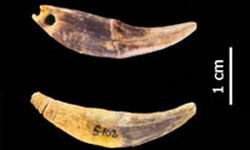
Professor Zilhao has been able to show that sophisticated artefacts such as decorated bone points and personal ornaments found in the Châtelperronian culture of France and Spain were genuinely associated with Neandertals around 44,000 years ago, rather than acquired from modern humans who might have been living nearby. His findings are published in the Proceedings of the National Academy of Sciences (PNAS) USA.

The site from which this Neandertal culture derives its name is the Grotte de Fées at Châtelperron in Central France, first excavated in the 1840s. It has been one of the most important and controversial places to understand how modern humans that had previously moved out of Africa replaced the Neandertals, often portrayed as more ‘primitive’.

In the conventional interpretation of the rock strata of the site, the cave was thought to have evidence of both modern human and Neandertal occupation in interleaved layers. The fact that Neandertals came back to the site after modern humans had lived in it for quite some time would prove the long-term contemporaneity of the two groups, and validate the notion that the cultural novelties seen among the latest Neandertals represented immitation or borrowing, not innovation.

Now archaeologists can show that the Grotte des Fées stratigraphic pattern is illusory because the supposedly Neandertal levels overlying those belonging to the modern human Aurignacian culture are in fact backdirt from nineteenth-century fossil hunting. According to Professor Zilhao and his team, this adds to the evidence from other sites in the region that the Neandertals already had the capacity for symbolic thinking before the arrival of the modern humans into western Europe, which has been radiocarbon dated to around 40,000 years ago.

Professor Zilhao said: “This discovery, along with research on the rock strata at other cave sites, has huge implications for how we view the European Neandertals and, more widely, human evolution. The differences between Neandertals and modern humans may be much less than had been previously thought, suggesting that human cognition and symbolic thinking may date back to before the two sub-species split around 400,000 years ago.”

Source: University of Bristol


Rate this story - 4.7 /5 (33 votes)


August 25, 2006 all stories

Comments: 0

4.7 /5 (33 votes)

  • hide
  • Related Stories

  • Ongoing evolution among modern humans
    created Jan 05, 2010 | popularity not rated yet | comments 0
  • Supervolcano eruption -- in Sumatra -- deforested India 73,000 years ago
    created Nov 23, 2009 | popularity not rated yet | comments 0
  • Researchers Probe Links Between Modern Humans and Neanderthals
    created Sep 19, 2009 | popularity not rated yet | comments 0
  • Diet, population size and the spread of modern humans into Europe
    created Aug 11, 2009 | popularity not rated yet | comments 0
  • Prehistoric Cold Case Hints of Interspecies Homicide
    created Jul 20, 2009 | popularity not rated yet | comments 0


  • hide
  • Relevant PhysicsForums posts

  • Do we lose weight by respiration ? (Losing carbons)
    created 2 hours ago
  • Sleeping habits and the risk of cancer
    created Feb 08, 2010
  • Pressure in chambers of the heart
    created Feb 07, 2010
  • Primordial soup canned?
    created Feb 07, 2010
  • More from Physics Forums - Biology

Other News

Study challenges bird-from-dinosaur theory of evolution - was it the other way around?

Study challenges bird-from-dinosaur theory of evolution - was it the other way around?

Other Sciences / Archaeology & Fossils

created 16 hours ago | popularity 3.7 / 5 (11) | comments 4 | with audio podcast

(PhysOrg.com) -- A new study just published in the Proceedings of the National Academy of Sciences provides yet more evidence that birds did not descend from ground-dwelling theropod dinosaurs, experts say, a ...


TED takes on 'What the world needs now'

Other Sciences / Other

created 4 hours ago | popularity not rated yet | comments 0

Let the mind-bending begin! A TED conference that attracts brilliant minds and challenges them to solve humanity's ills got underway Tuesday in the southern California city of Long Beach.


New research reveals burglars have changed their 'shopping list'

Other Sciences / Social Sciences

created 4 hours ago | popularity 3.5 / 5 (2) | comments 3

Globalisation, and particularly cheaper electronic goods from China and the Far East, has altered behaviour among Britain's burglars according research in progress at the University of Leicester.


'Counterfactual' thinkers are more motivated and analytical, study suggests

Other Sciences / Social Sciences

created 19 hours ago | popularity 4.4 / 5 (5) | comments 6 | with audio podcast

(PhysOrg.com) -- "If only I had..." Almost everyone has said those four words at some time. Rather than intensifying regret, '"what if" reflection about pivotal moments in the past helps people to weave a coherent life story, ...


Office romance? Not a problem most of time: study

Office romance? Not a problem most of time: study

Other Sciences / Social Sciences

created 17 hours ago | popularity not rated yet | comments 1

(PhysOrg.com) -- Pam and Jim on The Office. Meredith and McDreamy on Grey's Anatomy. Television shows depict many workplace romances, but in the real world how do co-workers view love on the job? According ...