Suspicion Confirmed: Flat Molecules Better for Conducting Electricity
August 25, 2006 Suspicion Confirmed: Flat Molecules Better for Conducting Electricity

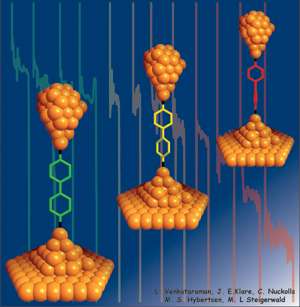
Conductance vs. Conformance: The diagram above illustrates how the conductance of the molecule (the green, yellow or red structure in the center of each model) drops as its two benzene rings are rotated relative to one another. On the far left the molecule is shown in its flattest form, and has the highest conductance. Diagram courtesy of L. Venkataraman.

Columbia research scientist Latha Venkataraman has demonstrated that in creating single-molecule electronic devices, flatter molecules conduct electricity better. That principle has long been suspected, but to demonstrate it definitively required an innovation to existing methods for measuring conductance in nano-scale objects.

The field of nanotechnology involves designing machines and devices on a nanoscale. One of the main challenges for scientists had been in figuring out how to test the conductance of electronic components that consist of a single molecule. Scientists have come up with a number of techniques, but the large fluctuations in the results produced by these techniques have made it difficult to predict how individual molecules will behave as electronic devices.

In her previous research, Venkataraman -- together with her colleagues Jennifer Klare, Colin Nuckolls, Mark Hybertsen and Michael Steigerwald from Columbia’s Nanoscale Science and Engineering Center -- came up with a refinement of one of the prevailing methods for measuring conductance in a molecule. She used a novel amine-gold link to attach single molecules to the gold electrodes (published in Nano Letters in March 2006).

Venkataraman et al. have now applied this technique to provide definitive evidence to support a long-held belief that flatter molecules conduct electricity better than twisted ones.

“Overall, the discovery of the amine-gold link chemistry has been a significant breakthrough in the field of molecular electronics,” said Venkataraman. “It has enabled detailed and systematic studies of single molecule conductance as a function of molecular properties and we can now design, make and test single molecule devices with innovative properties.”

Go to full text of the Nature paper:
Dependence of single-molecule junction conductance on molecular conformation

Source: Columbia University


print this article email this article download pdf blog this article bookmark this article     Stumble it Digg this share on Facebook retweet share on Reddit add to delicious
Rate this story - 4.2 /5 (30 votes)


August 25, 2006 all stories

Comments: 0

4.2 /5 (30 votes)
  • Stumble this up

  • Digg this

  • share this

  • hide
  • Related Stories

  • In touch with molecules
    created Nov 12, 2009 | popularity not rated yet | comments 0
  • Gold solution for enhancing nanocrystal electrical conductance
    created Sep 10, 2009 | popularity not rated yet | comments 0
  • Researchers discover a potential on-off switch for nanoelectronics
    created Mar 03, 2009 | popularity not rated yet | comments 0
  • Single polymer chains as molecular wires
    created Feb 27, 2009 | popularity not rated yet | comments 0
  • Measuring conductance of carbon nanotubes, one by one
    created Dec 15, 2008 | popularity not rated yet | comments 0


  • hide
  • Relevant PhysicsForums posts

  • Average Acceleration
    created 1hour ago
  • God and the Physical Laws
    created 1hour ago
  • Time-varying current in a long straight wire
    created 1hour ago
  • Some Concept Questions
    created 4 hours ago
  • More from Physics Forums - General Physics

Other News

carbon fiber

Ultra-Long Carbon Nanotubes Could Serve as Future Transmission Lines

Nanotechnology / Nanomaterials

created Nov 10, 2009 | popularity 4.9 / 5 (21) | comments 13

(PhysOrg.com) -- When it comes to carbon nanotubes, the majority of research so far has focused on small-scale applications. But now, a team of researchers from Rice University has created carbon nanotubes ...


Researchers turn algae into high-temperature hydrogen source

Researchers turn algae into high-temperature hydrogen source

Nanotechnology / Nanophysics

created Nov 12, 2009 | popularity 3.6 / 5 (7) | comments 5

In the quest to make hydrogen as a clean alternative fuel source, researchers have been stymied about how to create usable hydrogen that is clean and sustainable without relying on an intensive, high-energy ...


Argonne 'homegrown' hybrid solar cell aims for low-cost power

Argonne 'homegrown' hybrid solar cell aims for low-cost power

Nanotechnology / Nanomaterials

created Nov 10, 2009 | popularity 4.2 / 5 (11) | comments 3

(PhysOrg.com) -- Scientists at the U.S. Department of Energy’s (DOE) Argonne National Laboratory have refined a technique to manufacture solar cells by creating tubes of semiconducting material and then "growing" ...


Nanoparticles for gene therapy improve

Nanoparticles for gene therapy improve

Nanotechnology / Bio & Medicine

created Nov 06, 2009 | popularity 5 / 5 (5) | comments 3

(PhysOrg.com) -- About five years ago, Professor Janet Sawicki at the Lankenau Institute in Pennsylvania read an article about nanoparticles developed by MIT's Robert Langer for gene therapy, the insertion ...


In touch with molecules

In touch with molecules

Nanotechnology / Nanophysics

created Nov 12, 2009 | popularity 5 / 5 (2) | comments 2

The performance of modern electronics increases steadily on a fast pace thanks to the ongoing miniaturization of the utilized components. However, se-vere problems arise due to quantum-mechanical phenomena ...