Organs Monitor Themselves During Early Development
How are you? In biological terms this question could involve a feedback loop that lets the body check in on itself and then act on that information. Although feedback loops are essential and they abound in biology, they aren’t well understood. Feedback loops enable an organ such as the liver to detect if it is injured, ascertain if it is growing and developing normally, and if it needs to regenerate itself. When such loops derail, cancer and other diseases can arise.
Scientists at NYU School of Medicine have unraveled the signals in a feedback loop governing ovarian development. This work has been several years in the making and is being published on 27 August in the Advance Online issue of the journal Nature.
“I think our study has indeed important implications that extend beyond understanding of how a gonad such as the ovary develops,” explains Dr. Ruth Lehmann, Ph.D., Julius Raynes Professor of Developmental Genetics and Howard Hughes Medical Investigator. “In every organ, may it be a gonad, a liver, or a thymus, different tissues contribute to the organ, and the growth of the different tissues has to be coordinated both during normal development and during regeneration.”
Tapping into that kind of powerful feedback loop could help treat many kinds of disorders and show how the power of stem cells could be harnessed to help organs call different cell types into action and regenerate, the researchers said. Stem cells are cells that have not yet specialized and can develop into any number of different cell types. They also have the remarkable ability to self-renew indefinitely.
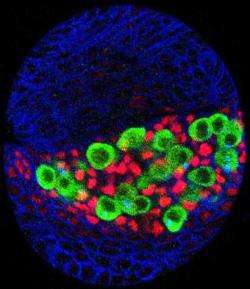
The organism studied is one that does not enjoy much public appreciation but is favored in many genetics labs: Drosophila melanogaster, the fruit fly. Dr. Lehmann and post-doctoral fellow Lilach Gilboa, Ph.D., decoded the process in the developing fruit fly ovary that allows the ovary to monitor the number of germ cells it contains and to correct that number if the need arises. Germ cells are cells that give rise to either sperm or egg and can ultimately give rise to a new organism and all the cells that an organism needs.
This study illustrates how the ovary controls its amount of stem cell precursors, called primordial germ cells (PGCs). Primordial germ cells are important cells. Some of them develop into germline stem cells, which have regenerative powers and others will differentiate into eggs.
Signals, sensors, feedback
A fruit fly takes ten days to go from embryo to larva to pupa to flying insect. The researchers looked at a larval development phase during which the ovary grows remarkably fast. In three days the number of primordial germ cells rises from twelve cells to 100 cells.
The scientists started by looking at larvae with defects that cause them to have too few germ cells. The animal could well mature with this defect and suffer from reduced fertility. But it does not. Instead, they found that the ovary has a way to sense its lack of germ cells and steps up production. “Within three days, the ovary catches up; it then has enough germ cells,” says Dr. Gilboa. “I had not a shred of a clue how this is accomplished, so I set out to understand how the ovary does this.”
There were no experimental tools to let her study the entire process. She needed to be able to test many genes, many conditions, and find markers of those conditions so the results would be visible under the microscope every step of the way. Over several years, Dr. Gilboa developed both the methods and know-how to explore what she calls “a black hole”: the process that transforms an embryonic ovary into an adult one.
As the painstaking experiments reveal, the two cell types that interact in a feedback loop through a signaling pathway are 1) primordial germ cells and 2) intermingled cells, which are neighboring somatic cells in the ovary.
The surface of the intermingled cells is pocked with epidermal growth factor (EGF) receptors, docking ports for signaling molecules. Dr. Gilboa found that primordial germ cells produce a protein called Spitz. This protein is shuttled out of the germ cells and binds to the EGF receptors on the intermingled cells. That docking activates the intermingled cells and is important for their survival.
Spitz acts a bit like a volume control dial. Once it docks onto the EGF receptors, the intermingled cells send a signal to the primordial germ cells to stop growing. Increased EGF signaling in intermingled cells leads to reduced numbers of germ cells. “But if there is very little Spitz, that reduces the number of intermingled cells and thus the number of germ cells will rise,” Dr. Gilboa says.
This feedback loop acts as a sensor that ensures there are sufficient primordial germ cells in the ovary at the end of larval development. The level of EGF signaling is used to keep the amount of germ cells just right, so that there are not too few and not too many of them.
The scientists had a hunch that PGCs and the somatic cells communicate. “Dr. Gilboa’s experiments clearly show there is a feedback mechanism, whereby the PGCs send a signal to the somatic cells to keep them alive and the somatic cells send a signal back to the germ cells, keeping them in check,” says Dr. Lehmann.
The experiments
Using a tool called the Gal4/UAS system, the researchers overexpressed genes of interest. They honed in on a set of signaling molecules in order to interfere or augment particular signaling pathways. They looked at how the interaction between the two types of cells in the ovary plays out. “Somatic cells and primordial germ cells develop in close contact with each other,” says Dr. Gilboa. “Different cell types speak to each other, control each other and function together when an organ grows,” she says. In the human ovary for example, a follicle ripens every month. Without the somatic cells of the ovary, the egg on its own would not ripen. The eggs need this environment for their development, she says.
In every organism, both egg and sperm cells cannot develop unless they are embedded in a matrix of somatic cells, says Dr. Lehmann. Interactions of somatic cells and germ cells are of central importance to germ cell development.
The fly as a model
Why care about the fruit fly? This insect is helping researchers to grasp fundamental principles of biology and body function, explains Dr. Gilboa. “Drosophila inspires scientists in other fields and they can build on those general principles to further their work,” she says. A researcher studying the challenge of infertility in humans could apply this study to his or her own work, Dr. Gilboa explains. Studying a model organism like the fly with its short generation time and ease of handling allows us to address even complicated matters like the development of an organ in a timely and less costly manner than if we used other model organisms such as the mouse, where similar studies would be quite difficult to carry out,” says Dr. Lehmann.
Genetics research is revealing commonalities across species; the fruit fly delivers cues. It is an animal in which processes are first discovered and which are later confirmed in humans. “Evolution works—what works for the fruit fly is the same principle that nature has put in place for us,” says Dr. Gilboa.
The implications of this study are not limited to the ovary, since the mechanism the scientists unearthed sheds light on how an organ—any organ in the body—grows. This work, says Dr. Lehmann, “has established a paradigm that can now be tested for the development of other organs and in other organisms, including the mouse. Eventually findings in model organisms increase our understanding of normal development and disease.”
Source: New York University Medical Center


