Brain's Filing System Uncovered
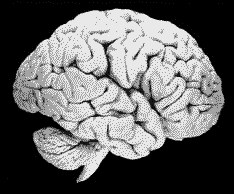
Socks in the sock drawer, shirts in the shirt drawer, the time-honored lessons of helping organize one’s clothes learned in youth. But what parts of the brain are used to encode such categories as socks, shirts, or any other item, and how does such learning take place?
New research from Harvard Medical School (HMS) investigators has identified an area of the brain where such memories are found. They report in the advanced online Nature that they have identified neurons that assist in categorizing visual stimuli. They found that the activity of neurons in a part of the brain called the parietal cortex encode the category, or meaning, of familiar visual images and that brain activity patterns changed dramatically as a result of learning. Their results suggest that categories are encoded by the activity of individual neurons (brain cells) and that the parietal cortex is a part of the brain circuitry that learns and recognizes the meaning of the things that we see.
“It was previously unknown that parietal cortex activity would show such dramatic changes as a result of learning new categories,” says lead author David Freedman, PhD, HMS postdoctoral research fellow in neurobiology. “Some areas of the brain, particularly the frontal and temporal lobes, have been associated with visual categorization. Since these brain areas are all interconnected, an important next step will be to determine their relative roles in the categorization process.”
We are not born with a built-in ability to recognize categories like table, chair, and camera. Instead, most categories such as these are learned through experience. Categories are a cornerstone of complex behavior, because they give meaning to the sights and sounds around us. For example, if you are told that a new electronic gadget is a telephone, this instantly provides a great deal of information about its relevant parts (speaker, microphone, keypad for dialing, etc.) and functions.
While much is known about how the brain processes simple visual features such as colors, angles, and motion-directions, less is known about how the brain learns and recognizes the meaning of stimuli. The process of grouping related visual images into categories allows the brain to organize stimuli according to their meaning and makes it possible for us to quickly make sense of our surroundings.
In these experiments, monkeys were taught to play a simple computer game in which they grouped members of a set of visual motion patterns into one of two categories. Freedman and senior author John Assad, PhD, HMS associate professor of neurobiology, then monitored the activity of neurons in two interconnected brain areas, the parietal cortex and the middle temporal area, while the monkeys played the categorization game. The activity of parietal neurons mirrored the monkeys’ decisions about which of the two categories each visual pattern belonged. In contrast, neurons in the middle temporal area were more sensitive to differences in the visual appearance among the set of motion patterns and did not encode their category membership.
Category representations in the parietal cortex also changed dramatically with learning and experience. Over the course of several weeks, the monkeys were retrained to group the same visual patterns into two new categories. Parietal cortex activity was completely reorganized as a result of this retraining and encoded the visual patterns according to the newly learned categories.
“This research helps to further the understanding of how the brain learns and recognizes the significance, or meaning, of visual images and demonstrates that learning new categories can cause dramatic and long-lasting changes in brain activity,” says Freedman. “We are continuing this work to determine if the parietal cortex is specialized for processing motion-based categories or if it plays a more general role in categorizing other types of visual stimuli, such as shapes, as well.”
Freedman is optimistic that research of this type will eventually contribute to a better understanding of neurological diseases and disorders. “Understanding how the brain learns, stores, recognizes and recalls visual information will help us overcome impairments to these functions caused from brain damage and diseases, including strokes, Alzheimer’s disease, and schizophrenia,” Freedman says.
Source: Harvard Medical School


