Flying on hydrogen
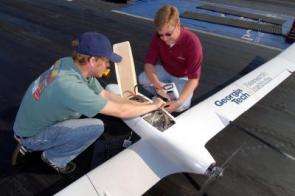
Georgia Institute of Technology researchers have conducted successful test flights of a hydrogen-powered unmanned aircraft believed to be the largest to fly on a proton exchange membrane (PEM) fuel cell using compressed hydrogen.
The fuel-cell system that powers the 22-foot wingspan aircraft generates only 500 watts. "That raises a lot of eyebrows," said Adam Broughton, a research engineer who is working on the project in Georgia Tech's Aerospace Systems Design Laboratory (ASDL). "Five hundred watts is plenty of power for a light bulb, but not for the propulsion system of an aircraft this size." In fact, 500 watts represents about 1/100th the power of a hybrid car like a Toyota Prius.
A collaboration between ASDL and the Georgia Tech Research Institute (GTRI), the project was spearheaded by David Parekh, GTRI's deputy director and founder of Georgia Tech's Center for Innovative Fuel Cell and Battery Technologies.
Parekh wanted to develop a vehicle that would both advance fuel cell technology and galvanize industry interest. While the automotive industry has made strides with fuel cells, apart from spacecraft, little has been done to leverage fuel cell technology for aerospace applications, he noted.
"A fuel cell aircraft is more compelling than just a lab demonstration or even a fuel cell system powering a house," Parekh explained. "It's also more demanding. With an airplane, you really push the limits for durability, robustness, power density and efficiency."
In November, the researchers will present details of the project at the Society of Automotive Engineers' Power System Conference in New Orleans.
Fuel cells, which create an electrical current when they convert hydrogen and oxygen into water, are attractive as energy sources because of their high energy density. Higher energy density translates into longer endurance.
Though fuel cells don't produce enough power for the propulsion systems of commercial passenger aircraft, they could power smaller, slower vehicles like unmanned aerial vehicles (UAVs) and provide a low cost alternative to satellites. Such UAVs could also track hurricanes, patrol borders and conduct general reconnaissance.
Fuel cell powered UAVs have several advantages over conventional UAVs, noted Tom Bradley, a doctoral student in Georgia Tech's School of Mechanical Engineering who developed the fuel cell propulsion system. For starters, fuel cells emit no pollution and unlike conventional UAVs, don't require separate generators to produce electricity for operating electronic components. "Another plus, because fuel cells operate at near ambient temperatures, UAVs emit less of a heat signature and would be stealthier than conventionally powered UAVs," he said.
A few other research groups have also demonstrated hydrogen-powered UAVs, but these aircraft were either very small or used liquid hydrogen. "Compressed hydrogen, which is what the automotive industry is using, is cheaper and easier to work with," said Bradley, "so our research will be easier to commercialize."
In contrast to the smaller UAVs, which had no landing gear and had to be hand launched, Georgia Tech's demonstrator vehicle operates like a full-sized aircraft, requiring no auxiliary batteries or boosters for take-off.
While little information has been released about other hydrogen-powered UAVs, outreach is an important part of Georgia Tech's project. "We are laying the groundwork in design development that others can use to develop hydrogen-powered aircraft," explained Dimitri Mavris, ASDL director and Boeing Professor in Advanced Aerospace Systems Analysis in Georgia Tech's School of Aerospace Engineering. "By documenting the technical challenges we've encountered – as well as our solutions – we provide a baseline for others to follow."
The researchers hope to see many other aircraft take to the skies on power from fuel cells.
"As significant as it is, we are not merely developing a one-of-a-kind airplane," added Parekh. "We're working to define a systems engineering approach for fuel-cell powered flight. We're seeking to blaze a trail that others can follow."
In addition to their upcoming presentation at the Society of Automotive Engineers meeting, the researchers presented papers earlier this year at meetings held by the American Society of Mechanical Engineers and the American Institute of Aeronautics and Astronautics. The project is supported with internal funding from GTRI, along with grants from the National Aeronautics and Space Administration (NASA) and the National Science Foundation (NSF).
"Hydrogen power requires a drastically different approach to aircraft design compared to conventional planes powered by fossil fuels," observed Blake Moffitt, a doctoral student in Georgia Tech's School of Aerospace Engineering who designed much of the aircraft.
To construct the fuel cell power plant, researchers bought a commercial fuel cell stack and modified it extensively, adding systems for hydrogen delivery and refueling, thermal management and air management. They also built control systems, such as data acquisition so information could be transmitted during flight.
Among design challenges:
-- Slim performance margins. Researchers developed innovative computer tools to analyze performance, which enabled them to optimize the propulsion system and aircraft design.
-- Weight management. Creative methods were used to trim pounds, such as using carbon foam for the power plant's radiator.
-- Reducing drag, which the team achieved via long, slender wings (spanning 22 feet), a streamlined fuselage, a rear-mounted propeller and an inverted V-shaped tail.
-- Miniaturization. The fuselage measured 45 inches in length with a maximum width of 9.75 inches and maximum height of 7.25 inches. Finding components small enough to fit in this space required some ingenuity, such as using a pump from a liquid-cooled computer and a hydrogen tank designed for a paintball gun.
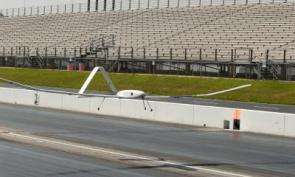
In June, researchers tested the vehicle at the Atlanta Dragway in Commerce, Ga.
Hot, humid, windy weather made testing conditions less than ideal and reduced thrust. Yet researchers were able to conduct four flights, with the aircraft traveling between 2.5 and 3.7 meters above ground for up to a minute at a time.
"Especially important, the data generated during these flights validated our design methodologies," said Moffitt. "The data also indicated the aircraft is capable of longer, higher performance flights."
During the next few months, the team will continue to test and refine the aircraft, making it more reliable and robust. Ultimately, they plan to design and build an UAV capable of a trans-Atlantic flight – something that Parekh believes will be possible within the next five years.
Source: Georgia Institute of Technology


