Wild bees make honey bees better pollinators
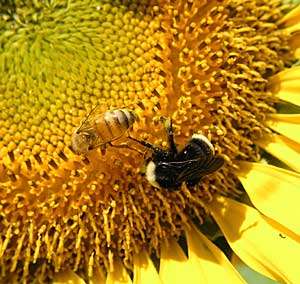
When honey bees interact with wild native bees, they are up to five times more efficient in pollinating sunflowers than when native bees are not present, according to a new study by a pair of researchers at the University of California, Berkeley, and UC Davis.
Coming at a time when populations of honey bees - a species that was imported into the Americas centuries ago - have been decimated by parasitic mites, the findings suggest that protecting wild native bees and their habitat could play a crucial role in ensuring adequate pollination for a host of important crops.
"Up until now, we've thought that honey bees alone were doing most of the pollination," said Sarah Greenleaf, a postdoctoral researcher in plant pathology at UC Davis and the study's lead author. "But now we know that a lot of honey-bee pollination happens because of their interaction with wild native bees. This means that wild bees are much, much more important than we previously thought."
The study is being published in the online early edition of the Proceedings of the National Academy of Sciences the week of Aug. 28, and will appear as the cover story in the journal's Sept. 12 print issue.
Working with conservation biologist Claire Kremen, an assistant professor at UC Berkeley's College of Natural Resources, Greenleaf observed the behavior of honey bees from managed hives and wild native bees in sunflower fields during two growing seasons. The sunflowers were being grown for hybrid seed production on 16 farms in Yolo and Solano counties in Northern California.
In fields where wild bees were rare, a single visit by a honey bee produced an average of three seeds. But as wild bee numbers increased, so did the number of seeds produced per honey bee visit, up to an average of 15 seeds per visit. This was the case when either the richness of the species mix of wild bees increased, or when the absolute number of wild bees increased.
To find out how many flowers a bee pollinated, Greenleaf covered immature sunflower heads with mesh bags. When the flowers were open and ready for pollination, she removed the bag and stood watch until a honey bee landed and went to work. As soon as the bee flew off, she re-bagged the flower head, returning a month later to count the seeds that had been produced.
When Kremen and Greenleaf followed the behavior of their tiny subjects, they discovered the reason for the boost in pollination: Like the captain of a plane switching out of autopilot when she spots a craft nearby, a honey bee alters its flight pattern after meeting up with a wild bee on a sunflower head.
Many plants - including sunflowers used for hybrid seed production - produce two kinds of flowers: pollen-bearing male flowers and nectar-bearing female flowers. In hybrid sunflower seed production, rows of one cultivar that bears only male flowers are interspersed among rows of another cultivar that bears only female flowers.
The researchers explained that because foraging honey bees are specialized workers - some typically collecting pollen and others nectar - anything that causes them to alter their foraging behavior improves the likelihood that they will move between different kinds of flowers, resulting in pollen being transferred to the place where it's needed: on a female flower part.
In the sunflower fields, the researchers found that when pollen-gathering honey bees met up with other honey bees, they generally stuck to their regular routine, foraging down the row from one male plant to the next. A mere 7 percent shifted rows and wound up on a female flower after such an encounter. But after a honey bee encountered a wild bee, 20 percent buzzed off to another row and alighted on female flowers.
"Growers can throw more and more honey bees out there, but they're not going to get more pollination if the bees visit only one of the cultivars," Kremen said. "Wild bees make the honey bees more skittish so they move more frequently between the different cultivars. Each time they move, they have the possibility of transporting the pollen between the rows."
For the sunflower fields in the study, honey bees were stocked at the rate of 1.5 hives per acre. Of the 20,472 bee visits to sunflowers that Greenleaf observed, 72 percent were by honey bees from managed hives and the rest were by 32 different species of native wild bees, including carpenter bees and several bumble bee, leafcutter bee and digger bee species.
Greenleaf found that the wild native bees' pollination efficiency varied depending on species, from 0 to 19 seeds per visit. Overall, direct pollination from wild bees accounted for only 7 percent of total pollination in the sunflower fields. But by provoking honey bees to alter their behavior, wild bees were indirectly responsible for an additional 40 percent of the pollination. Honey bees on their own provided just 53 percent of the pollination.
Native to Europe, Africa and Asia, the honey bee, Apis mellifera, is the principal species used for crop pollination worldwide. Honey bees were brought to the United States by early colonists and immediately spread from managed colonies into the wild.
Since the 1980s, when two species of mites that parasitize honey bees were inadvertently introduced into the United States, populations of honey bees living in the wild have all but disappeared, and the number of managed hives has plummeted from 4 million to 2.4 million. Along with honey bee declines, populations of wild bees are also dropping, Greenleaf said. Habitat loss and "unfriendly farming practices" have both taken a toll.
For crops such as hybrid sunflower, which was already receiving inadequate pollination, declining bee populations may be reducing yields, Greenleaf said.
"We've only recently started to document the services that nature provides us," Kremen said. "In this case, the agents providing services are both commercially available honey bees and the wild bees living in the natural habitat surrounding the farm. The surprising finding here is how important the interaction between honeybees and other species is."
Greenleaf and Kremen said that they would expect to see similar pollination gains in a range of other crops, including hybrid seed crops such as onions and cotton that are produced in the same way as hybrid sunflower seeds; tree crops which require cross-pollination between two cultivars, including almonds, cherries and most apples; and crops that bear separate male and female flowers such as squashes, watermelons and kiwis.
Conserving patches of natural habitat for native bees in agricultural areas could help maintain their populations and provide better pollination for crops, Kremen said. Both in this study and in previous studies she has conducted in various crops, the closer her study plots were to native habitat, the greater the diversity and abundance of native bees.
"Given that we don't have enough honey bees," Greenleaf said, "it's really great that there's a way to make the ones that are left better pollinators."
Source: UC Berkeley, by Liese Greensfelder


