Ancient Raptors Likely Feasted on Early Man
A new study suggests that prehistoric birds of prey made meals out of some of our earliest human ancestors.
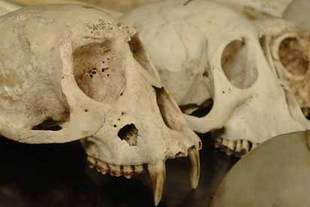
Researchers drew this conclusion after studying more than 600 bones from modern-day monkeys. They had collected the bones from beneath the nests of African crowned eagles in the Ivory Coast’s Tai rainforest. A full-grown African crowned eagle is roughly the size of an American bald eagle, which typically weighs about 10 to 12 pounds.
Punctures and scratches on many of the monkey skulls have led some researchers to rethink which animals may have preyed on our human ancestors, said W. Scott McGraw, the study’s lead author and an associate professor of anthropology at Ohio State University.
“It seems that raptors have been a selective force in primate evolution for a long time,” he said. “Before this study I thought that eagles wouldn’t contribute that much to the mortality rate of primates in the forest.
“I couldn’t have been more wrong.”
The results may also have important implications for the mystery surrounding the death of one human ancestor who lived about 2.5 million years ago.
Archaeologists discovered the skull of a 31⁄2-year old ape-like child in a cave in South Africa in 1924. Researchers believed this child, called the Taung child (Australopithecus africanus), had been killed by a predatory cat. But McGraw said that puncture marks on the monkey skulls he examined closely resemble those found on the skull of the Taung child.
“Eagles leave very distinctive beak and talon punctures around the face and in the eye sockets,” “The skull of the Taung child has these same kinds of puncture marks.”
The study is online at the website of the American Journal of Physical Anthropology, and is scheduled for publication in the journal’s October issue. McGraw conducted the study with Catherine Cooke, a graduate student in anthropology at Ohio State, and with Susanne Schultz, of the University of Liverpool, collected most of the bones for the study.
The best way to learn about an eagle’s prey is to gather the remains that are in or near the raptor’s nest, says McGraw.
“Eagles are ambush predators – they go in for the kill quickly,” said McGraw, who has spent much of the last 15 years studying primates in the Tai rainforest, which is in southwestern Ivory Coast.
“So the chance of actually seeing an eagle attack a monkey is extremely slim,” he continued. “Yet raptors are kind enough to leave all the bones around afterwards. That means we can work backwards and construct a prey profile based on what’s left over.”
Over the course of three years the researchers collected some 1,200 animal bones discarded from 16 African crowned eagle nests. Slightly more than half of the bones (669) belonged to primates. The rest of the bones were from other, non-primate animals that the eagles preyed upon.
Most of the bones in the collection belonged to smaller monkey species, which weigh anywhere from 2.5 to 11.5 pounds as adults. But a third of the monkeys whose bones were part of the sample set would weigh anywhere from 13.5 to 24 pounds when alive. The majority of these bones were from mangabeys, the largest monkey in the Tai forest.
McGraw admitted that this finding surprised him. Mangabeys live primarily on the ground – all of the other monkey species live in the canopy of the rainforest. It makes sense that eagles would zero in on monkeys in trees, as these primates are presumably easier to spot and attack. Also, mangabey populations aren’t as dense as other monkey species in the Tai rainforest.
“It appears that the crowned hawk eagle specifically targets these large, relatively rare monkeys,” McGraw said. “When we consider the density of the average mangabey population, the odds of an eagle encountering one of these monkeys should be small. But these mangabeys are turning up in nests more often than chance alone would predict.”
The finding suggests that birds of this size were quite capable of successfully attacking a young hominid.
Archaeologists think that the Taung toddler weighed around 26 pounds (12 kg). McGraw says that scientists think that a raptor about the same size as a modern-day African crowned eagle may have killed the young hominid.
“Many people thought that an eagle of this size wouldn’t have enough strength to lift a primate the size of the Taung child,” McGraw said. “That’s a non-issue, because eagles don’t hunt and process their kills that way. They typically dismember their prey very quickly, and then take pieces of the carcass back to the nest.”
After identifying the bones, the researchers began to assess actual damage patterns on the bones.
The collection consisted mostly of skulls and the long bones of the hind limbs (namely the femur, or thigh bone, and tibia, a bone in the lower leg.) Smaller, more fragile bones are often destroyed during the attack, and can also rapidly decay in a rainforest environment.
Monkey skulls, shoulder blades and pelvic girdles showed the greatest amount of damage. Most of the skulls were fractured or punctured, presumably from the force applied by the grip of an eagle’s talons. There were fractures in the eye sockets and at the base of most of the skulls, either from beaks or talons that had punctured the bone in order to retrieve soft tissue.
There were noticeable punctures and scrapes across nearly every shoulder blade in the sample. The ends of many of the long hind limb bones had been removed, apparently to get to the marrow inside.
The puncture marks on some of the monkey skulls are very similar to those found on the skull of the Taung child, McGraw said.
“This fossil is probably the most written-about, studied and handled hominid skull ever,” he said. “But almost no one had really bothered to look at skulls discarded from eagle nests. It’s not that the damage was overlooked in the Taung skull, it’s just that we didn’t have the link to make sense of it.”
He went on to say that the punctures in the Taung skull probably aren’t due to damage during the fossilization process; rather, these marks are instead a clue to what killed the small hominid.
“Those marks aren’t from some large predatory cat, they’re from an ancient crowned hawk eagle,” McGraw said.
The evidence from this study is also changing the way McGraw and his colleagues look at predator-prey dynamics.
“The findings suggest that birds of prey have been one of the most important selective forces in primate evolution for a long time,” he said. “There are other primate fossil collections around the world that may deserve a second look for evidence of wounds inflicted by raptors.”
Source: Ohio State University


