Scientists watch supernova in real-time
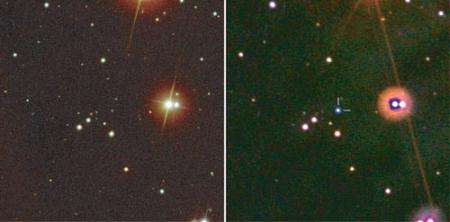
For the first time a star has been observed in real-time as it goes supernova – a mind bogglingly powerful explosion as the star ends its life, the resulting cosmic eruption briefly outshining an entire galaxy. UK scientists, in collaboration with international colleagues, used NASA's Swift satellite and a combination of orbiting and ground-based observatories to catch a supernova in the act of exploding. The results, including an associated and intriguing Gamma Ray Burst [GRB], appear in 31 August issue of Nature.
The event began on the 18th February, 2006, in a star forming galaxy about 440 million light-years away toward the constellation Aries. At that time it was immediately realised that this was an unusual gamma-ray burst, about 25 times closer and 100 times longer than a typical gamma-ray burst. The burst lasted for almost 40 minutes as opposed to a typical GRB of a few milliseconds to tens of seconds. Because the burst was so long Swift was able to observe the bulk of the explosion with all three of its instruments: the Burst Alert Telescope, which detected the burst and relayed the location to ground observatories within 20 seconds; the X-ray telescope [XRT] and Ultraviolet/Optical Telescope [UVOT], which provide high-resolution imagery and spectra across a broad range of wavelengths.
"The fact that Swift can re-point very fast, slewing round to bring the XRT and UVOT to bear on the burst allowed us to get onto it very quickly indeed, enabling us to observe the critically important early behaviour of the event" remarked Dr. Alex Blustin from University College London's Mullard Space Science Laboratory [UCL/MSSL],
Careful, multi-wavelength analysis of space and ground-based observations has now revealed exactly what took place.
The exceptionally long burst, in the form of a jet of high-energy X-rays, pierced through the doomed star from its core and sent out a warning within minutes that a supernova was imminent. As the GRB faded away the massive star blew itself into smithereens.
"This GRB was the most extraordinary evolving object yet seen by Swift," said team member Dr. Paul O'Brien at the University of Leicester. "The three on-board telescopes all detected a slowly brightening then fading object. The results suggest a broad jet expanded into the surroundings but it was accompanied by a slower-moving and incredibly hot - two million degree - bubble of gas produced from the shock-wave of the exploding star".
Swift's three telescopes - covering gamma ray, X-ray, ultraviolet and optical wavelengths - captured X-rays fading to ultraviolet and then optical light, evidence of the shock wave from the explosion pushing exploded star material into the surrounding medium. Dr. Alex Blustin and colleague Dr. Mat Page, also from UCL/MSSL, conducted the analysis of Swift's ultra violet and optical data that tracked the expansion of the shock wave from the explosion.
Paul O'Brien added," This is the first time such an extraordinary event has been seen from a GRB. The thermal component of the supernova shock wave was clearly seen in this case as the GRB itself was fairly modest, some 100 times less than a typical GRB - a mere ten million billion times the power of the Sun!"
UK astronomers from the Universities of Leicester and Hertfordshire were part of a group led by Italy's National Institute for Astrophysics that used the European Southern Observatory's 8.2-metre Very Large Telescope [VLT] in Chile and the University of California's Lick Observatory Shane 3-metre telescope to obtain regularly-sampled optical spectroscopy of the shock wave. Two days later the classical supernova, a glowing cloud of gas powered by the decay of radioactive debris from the dead star, was beginning to outshine the fading shock wave.
Dr Andrew Levan, University of Hertfordshire said," As well as studying the early evolution of the supernova for the first time these observations also show how the material ejected in the explosion evolve in the following days and weeks, the timescales on which supernovae are normally studied". Dr. Levan added," This shows that the supernova associated with this GRB is a transition object, brighter than most supernovae in the universe, but fainter than those previously seen with GRB's. Understanding the reasons for this is a crucial step in understanding why only a small percentage of massive stars can create GRB's".
"Usually these events are not detected until after the supernova has brightened substantially in the optical wavelength, many days after the initial explosion", commented Prof. Keith Mason, UK lead investigator for the UVOT telescope on Swift and CEO of the Particle Physics and Astronomy Research Council [PPARC]," but on this occasion we were able to study the remarkable event in all its glory from the very beginning".
Source: Particle Physics & Astronomy Research Council


