Atmospheric ozone recovering in mid-latitudes, report shows
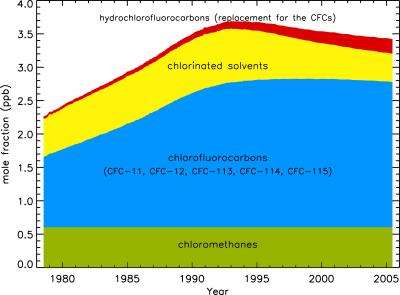
Concentrations of atmospheric ozone -- which protects Earth from the sun's ultraviolet radiation -- are showing signs of recovery in the most important regions of the stratosphere above the mid-latitudes in both the Northern and Southern hemispheres, a new study shows.
Researchers attribute the improvement to both a reduction in ozone-depleting chemicals phased out by the global Montreal Protocol treaty and its amendments and to changes in atmospheric transport dynamics. The study, funded by NASA, is the first to document a difference among stratospheric regions in ozone-level improvement and to establish a cause-and-effect relationship based on direct measurements by multiple satellite and ground-based, ozone-monitoring systems.
"We do think we're on the road to recovery of stratospheric ozone, but what we don't know is exactly how that recovery will happen," said Derek Cunnold, a professor of earth and atmospheric sciences at the Georgia Institute of Technology. "Many in the scientific community think it will be at least 50 years before ozone levels return to the pre-1980 levels when ozone began to decline."
The research results will be published Sept. 9, 2006 in the American Geophysical Union's Journal of Geophysical Research-Atmospheres. Georgia Tech research scientist Eun-Su Yang led the study in close collaboration with Cunnold, Ross Salawitch of NASA's Jet Propulsion Laboratory at the California Institute of Technology, M. Patrick McCormick and James Russell III of Hampton University, Joseph Zawodny of NASA Langley Research Center, Samuel Oltmans of the NOAA Earth System Research Laboratory and Professor Mike Newchurch at the University of Alabama in Huntsville.
The study's data indicate that atmospheric ozone has stopped decreasing in one region and is actually increasing in the other of the two most important lower regions of the stratosphere.
Scientists attribute the stabilization of ozone levels in the past decade in the 11- to 15- mile (18- to 25-kilometer) altitude region to the Montreal Protocol, enacted in 1987, and its amendments. The treaty phased out the use of ozone-depleting chemicals, including chlorofluorocarbons (CFCs) emitted from such sources as spray-can propellants, refrigerator coolants and foam insulation.
In the 7- to 11-mile (11- to 18-kilometer) region, the researchers link a slight increase in ozone to changes in atmospheric transport - perhaps caused by natural variability or human-induced climate warming - rather than atmospheric chemistry. The changes in this altitude range - below the region where ozone-depleting gases derived from human activity are thought to cause ozone depletion - contribute about half of the overall- measured improvement, researchers said.
"There is now widespread agreement in the scientific community that ozone is leveling off in the 18- to 25-kilometer region of the stratosphere because of the Montreal Protocol," Cunnold said. "And we believe there is some tendency toward an increase in ozone in this region, though further study is needed to be certain.
"In the 11- to 18-kilometer region, ozone is definitely increasing because of changes in atmospheric dynamics and transport not related to the Montreal Protocol," he added. "But we don't know the long-term effect this change will have in this region."
Other recent studies complement these new findings. Among them are a study published in 2003 in the Journal of Geophysical Research, which reported a slowdown in the ozone depletion rate in the upper stratosphere at about 22 to 28 miles altitude (35 to 45 kilometers). Newchurch at the University of Alabama in Huntsville led this study in collaboration with: Cunnold, his former Ph.D. advisor; Yang, his former Ph.D. student; and other prominent scientists. Newchurch is also an author on the current paper.
More recently, a study published in the journal Nature on May 3, 2006 indicated a stabilization and slight increase in the total-column stratospheric ozone in the past decade. This work, led by Betsy Weatherhead at the University of Colorado at Boulder, relied on satellite and ground-based ozone data used in 14 modeling studies done by researchers around the world. She and her colleagues also attributed the changes to the Montreal Protocol, but could not separate treaty-related changes from transport-related changes because of limited information available on ozone variations by height.
In the current study, Yang, Cunnold and their co-authors reached their conclusions based on satellite and ground-based atmospheric ozone measurements. They analyzed a tremendous amount of data from three extremely accurate NASA satellite's instruments (SAGE I and II and HALOE) that began collecting data in 1979 and continued until 2005, with the exception of a three-year period in the early 1980s. Ground-based ozone measurements taken by NASA and NOAA from 1979 to 2005 and balloons provided essential complementary data for the study, Yang said. The satellites and the balloons measured ozone levels by atmospheric region. The ground-based data recorded measurements for the total ozone column.
"The ground-based measurements were especially important for the lower atmosphere because satellites can have difficulty in sensing the lowest regions," Yang said.
Salawitch, a senior research scientist at NASA's Jet Propulsion Laboratory, noted: "Our study provides a quantitative measure of a key fingerprint that is lacking in earlier studies -- the response of the ozone layer as function of height. We reconcile the height- dependent response with observations from other instruments that record variations in total-column ozone".
To accurately attribute the ozone level changes to the Montreal Protocol, researchers had to account for long- and short-term natural fluctuations in ozone concentration, Cunnold noted. One such fluctuation is an 11-year solar cycle, and another is a two-year oscillation that occurs in the tropics, but affects ozone in other latitudes because of atmospheric transport. Despite the natural fluctuations, Yang, Cunnold and their co- authors are very confident in the conclusions they reached from the data they analyzed.
"We know from the study we've just published that the Montreal Protocol -- the first major global agreement related to atmospheric change -- is working," Cunnold said.
A new NASA satellite called Aura is continuing to measure ozone in various regions of the stratosphere, and these same researchers are involved in the ongoing study of the ozone layer using the satellite's data.
Source: Georgia Institute of Technology


