New technology uses cell phone positioning data to report traffic tangles
August 30, 2006
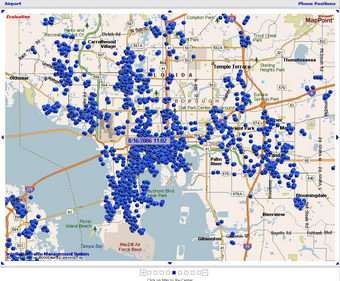
In a snapshot from a single carrier´s network in Tampa, Fla., blue dots represent all active mobile phones -- data sources for the IntelliOne system. Credit: IntelliOne Technologies Corporation
Engineers have developed a system for taking anonymous cell-phone location information and turning it into an illuminated traffic map that identifies congestion in real time.The system takes advantage of the steady stream of positioning cues--untraced signals all cell phones produce, whether in use or not, as they seek towers with the strongest signals. It is the first traffic-solution technology that monitors patterns on rural roads and city streets as easily as on highways.
Developed by IntelliOne of Atlanta, Ga., the TrafficAid system could not only help guide drivers around tie-ups, but also tell emergency responders where accidents are or how effectively an evacuation is unfolding by pinpointing clusters of cell phones.
"Unlike sensors and other equipment along major freeways that is expensive and takes years to deploy, our system takes advantage of existing cellular networks in which wireless carriers have already invested billions of dollars," said National Science Foundation (NSF) awardee and IntelliOne CEO Ron Herman, a former engineer and computer scientist.
Herman was inspired by a friend's demonstration several years ago of a proof-of-concept Palm Pilot software that used real-time California Department of Transportation travel-time data to route the drivers around traffic snarls."I was completely sold," said Herman. "I believed then the next 'killer app' for mobile would demand live traffic data for every road--not just select highways equipped with speed sensors--and set out to make it happen."
Creation and development of TrafficAid was supported in part by a grant from the National Science Foundation's (NSF) Small Business Innovation Research (SBIR) program, which directly supports businesses and their partners in academia. The program supported the new system not only for its consumer applications, but also for its potential impact in industry.
"IntelliOne's capabilities extend beyond the consumer to include support for logistics and fleet management," said Errol Arkilic, the NSF program officer who oversees the IntelliOne award. "Withreal-time management in response to traffic conditions, fleet operators could significantly improve delivery times, reducing fuel and labor costs."
Because TrafficAid does not use personally identifiable data, the servers that generate position and traffic information do not know whose phone is showing up in the data stream, only that a particular phone at a given location is moving at a given speed.
From this information, IntelliOne uses its Mobile Positioning System (MPS) to convert ordinary signaling data into phone locations at a rate of two times per second, which in turn is passed to the company's Traffic Determination Engine (TDE), where each phone is matched to the correct road and monitored with other phone locations to produce average speeds and travel times for all roads with cell coverage.
IntelliOne showcased the system at their Need4Speed demonstration in Tampa Bay, Fla., over a 2-week period beginning in mid-August. Journalists, along with representatives from automakers, mapping and traffic companies and federal agencies, rode in test vehicles that negotiated traffic in real time.
The cars completed routes that included freeways, highways and city streets while comparing the new system to Global Positioning Satellite (GPS) information and the Florida Department of Transportation's 511 system, which includes source data from video cameras, roadside radar and in-pavement monitors.
Unlike traditional GPS navigation systems that depend on 511-type information, TrafficAid updated much more quickly and accurately represented traffic speeds to within 3-5 miles per hour at any given location.
"The Need4Speed test results exceeded our expectations," said Herman."On several occasions, our TDE out performed the 511 field sensors, especially in areas with heavy construction." Herman was also encouraged by the validation from industry leaders, which will help him as he works to build collaborations with wireless carriers. "We look forward to a very busy 2007," he said.
Source: National Science Foundation
-
British firms warned of Olympics Internet gaps
Feb 05, 2012 |
not rated yet |
0
-
For many Indonesians, 'Fesbuk' is the only Internet
Feb 02, 2012 |
4 / 5 (1) |
1
-
Spammers propel India to junk-mail top spot
Jan 01, 2012 |
5 / 5 (2) |
0
-
Many fliers refuse to turn off electronic gadgets
Dec 23, 2011 |
4.3 / 5 (7) |
70
-
IBM reveals five innovations that will change our lives in the next five years (Update)
Dec 19, 2011 |
2.9 / 5 (25) |
27
-
Engineers build first sub-10-nm carbon nanotube transistor
Feb 01, 2012 |
4.9 / 5 (31) |
30
-
Something old, something new: Evolution and the structural divergence of duplicate genes
Jan 31, 2012 |
4.6 / 5 (7) |
1
-
The hidden nanoworld of ice crystals: Revealing the dynamic behavior of quasi-liquid layers
Jan 30, 2012 |
5 / 5 (3) |
1
-
Stock market network reveals investor clustering
Jan 27, 2012 |
3.9 / 5 (23) |
8
-
Of microchemistry and molecules: Electronic microfluidic device synthesizes biocompatible probes
Jan 26, 2012 |
5 / 5 (1) |
0
-
Calling function with no input argument
9 hours ago
-
Force free body diagram problem on gym equipment
10 hours ago
-
Empirical data regarding shower heads and water
18 hours ago
-
feed hold button on CNC lathe
Feb 09, 2012
-
RFAC in Fortran
Feb 09, 2012
-
dynamics 2/32
Feb 08, 2012
- More from Physics Forums - General Engineering
More news stories
Google users warned of threat to smartphone wallets
Users of Google smartphone wallets were being warned on Friday that there is a way to crack pass codes intended to thwart thieves from going on illicit shopping sprees.
3 hours ago |
5 / 5 (1) |
0
Anonymous knocks CIA website offline (Update)
The website of the Central Intelligence Agency was inaccessible on Friday after the hacker group Anonymous claimed to have knocked it offline.
4 hours ago |
5 / 5 (6) |
10
New error-correcting codes guarantee the fastest possible rate of data transmission
Error-correcting codes are one of the triumphs of the digital age. Theyre a way of encoding information so that it can be transmitted across a communication channel such as an optical fiber o ...
Technology / Computer Sciences
13 hours ago |
5 / 5 (4) |
5
|
New power source discovered
(PhysOrg.com) -- Researchers at the Massachusetts Institute of Technology (MIT) and RMIT University have made a breakthrough in energy storage and power generation.
Technology / Energy & Green Tech
12 hours ago |
4.8 / 5 (19) |
7
|
Small modular reactor design could be a 'SUPERSTAR'
(PhysOrg.com) -- Though most of today's nuclear reactors are cooled by water, we've long known that there are alternatives; in fact, the world's first nuclear-powered electricity in 1951 came from a reactor ...
Technology / Energy & Green Tech
12 hours ago |
4.3 / 5 (11) |
20
|
Complex wiring of the nervous system may rely on a just a handful of genes and proteins
Researchers at the Salk Institute have discovered a startling feature of early brain development that helps to explain how complex neuron wiring patterns are programmed using just a handful of critical genes. ...
Putting the squeeze on planets outside our solar system
(PhysOrg.com) -- Using high-powered lasers, scientists at Lawrence Livermore National Laboratory and collaborators discovered that molten magnesium silicate undergoes a phase change in the liquid state, abruptly ...
The power of estrogen -- male snakes attract other males
A new study has shown that boosting the estrogen levels of male garter snakes causes them to secrete the same pheromones that females use to attract suitors, and turned the males into just about the sexiest ...
NASA sees wide-eyed cyclone Jasmine
Cyclone Jasmine's eye has opened wider on NASA satellite imagery, as it moves through the Southern Pacific Ocean.
Humans may have helped the decline of African rainforests 3000 years ago
(PhysOrg.com) -- Large areas of rainforests in Central Africa mysteriously disappeared over three thousand years ago, to be replaced by savannas. The prevailing theory has been that the cause was a change ...
NASA sees Giovanna reach cyclone strength, threaten Madagascar
Tropical Storm 12S built up steam and became a cyclone on February 10, 2012 as NASA's Terra satellite passed overhead. Residents of east-central Madagascar should prepare for this cyclone to make landfall ...