SMART-1 maps its own impact site
August 31, 2006 SMART-1 maps its own impact site

Credits: ESA/Space-X (Space Exploration Institute)

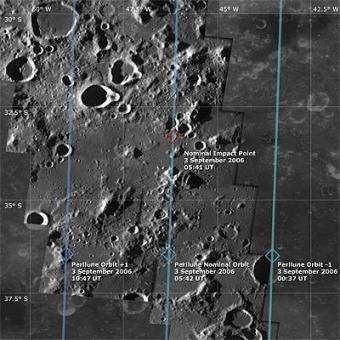
This mosaic of images, obtained by the Advanced Moon Imaging Experiment (AMIE) on board ESA's SMART-1 spacecraft, shows the SMART-1 landing site on the Moon.

AMIE obtained this sequence on 19 August 2006 from the relatively high distance of 1200 kilometres from the surface (far from the SMART-1 perilune, or point of closer approach), with a ground resolution of about 120 metres per pixel. The imaged area, located at mid-southern latitudes on the lunar near-side, belongs to the so-called 'Lake of Excellence'.

To take these images, SMART-1 had to be tilted by 20 degrees in order to obtain a large ground coverage and an image mosaic of several views, each covering an area about 60 kilometres per side.

SMART-1 will be flying from North to South, and it will impact the surface 46 seconds, or about 90 kilometres, before reaching its nominal perilune (situated South of the impact location). This is due to the last orbit and the topography of the impact area. According to calculations based on the available maps and topography, impact would take place at a descending angle of one degree on a relatively flat surface.

SMART-1's impact is currently expected on 3 September 2006 at 07:41 CEST (05:41:51 UT), in the point located at 46.2є West longitude and 33.3є South latitude.

At 02:37 CEST (00:37 UT), one orbit earlier, the spacecraft should be just flying at its perilune. By that time, it will be over crater Clausius (25 kilometres diameter and 2.5 kilometres depth), at about 800 metres above the Lake of Excellence volcanic plain. As observed from these SMART-1 images, the rim of crater Clausius (bottom right of the image) is quite low and eroded, and should possibly be below SMART-1 last perilune.

"If SMART-1 passes safely the rim of crater Clausius, the probe will go for its last lunar orbital tour until its foretold death," said Bernard Foing, ESA SMART-1 Project Scientist.

Source: ESA


print this article email this article download pdf blog this article bookmark this article     Stumble it Digg this share on Facebook retweet share on Reddit add to delicious
Rate this story - 3.5 /5 (6 votes)


August 31, 2006 all stories

Comments: 0

3.5 /5 (6 votes)
  • Stumble this up

  • Digg this

  • share this


  • hide
  • Relevant PhysicsForums posts

  • Consistency of Meteor Shower Dates (i.e. the peak of Perseids always on Aug 13th)
    created 16 hours ago
  • Favourite Astronomy Book?
    created Nov 10, 2009
  • dark energy
    created Nov 10, 2009
  • The shape of our solar system's orbits.
    created Nov 07, 2009
  • More from Physics Forums - General Astronomy

Other News

A bubbling ball of gas

A bubbling ball of gas (w/ Video)

Space & Earth / Space Exploration

created 32 minutes ago | popularity not rated yet | comments 0

The Sun is a bubbling mass. Packages of gas rise and sink, lending the sun its grainy surface structure, its granulation. Dark spots appear and disappear, clouds of matter dart up - and behind the whole thing ...


NOAA deploys new 'smart buoy' off Annapolis

Space & Earth / Environment

created 2 hours ago | popularity 5 / 5 (1) | comments 0

NOAA deployed the seventh in a series of "smart buoys" to monitor weather conditions and water quality in the Chesapeake Bay today. The buoy, located at the mouth of Severn River near Annapolis, Md., will be used by commercial ...


Rapid star formation spotted in 'stellar nurseries' of infant galaxies

Rapid star formation spotted in 'stellar nurseries' of infant galaxies

Space & Earth / Astronomy

created 7 hours ago | popularity 5 / 5 (1) | comments 0

The Universe's infant galaxies enjoyed rapid growth spurts forming stars like our sun at a rate of up to 50 stars a year, according to scientists at Durham University.


Reducing greenhouse gases may not be enough to slow climate change

Space & Earth / Environment

created 6 hours ago | popularity 3 / 5 (2) | comments 3

Georgia Tech City and Regional Planning Professor Brian Stone publishes a paper in the December edition of Environmental Science and Technology that suggests policymakers need to address the influence of global deforestation ...


The Stars My Destination

The Stars My Destination

Space & Earth / Space Exploration

created 20 hours ago | popularity 4.9 / 5 (20) | comments 0

The Voyager spacecraft are now in the outermost layer of the heliosphere, traveling toward interstellar space - the first man-made spacecraft to travel such a vast distance from Earth.