August 31, 2006 feature
Snakes’ heat vision enables accurate attacks on prey
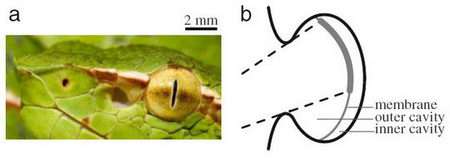
Call it a sixth sense, or evolution’s gift to these cold-blooded reptiles: some snakes have infrared vision. Also called “heat vision,” the infrared rays, which have longer wavelengths than those of visible light, signify the presence of warm-blooded prey in 3 dimensions, which helps snakes aim their attacks. Pit vipers and boids, the two snake types that possess this ability, have heat-sensitive membranes that can detect the difference in temperature between a moving prey—such as a running mouse—and its surroundings on the scale of milliKelvins.
The detection system, which consists of cavities located on each side of the head called “pit organs,” operates on a principle similar to that of a pinhole camera, explain scientists Andreas Sichert, Paul Friedel and J. Leo van Hemmen in a recent issue of Physical Review Letters. A pinhole camera is a camera without a lens, where light from an image passes through a very small hole. Similarly, a pit organ’s aperture is about 1 mm—large enough to allow the snake to quickly detect moving prey. Some scientists (de Cock Buning) even suggest that pythons—a type of boid—have a variety of differently shaped pit organs, each serving a different biological function.
“The information of the infrared and the visual system are both represented in the optic tectum,” Sichert told PhysOrg.com. “This information forms a neuronal map, where, for example, the front part of the optic tectum represents the part of visual space in front of the snake. How exactly the two systems merge is as yet unknown. In the optic tectum, six classes of tectal cells have been identified that respond to infrared and visual stimuli in different ways. So a snake can get additional information such as ‘is a moving visible object warm (e.g., a warm-blooded animal) or cold?’ In case of bad optical conditions (most prominent example is darkness), it can of course ‘see’ warm (or cold) objects.”

The scientists explained that typical prey, such as mice and rabbits, have a surface temperature of about 25 degrees C and emit body heat at wavelengths under 75 micrometers, in the infrared range.
“If the radiation intensity hitting the membrane at some point is larger than the emitted thermal radiation of the membrane itself, the membrane heats up at that location,” the scientists reported in their study.
In pit vipers, which have only two pit holes (one in front of each eye), a block of about 1,600 sensory cells lie on a membrane which has a field of view of about 100 degrees. This means the snake’s brain would receive an image resolution of about 2.5 degrees for pointlike objects, such as eyes, which are one of the hottest points on mammals.
However, pit organs work a little differently than pinhole cameras in that incoming radiation does not strike a single point on the membrane. Because the pit hole is very large compared to the membrane size, the radiation strikes many points. When detecting pointlike and even non-pointlike objects, it’s nearly impossible to tell the location of the heat source. Until now, scientists did not know how snakes could use this heat vision to make accurate attacks on their prey.
Sichert, Friedel and van Hemmen confronted this paradox—that the optical quality of the infrared vision is much too blurry to allow snakes to strike prey with the observed accuracy of about 5 degrees. In order to develop an algorithm to explain the paradox, the scientists decided to work backward: by using solely the heat distribution on the pit organ membrane, they reconstructed the original 3D spatial heat distribution (e.g. rabbit shape, as shown in the figure). Because they used very simple computations similar to those of snakes, the group generated an image similar to what the snake “sees” with its neuronal map via its network of synapses.
By including several variables, including background noise, the snakes’ measurement errors, and correlation of the input signals, the scientists then developed a neuronal algorithm that accurately reconstructed the heat image from the membrane. Whereas the group found that snakes have a fairly high input-noise tolerance, they found that one of the most vital requirements is accurate detectors and the ability to detect edges in the images produced on the pit membrane.
“A heat distribution in 3-dimensional space causes a heat image on the pit membrane that, by the very nature of the big pit hole, is heavily blurred,” said Sichert. “A superposition of edge detectors in the brain can now reconstruct the heat distribution by using the whole image on the membrane for each point in space to be reconstructed. So reconstruction is possible because the information is still available in the blurred image on the pit membrane, where the receptors are.”
In fact, Sichert added that snakes’ heat vision presents such a clear image when reconstructed that it surpasses even many human devices. “The infrared system of snakes is still as good as—and, in fact, far better than—any technical uncooled infrared camera with a similar number of detector cells,” he said.
Citation: Sichert, Andreas B., Friedel, Paul and van Hemmen, J. Leo. “Snake’s Perspective on Heat: Reconstruction of Input Using an Imperfect Detection System.” Physical Review Letters. 97, 068105 (2006).
By Lisa Zyga, Copyright 2006 PhysOrg.com


