Hubble Captures a Rare Eclipse on Uranus
August 31, 2006 Hubble Captures a Rare Eclipse on Uranus

Credit: NASA, ESA, L. Sromovsky (University of Wisconsin, Madison), H. Hammel (Space Science Institute), and K. Rages (SETI Institute)

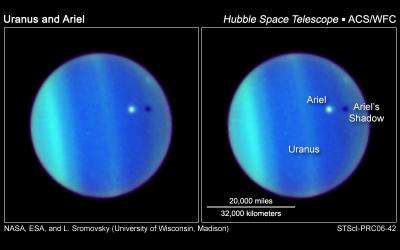
This image is a never-before-seen astronomical alignment of a moon traversing the face of Uranus, and its accompanying shadow. The white dot near the center of Uranus’ blue-green disk is the icy moon Ariel. The 700-mile-diameter satellite is casting a shadow onto the cloud tops of Uranus. To an observer on Uranus, this would appear as a solar eclipse, where the moon briefly blocks out the Sun as its shadow races across Uranus’s cloud tops.

Though such "transits" by moons across the disks of their parents are commonplace for some other gas giant planets, such as Jupiter, the satellites of Uranus orbit the planet in such a way that they rarely cast shadows on the planet's surface. Uranus is tilted so that its spin axis lies nearly in its orbital plane. The planet is essentially tipped over on its side. During the course of its orbit around the Sun, first one pole and then the other is alternately illuminated. As a result, Uranus has extreme seasons during its 84-year orbit around the Sun. The moons of Uranus orbit the planet above the equator, so their paths align edge-on to the Sun only every 42 years.

This transit has never been observed before because Uranus is just now approaching its 2007 equinox when the Sun will shine directly over the giant planet’s equator. The last time a Uranian equinox occurred, when transits could have been observed, was in 1965. However, telescopes of that era did not have the image sharpness required to view satellite transits on Uranus. When Hubble was launched in 1990, the Sun was shining over Uranus’s far northern latitudes. Over the past decade Hubble astronomers have seen the Sun’s direct illumination creep toward equatorial latitudes and the moons' orbits approach an edge-on configuration.

Ariel, named for a mischievous airy spirit in Shakespeare's “The Tempest,” is only one-third the size of Earth's moon. Ariel is the nearest large satellite to Uranus. As Uranus approaches equinox, there will be additional eclipses by the large moons Umbriel, Titania, and Oberon, and by many smaller moons.

Lawrence A. Sromovsky of the University of Wisconsin-Madison, Heidi B. Hammel of the Space Science Institute, Boulder, Colorado, and Kathy A. Rages of the SETI Institute, Mountain View, California, created this color composite image from images at three wavelengths in near infrared light obtained with Hubble’s Advanced Camera for Surveys on July 26, 2006.

Source: Space Telescope Science Institute


print this article email this article download pdf blog this article bookmark this article     Stumble it Digg this share on Facebook retweet share on Reddit add to delicious
Rate this story - 4.5 /5 (38 votes)


August 31, 2006 all stories

Comments: 0

4.5 /5 (38 votes)
  • Stumble this up

  • Digg this

  • share this

  • hide
  • Related Stories

  • The Stars My Destination
    created Nov 10, 2009 | popularity not rated yet | comments 0
  • Fantastic Voyage
    created Nov 02, 2009 | popularity not rated yet | comments 0
  • Scientists Explore Galactic Frontier, Release First-Ever All-Sky Map (w/ Video)
    created Oct 15, 2009 | popularity not rated yet | comments 0
  • Saturn to Pull Celestial Houdini on August 11
    created Aug 10, 2009 | popularity not rated yet | comments 0
  • Primitive asteroids in the main asteroid belt may have formed far from the sun (w/ Video)
    created Jul 15, 2009 | popularity not rated yet | comments 0


  • hide
  • Relevant PhysicsForums posts

  • Help with Images and Optical Instrument Question..
    created 9 hours ago
  • Redshift as a distance indicator
    created 16 hours ago
  • Question about 2-body gravity
    created Nov 24, 2009
  • life on Mars
    created Nov 24, 2009
  • More from Physics Forums - General Astronomy

Other News

Past regional cold and warm periods linked to natural climate drivers

Space & Earth / Earth Sciences

created 14 hours ago | popularity 3.7 / 5 (10) | comments 15

Intervals of regional warmth and cold in the past are linked to the El Niño phenomenon and the so-called "North Atlantic Oscillation" in the Northern hemisphere's jet stream, according to a team of climate scientists. These ...


Russia: no space for space tourists (AP)

Russia: no space for space tourists

Space & Earth / Space Exploration

created 21 hours ago | popularity 2.7 / 5 (3) | comments 2

(AP) -- A top Russian space official says there is no space for tourists wishing to fly to the International Space Station.


Astronauts surprised by holiday turkey dinners (AP)

Astronauts surprised by holiday turkey dinners

Space & Earth / Space Exploration

created 17 hours ago | popularity 5 / 5 (1) | comments 0

(AP) -- Space shuttle Atlantis' astronauts thought they were going to give thanks with pantry leftovers Thursday as their mission drew to a close, but found turkey dinners awaiting them.


Gullies and Flow Features on Crater Wall

Gullies and Flow Features on Crater Wall

Space & Earth / Space Exploration

created 17 hours ago | popularity 5 / 5 (1) | comments 0

(PhysOrg.com) -- This image from the High Resolution Imaging Science Experiment (HiRISE) camera on NASA's Mars Reconnaissance Orbiter shows a sample of the variety and complexity of processes that may occur ...


Thanksgiving last full day in space for shuttle (AP)

Thanksgiving last full day in space for shuttle

Space & Earth / Space Exploration

created 21 hours ago | popularity not rated yet | comments 0

(AP) -- Space shuttle Atlantis' astronauts will spend Thanksgiving checking their ship for the ride home.