SMART-1 impacts Moon (Update 2)
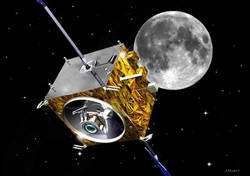
At 07:42:22 CEST (05:42:22 UT) today, the SMART-1 spacecraft impacted the Moon's surface as planned, ending ESA's first solar-powered mission to another celestial body and Europe's first mission to the Moon. ESA estimates that impact occurred at 46.2º West, 34.4º South.
One of the most innovative missions in space exploration came to a dramatic close on Sunday as Europe's first probe to the Moon crashed into the lunar surface giving stargazers around the world an astronomical fireworks display.
The European Space Agency's (ESA) revolutionary probe known as SMART-1 smashed into a plain called the Lake of Excellence on the southwestern side of the Moon's face, "producing a more intense flash than expected", the mission's chief scientist Bernard Foing said from ESA's base in Darmstadt, Germany.
The craft's suicide ride was watched live via a French-Canadian telescope based in Hawaii as it plunged to the surface on schedule at 0542 GMT at a speed of two kilometres per second (7,200 kmph), throwing up a cloud of dust.
Approaching with "a very shallow trajectory", SMART-1 "bounced on the surface, creating a kind of fireworks display that was brighter than if it had plunged straight down onto the lunar surface," Foing said.
ESA estimated that the impact would leave a crater measuring three to 10 metres in diameter and one metre deep.
The agency's spokesman Bernard Von Weyhe described the probe's demise as "pretty spectacular" and said that significant amounts of material had spewed out on impact, allowing scientists to carry out further tests on the crash site.
Over the past three years, operating with a full-time staff of just seven and a total budget of just 120 million euros (151 million dollars), the little probe has been patiently testing new technology that one day could help put Man on Mars.
Scientists also say that the 20,000 extremely detailed photos transmitted by the craft will yield a fresh look at the Moon, revealing Earth's satellite as a place of surprising complexity and promise rather than a lifeless rock with little to offer except grey dust.
"SMART-1 is the vanguard" of future space missions, said the craft's operations manager, Octavio Camino-Ramos. "Almost everything on board was innovative. It was a mission to test technology, the science was an extra plus."
A revolutionary ion thruster engine has propelled the cube, which measured just one metre across and weighed in at a paltry 350 kilos (770 pounds), since it was launched in September 2003.
The engine type has only been used once before -- with the US craft Deep Space 1, launched in 1998 to rendezvous with an asteroid and then a comet.
Ion engines are fuelled by xenon gas. The gas atoms are charged by electric guns powered by solar panels and are then expelled from the rear of the spacecraft, delivering a tiny thrust, visible as a ghostly blue glow.
Compared with the blast, roar and smoke of chemical rockets, ion engines seem almost laughably puny.
But chemical engines burn out after a couple of minutes, whereas an ion engine can push on gently for months or even years, for so long as the Sun shines and the small supply of propellant lasts.
SMART-1 travelled 100 million kilometres but used up just 80 kilos (50 litres) of fuel, a extraordinary feat in space exploration standards.
But unlike the Deep Space mission's essentially straight-line trajectories, SMART-1 had to carry out a complex series of manoeuvres to slowly but relentlessly build up speed.
It had to loop again and again around the Earth to gain extra speed yet also juggle with the Moon's gravitational tug, all the time using a tiny engine that delivered the same power as someone picking up an A4-sized sheet of paper.
Camino said the experience was "an adventure," and compared it to navigating a small sailboat buffeted by swirling winds and currents. But the tiny thruster performed splendidly, even though it needed 14 months for a trip that took Apollo only three days.
"We have shown that ion propulsion works," Camino said, predicting that this will be the thruster of choice for two ESA missions in the next decade -- BepiColombo, to explore Mercury, and Solar Orbiter, which will swoop close to the Sun.
And it is also likely to be the propulsion for hauling big cargo containers to the Moon to help build the first lunar settlement, or to Mars, to support the first manned mission there, he said.
Other SMART-1 innovations are a new communications system, new-generation solar panels and a package of sensors and scanners that Foing hailed as "a miracle of miniaturisation -- seven instruments weighing just 19 kilos" (41.8 pounds).
Weighing as little as a tenth of conventional instruments being carried aboard space probes, SMART's X-ray telescope and infrared spectrometer have been carrying out the most detailed map of the Moon's elements and minerals, said Foing.
SMART-1 has also sought out locations at the lunar poles that are in permanent shade and could be worth exploring if, as some scientists hope, water exists on the Moon or just below its surface.
© 2006 AFP


