MRI On the Cheap and On the Go
When we hear the term “MRI,” most of us probably think of a special treatment room in a hospital with a huge doughnut-shaped machine that costs a lot of money and makes a lot of noise. Researchers with the U.S. Department of Energy’s Lawrence Berkeley National Laboratory are looking to change that perception with the successful testing of a laser-based MRI technique that would make the technology compact and portable, relatively cheap, and quiet.
“We have developed a novel approach for the detection of MRI based on optical atomic magnetometry,” said chemist Alexander Pines, one of the world’s leading authorities on NMR/MRI technology. Pines holds a joint appointment as a chemist with Berkeley Lab’s Materials Sciences Division and with UC Berkeley, where he is the Glenn T. Seaborg Professor of Chemistry. “Our technique provides a viable alternative for MRI detection with substantially enhanced sensitivity and time resolution for various situations where traditional MRI is not optimal.”
Pines led the development of this new MRI technique along with Dmitry Budker, who holds a joint appointment with Berkeley Lab’s Nuclear Science Division and UC Berkeley’s Physics Department. Shoujun Xu, a member of Pines’ research group, conducted the MRI measurements. The three were co-authors of a paper about this technique which appeared in the Aug 22 edition of the Proceedings of the National Academy of Science (PNAS). Other authors of the PNAS paper were Valeriy Yashchuk, Marcus Donaldson and Simon Rochester.
MRI, which stands for magnetic resonance imaging, and its sister technology, nuclear magnetic resonance (NMR) spectroscopy, are based on a property of atomic nuclei with an unpaired proton or neutron called “spin.” Such nuclei spin on an axis like miniature tops, giving rise to a magnetic moment, which means the nuclei act as if they were bar magnets with a north and south pole. When exposed to an external magnetic field, these spinning "bar magnets" attempt to align their axes along the lines of magnetic force. Since the alignment is not exact, the result is a wobbling rotation, or “precession,” that’s unique to each type of atom.
If, while exposed to the magnetic field, the precessing nuclei are also hit with a radiofrequency (rf) pulse, they will absorb and re-emit energy at specific frequencies according to their rate of precession. When the rf pulse is combined with magnetic field gradients, a spatially encoded signal is produced that can be detected and translated into images.
Obtaining a spatially encoded MRI signal from a sample depends upon polarizing the spins of its precessing nuclei so that an excess points in one direction, either “up” or “down.” Conventional MRI technology uses an exceptionally strong external magnetic field to produce a detectable signal. The stronger the magnetic field, the stronger the signal, which means a large and expensive cryogenic high-field magnet.
A smaller magnet results in less polarization and a weaker MRI signal, which therefore requires a more sensitive means of signal detection. One alternative being explored is the use of SQUIDs (superconducting quantum interference devices), which can detect the faintest of magnetic signals but must be cooled to a temperature of near absolute zero. This requirement makes SQUIDs expensive and somewhat tricky devices to use. It also limits the situations in which they can be effectively deployed.
The alternative MRI technology being developed by Pines, Xu, Budker and their colleagues is also highly sensitive to low-field magnetic signals but offers the enormous advantage of being operable at room temperatures.
Said Xu, “Our technique has comparable sensitivity with SQUIDs, but the fact that it does not require superconducting magnets or cryogenics significantly reduces the cost and maintenance of the apparatus, and opens the technology up to a broader range of applications. Furthermore, our technique has simple electronics that can be easily integrated into detector arrays.”
This new laser-based approach to MRI is derived from two technological advances. One, developed by the Pines’ research group, physically separates the two basic steps of MRI, signal encoding and detection. Physically separating these two steps enables each to be optimized for sensitivity. The other advance, developed by the Budker research group, is a highly sensitive atomic magnetometer that’s based on a phenomenon called “nonlinear magneto-optical rotation.” With this magnetometer, a sample of alkali atoms featuring a single unpaired electron is vaporized in a glass cell. The unpaired electron makes the atoms themselves act like spinning bar magnets, with a magnetic moment three orders of magnitude stronger than that of precessing nuclei.
A beam of laser light “pumps” the atoms so that their spins are polarized, then “probes” the polarized atoms for an MRI signal.
According to Budker, instead of the multimillion dollar costs of a conventional MRI system, this alternative MRI technology would cost only a few thousand dollars to implement.
“Our system is fundamentally simple and does not involve any single expensive component,” Budker said. “We anticipate that the whole apparatus will become quite compact and deployable as a battery-powered portable device.”
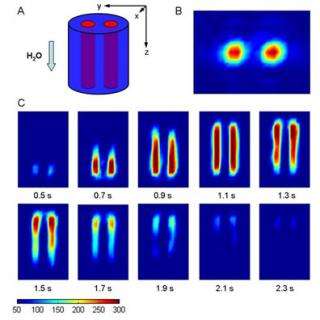
In the MRI system that the Berkeley researchers tested, the fluid to be imaged, water, was passed through two small cells for signal encoding, then transported to a U-shaped detection area for interrogation by a pair of Budker’s magnetometers. The magnetometers were oriented so that they detected the MRI signal with opposite signs. This configuration dramatically improved the signal-to-noise ratio, enabling the researchers to detect an MRI signal from microliters of water in 0.1 second without the presence of a strong magnet.
“We are continuing to optimize our system, in both sensitivity and detection efficiency, to make this technique suitable for microfluidics and biological objects with sizes in the micrometer regime,” said Xu. “In addition, further consolidation of the apparatus is underway so that the whole setup becomes portable and therefore can be conveniently utilized as an in-line analytical instrument for monitoring chemical reactions and biological processes.”
Source: Berkeley Lab


